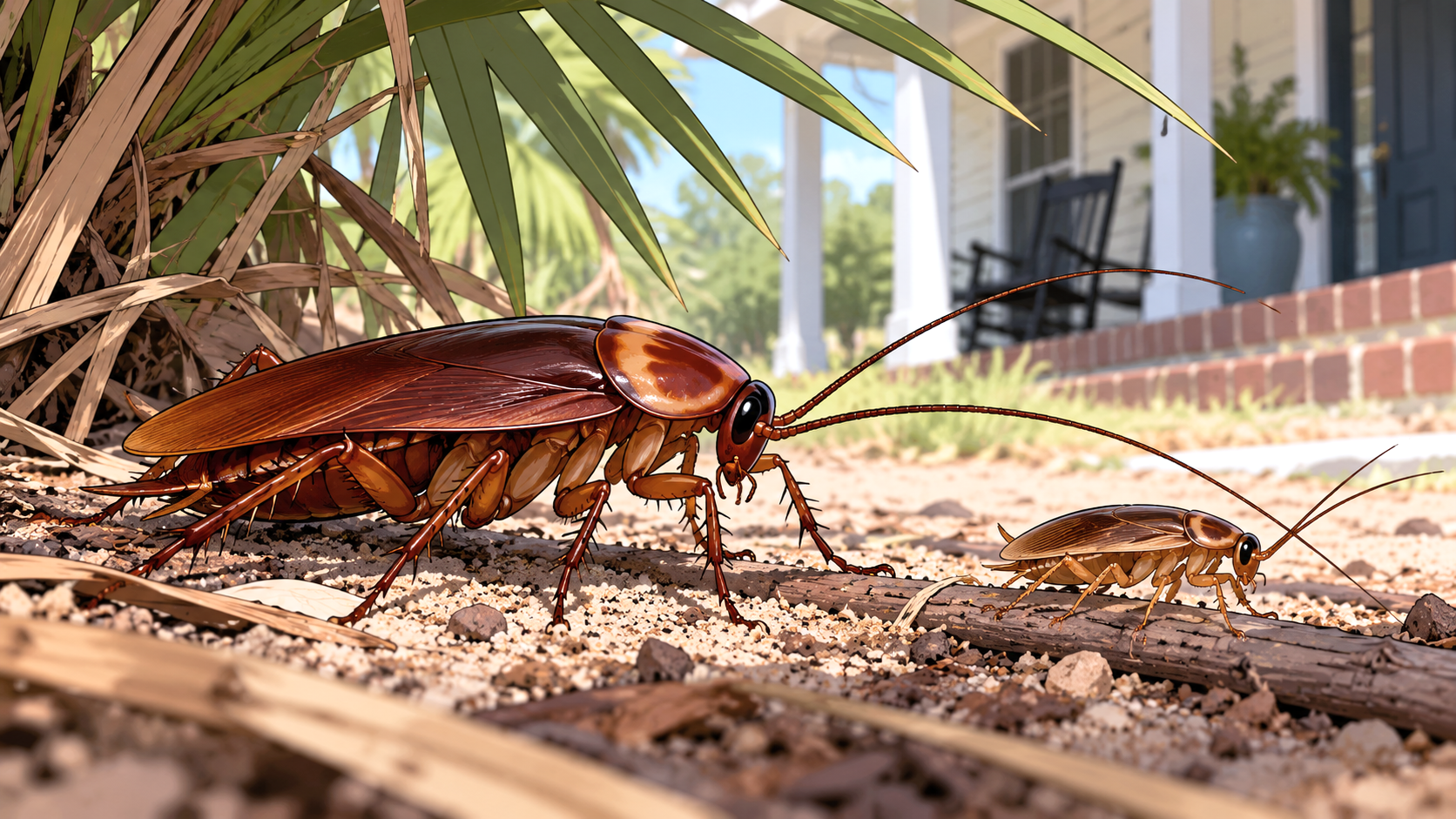
A palmetto bug is a cockroach, but “palmetto bug” is not the name of one universally defined cockroach species. In the southeastern United States, the nickname is applied to several large roaches. The Florida woods cockroach has a particularly strong claim to the name, while American and smokybrown cockroaches are also routinely called palmetto bugs.
So asking whether you found a cockroach or a palmetto bug does not produce two mutually exclusive choices. The useful question is which cockroach species someone means when they use the nickname.
Palmetto Bug Is a Regional Name, Not a Taxonomic Group
There is no separate insect category that places palmetto bugs alongside cockroaches. Cockroaches are insects in the order Blattodea, while “palmetto bug” is an informal common name. The Florida Museum describes it as a regional Southern term applied to cockroaches and similar-looking insects, and usage changes between locations and speakers.
That flexibility makes the name poor for precise identification. Someone in Florida may use it for a Florida woods cockroach, while another person may use exactly the same term for an American or smokybrown cockroach. The underlying animals can differ in appearance, flight ability, preferred habitat, and likelihood of establishing indoors. Scientific and established common names are more useful when comparing different types of cockroaches because they identify an actual species rather than a regional label.
The situation resembles “water bug,” another nickname frequently attached to large cockroaches despite also referring to genuinely aquatic insects. The meaning of water bug versus cockroach therefore depends heavily on how the speaker is using the name.
The Florida Woods Cockroach Has a Strong Connection to the Name
The Florida woods cockroach (Eurycotis floridana) is explicitly known as a palmetto bug. It occurs in the southeastern United States and occupies outdoor habitats such as tree cavities, beneath bark, woodpiles, leaf litter, and areas around palmettos. The University of Florida identifies “palmetto bug” as one of its established common names.
Adults are large, roughly 30 to 40 mm long, with a broad reddish-brown to nearly black body. They do not have functional flight wings. Rather than the long wings associated with several other large cockroaches, adults have short leathery wing pads and lack hind wings. They are also relatively slow-moving compared with many familiar household roaches.
Their outdoor ecology is important when one turns up inside. Florida woods cockroaches may enter structures or arrive with material such as firewood, but they are not considered common indoor colonizers. An isolated individual therefore should not automatically be interpreted like an established indoor population. The significance of finding one cockroach in a house depends partly on which species it is and whether additional evidence is present.
American Cockroaches Are Also Called Palmetto Bugs
The American cockroach (Periplaneta americana) is another major source of the nickname. Rutgers identifies the American cockroach as a species also referred to as a palmetto bug, and Texas A&M likewise lists palmetto bug and waterbug among its common names. Adults are large, reddish brown, and typically have a pale yellowish margin around the pronotum.
Unlike the Florida woods cockroach, adult American cockroaches possess well-developed wings. They commonly occupy warm, moist environments, including sewers, basements, utility spaces, commercial structures, and other protected areas. Their biology is different enough that identifying the actual species can change where you inspect for a source.
Calling one a palmetto bug does not alter any of those characteristics. It remains an American cockroach, P. americana. When identification depends on the specimen rather than its nickname, cockroach shape, coloration, markings, and wings provide more information.
Smokybrown Cockroaches Often Inherit the Same Nickname
The smokybrown cockroach (Periplaneta fuliginosa) is another large species frequently called a palmetto bug in the Southeast. University of Georgia entomologists describe the term as a catch-all name applied particularly to smokybrown and other large cockroaches.
Smokybrown adults are dark mahogany to nearly uniform brown, with long wings extending beyond the abdomen. They are strongly associated with warm, humid outdoor environments and can occupy tree holes, woodpiles, landscaping, gutters, and similar protected places. Adults can fly. Those traits make them quite different from the broad, wingless Florida woods cockroach even though both animals may be called palmetto bugs.
The nickname consequently cannot tell you whether the insect can fly, where it normally lives, or whether an indoor sighting represents an established population. Those conclusions require an actual identification.
Even Oriental Cockroaches Sometimes Get Included
Usage can expand further. University of Georgia notes that “palmetto bug” may also be applied to the Oriental cockroach (Blatta orientalis). This species is dark brown to nearly black and favors cool, damp environments. It lacks the appearance of a typical winged smokybrown cockroach, yet regional language can still place both under the same informal name.
At that point, treating “palmetto bug” as an identification becomes especially unhelpful. A large dark insect may also be confused with an unrelated household arthropod, and cockroach lookalikes cannot be ruled out merely because someone locally calls the specimen a palmetto bug.
The Name Does Not Tell You Whether Your House Is Infested
Hearing “palmetto bug” can make a large outdoor cockroach sound like a different and perhaps less consequential animal than a “roach.” Biologically, the softer nickname changes nothing. If the insect is an American, smokybrown, Florida woods, or Oriental cockroach, it remains a cockroach regardless of what people in the area call it.
What the sighting means depends on species, location, frequency, and supporting evidence. A Florida woods cockroach accidentally carried indoors with firewood is a different situation from cockroaches repeatedly emerging from protected areas inside a building. Droppings, egg cases, shed material, repeated sightings, and other signs associated with cockroach infestations provide evidence that a nickname cannot.
If you find a large roach indoors, photograph it before disposing of it and note exactly where it appeared. Compare identifiable features rather than deciding that “palmetto bug” itself explains the sighting. Correct pest identification is a basic part of integrated pest management because management should match the organism and the conditions supporting it.
Questions About the Palmetto Bug Name
Why are cockroaches called palmetto bugs?
The name has strong regional associations with the southeastern United States, where large outdoor cockroaches occur around vegetation that includes palmettos. The Florida woods cockroach is especially associated with the term, although common usage has expanded it to other large roaches.
Is “palmetto bug” just a nicer word for cockroach?
Sometimes it effectively functions that way in casual conversation. The term can sound less unpleasant than “cockroach,” but it also has genuine regional history. Either way, it does not create a separate biological category.
Are German cockroaches normally called palmetto bugs?
Not typically. The nickname is much more strongly associated with larger species such as Florida woods, American, and smokybrown cockroaches. German cockroaches are small indoor pests, so calling one a palmetto bug would make an already ambiguous term even less informative.
Can you identify a cockroach from the name a local person uses for it?
Not reliably. Common names overlap considerably. A photograph showing body shape, markings, wings, and size gives far stronger evidence, while the basic definition of a cockroach remains the same regardless of regional terminology.