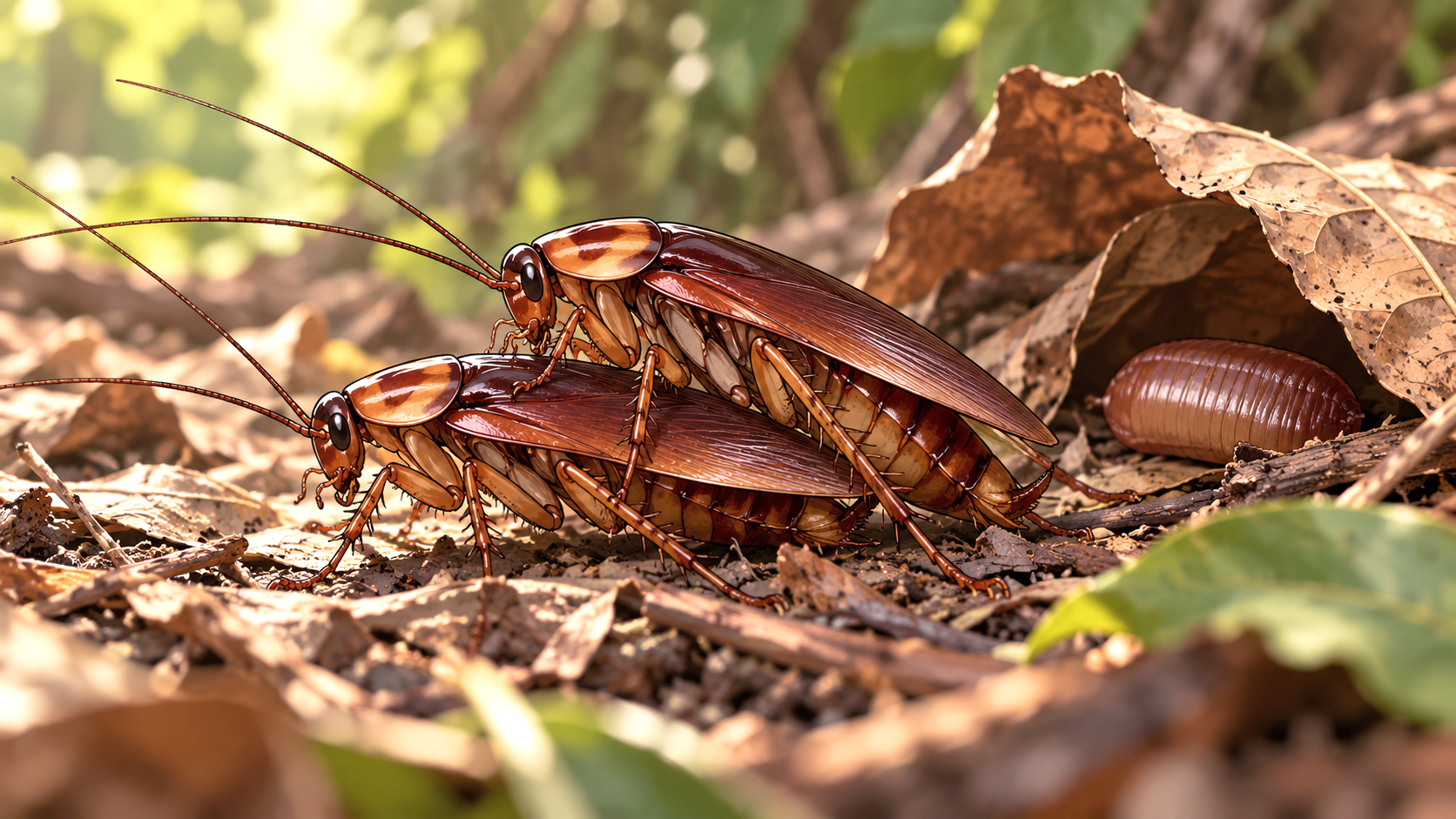
Cockroach reproduction is more varied than simply a male and female mating before eggs are laid. Sexual reproduction is standard among familiar household species, but females of some cockroaches can store sperm after mating, and a few species are capable of producing offspring without mating at all. What happens to the embryos also differs, with most pest cockroaches producing an external egg case while some less familiar species retain developing young internally.
Most cockroaches reproduce sexually. A male transfers sperm to a female during mating, and the female later uses stored sperm to fertilize eggs as they develop. The eggs are commonly packaged into a protective case called an ootheca. Some cockroach species can also reproduce through parthenogenesis without fertilization by a male.
Mating Begins With Chemical and Behavioral Signals
Cockroaches do not all use identical courtship behavior. Chemical communication plays an important role, and pheromones can help males locate or recognize receptive females. Once a potential mate is encountered, courtship may involve antennal contact, changes in body position, wing raising, and species-specific movements before copulation. The long cockroach antennae and their sensory structures are therefore involved in more than navigating dark spaces.
German cockroaches provide a particularly well-studied example. A courting male raises his wings and exposes abdominal glands that produce a secretion the female feeds on. Her position while feeding allows the male to connect their genitalia and begin copulation. Research into this behavior has shown that male courtship feeding is closely involved in successful mating. The details are not interchangeable across the thousands of cockroach species, so German cockroach courtship should not be treated as a universal script for the entire group.
Sperm Can Remain Available After Mating
During copulation, sperm is transferred to the female in association with a spermatophore. Female cockroaches possess sperm-storage organs called spermathecae, allowing sperm from an earlier mating to remain available when eggs are subsequently fertilized. Stored sperm means successful reproduction does not necessarily require a new mating immediately before every batch of eggs.
The biology can become more complicated when a female mates more than once. Work on the viviparous cockroach Diploptera punctata found sperm from different males mixing within the female’s reproductive tract, with later mating affecting paternity in subsequent offspring. Such findings show why the reproductive history of an individual female can extend beyond the most recent male she encountered.
Fertilized Eggs Are Usually Packaged Together
As mature eggs move through the female reproductive system, most familiar cockroaches package them into an ootheca rather than depositing separate exposed eggs. Secretions form the protective case around a group of eggs, producing the capsule associated with cockroach reproduction. The size, color, shape, and surface details of cockroach oothecae vary among species and are identification features rather than a single standard appearance.
Species also differ in what the female does after producing the case. German cockroaches retain the ootheca protruding from the abdomen through most of embryonic development, whereas females of many other household species deposit their cases considerably earlier. A public-health identification manual notes that most common domestic species drop or attach the completed ootheca while German cockroaches continue carrying it. Brown-banded females, for example, attach their cases to protected surfaces, while American cockroaches deposit theirs in sheltered locations. These reproductive differences are one reason different cockroach species can leave very different evidence inside a building.
One Mating Can Contribute to More Than One Reproductive Event
Sperm storage allows some female cockroaches to produce successive fertilized oothecae without mating immediately before each one. The number of viable offspring ultimately produced depends on species, female condition, mating history, nutrition, temperature, and other circumstances rather than on a fixed cockroach-wide reproductive rate.
Resource availability can influence reproduction before an ootheca is even produced. Studies of brown-banded cockroaches have found that nutrition affects reproductive performance, while research on German cockroaches has documented substantial physiological investment in growing ovarian oocytes before ootheca formation. Oocyte development accelerates during the days preceding oviposition, making reproduction an energetically demanding process rather than an automatic consequence of reaching adulthood.
Some Cockroaches Can Reproduce Without Males
Parthenogenesis allows an unfertilized egg to develop into an offspring. It occurs in some cockroaches, although its importance differs sharply among species and should not be generalized to every household roach. American cockroaches are capable of facultative parthenogenesis, meaning females can reproduce sexually when males are available but can also produce offspring asexually under some circumstances.
Laboratory research found that virgin American cockroach females could produce parthenogenetic oothecae, with groups of females beginning asexual reproduction sooner than isolated females. Another study found that unfertilized American cockroach eggs had lower reproductive success than sexually produced eggs and yielded female offspring. Sexually reproducing females also produced their first ootheca sooner and produced oothecae more frequently.
Oriental cockroaches have also produced offspring without mating under laboratory conditions. In one study, oothecae from unmated females had lower viability than those from mated females, and the resulting offspring were female, findings consistent with parthenogenetic reproduction. A lone female therefore cannot automatically be assumed reproductively irrelevant merely because no male has been observed.
Not Every Cockroach Leaves Its Embryos Outside the Body
The familiar ootheca deposited in a cabinet or crevice represents only one reproductive strategy within cockroaches. Some species retain the ootheca internally while embryos develop. Others go considerably further.
The Pacific beetle cockroach, Diploptera punctata, is viviparous. Developing embryos remain within the female and receive maternal nourishment before live young are born. This reproductive system is unusual enough that D. punctata has become an important research organism for studying viviparity and maternal provisioning in insects. These species-level exceptions demonstrate the reproductive diversity of cockroaches without changing what homeowners normally encounter among German, American, Oriental, and brown-banded cockroaches.
Questions About Cockroach Reproduction
Do cockroaches need a male and female every time eggs are produced?
Not necessarily. Females of some species can use sperm retained from an earlier mating for later reproductive events. Certain species also have some capacity for parthenogenesis, although that ability and its reproductive success vary.
Can two different cockroach species mate with each other?
Closely related species can sometimes show courtship responses to similar chemical signals, but successful reproduction depends on species-specific behavioral, anatomical, and reproductive compatibility. Finding several types of cockroaches in one environment does not mean they form a single interbreeding population.
Do baby cockroaches reproduce?
No. Nymphs are sexually immature. Reproductive capability comes with adulthood after the final nymphal molt, while young cockroaches pass through successive immature stages before reaching that point.
Does seeing a female carrying an ootheca mean the eggs are fertilized?
Not with absolute certainty. Females can sometimes form oothecae that are nonviable, and parthenogenetic species can produce viable offspring without conventional fertilization. An attached case does show that the female has entered an active reproductive phase.
One thought on “How Do Cockroaches Reproduce?”