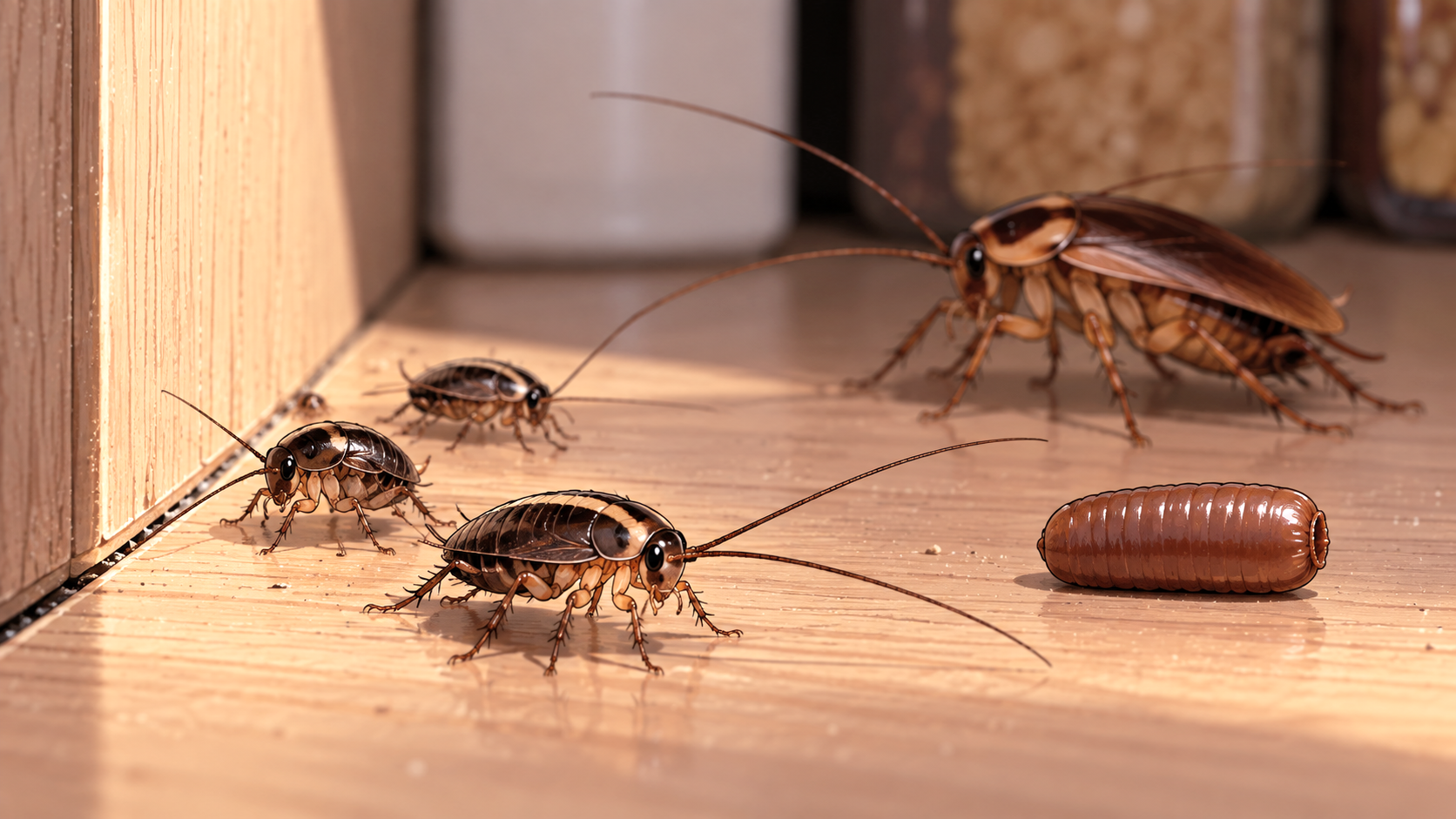
A very small cockroach can look surprisingly unlike the adult you expected to find. It may be darker, have no visible wings, or carry markings that become less obvious as it matures. The useful comparison is not simply “small versus large.” Juvenile cockroaches have a recognizable combination of adult-like body structure and immature features.
Baby cockroaches, called nymphs, look like smaller, wingless versions of adult cockroaches. They have six legs, long antennae, a flattened body, and paired cerci at the rear. Their color and markings vary by species and age, and newly molted nymphs can temporarily appear pale or almost white. Nymphs generally resemble adults but are smaller and lack developed wings.
A Nymph Already Has the Cockroach Body Plan
There is no grub-like or worm-like juvenile cockroach. Even a young nymph has the broad pronotum behind the head, long antennae, six conspicuous legs, segmented abdomen, and paired cerci characteristic of cockroaches. Its flattened cockroach body shape is present long before adulthood, although proportions can change as the insect grows.
The major missing adult feature is fully developed wings. Early nymphs have none, while older nymphs of winged species eventually develop visible wing pads. They still do not possess the complete adult wings produced at the final molt. This makes a wingless specimen less informative than people sometimes assume. A small insect with the long antennae, spiny legs, and rear cerci of a cockroach can be a nymph even when its back is completely uncovered by wings.
German Cockroach Nymphs Have a Noticeable Light Center
Young German cockroaches are dark brown to nearly black, creating a stronger contrast with the tan adults than their shared species might suggest. A pale longitudinal area runs along the middle of the back. As they grow, the familiar adult pattern becomes more apparent, including the two dark longitudinal stripes on the pronotum. A California identification chart describes the German cockroach nymph as having a yellow stripe down the center.
This combination of a dark body and lighter central marking is particularly useful when inspecting kitchens and other indoor harborages where German cockroaches occur. Very small individuals can otherwise be mistaken for unrelated insects, especially when seen moving rather than photographed. Their compact size does not alter the basic six-legged cockroach structure.
Brown-Banded Nymphs Carry Their Pattern Across the Body
Brown-banded cockroach nymphs arrange their contrasting markings in another direction. They have two pale transverse bands across the back, rather than the longitudinal central marking associated with German cockroach nymphs. The bands remain useful because adults of this species also display pale crosswise markings. Brown-banded nymphs are specifically identified by two pale bands across the back.
The species is small even at maturity, so size alone is a poor way to separate an older brown-banded nymph from another small household cockroach. Pattern orientation provides more information. These markings are among the features that make common household cockroach species distinguishable before they reach their final adult form.
American Cockroach Nymphs Change From Pale to Reddish Brown
A newly hatched American cockroach is initially pale to grayish white. It soon darkens, and later nymphal stages become reddish brown. The posterior edges of the thoracic and abdominal segments are darker, which can give older nymphs a visibly banded or striped appearance. American cockroach wing pads first become noticeable around the third or fourth instar.
Those developing pads should not be mistaken for finished wings. An older American cockroach nymph can already be fairly large while remaining immature, whereas the adult eventually develops long wings and a pale margin around the pronotum. Size therefore becomes more useful when combined with the specimen’s markings and stage rather than treated as proof of adulthood.
Oriental Cockroach Nymphs Become Progressively Darker
Oriental cockroaches follow another visual pattern. Newly hatched nymphs are relatively light, but subsequent stages become reddish brown and eventually dark brown to black. Public-health identification material describes young Oriental nymphs as tiny and initially whitish before becoming light brown and progressively darker.
Older nymphs can consequently resemble the dark adults quite closely except for their immature wing development and smaller size. The species’ shiny dark coloration can also make a juvenile look beetle-like during a quick encounter. Structural details are more dependable when deciding between a cockroach and a beetle.
A White Cockroach May Simply Have Molted
Pale coloration deserves special care because it can make an otherwise ordinary nymph look unfamiliar. Immediately after shedding its old exoskeleton, a cockroach has a soft, light-colored new cuticle. The body subsequently hardens and develops its normal pigmentation. American cockroach nymphs, for example, are white immediately after a molt before becoming reddish brown.
A white cockroach is therefore not automatically an unusual white species or an albino. Color needs to be interpreted alongside body structure and the possibility of a recent cockroach molt. A discarded exoskeleton nearby can strengthen that interpretation.
The Smallest Nymphs Cause the Most Identification Mistakes
Early nymphs can be only a few millimeters long, removing the large body size many people associate with cockroaches. Their lack of wings adds another unfamiliar feature. Long antennae, spiny running legs, a flattened segmented body, and paired cerci remain more useful than expecting a miniature copy of a winged adult.
Bed bugs are one frequent source of confusion because both can be small, brownish, and wingless. A bed bug is broader and more compact, with much shorter antennae and no cockroach-like cerci, while a young roach has the leggier profile typical of its group. Those differences become particularly useful when separating cockroach nymphs from bed bugs. Small beetles and other household insects can create similar uncertainty, so a clear photograph from above is preferable to identification based solely on color.
Less Obvious Questions About Cockroach Nymphs
Can nymphs from the same species look different from each other?
Yes. Early and late instars can differ substantially in size, pigmentation, proportions, and wing-pad development. Several visibly different sizes in one location can therefore belong to the same species.
Can you tell whether a cockroach nymph is male or female?
Sometimes, but not reliably from an ordinary household photograph. Sex can be determined in nymphs of some species by examining structures near the end of the abdomen, and research has demonstrated sex-specific features even in early cockroach instars. Those details generally require a much closer examination than routine identification.
Do baby cockroaches stay with their mother?
Most familiar household cockroaches do not provide prolonged maternal care after the young emerge. The nymphs can move and feed independently, although many individuals may occupy the same favorable harborage.
Are shed nymph skins a sign that cockroaches are growing nearby?
They can be. Nymphs leave old exoskeletons behind as they grow, and shed skins are recognized evidence of cockroach activity. A skin by itself may not reveal when the insect was present, but repeated finds alongside live nymphs or other signs deserve closer inspection.