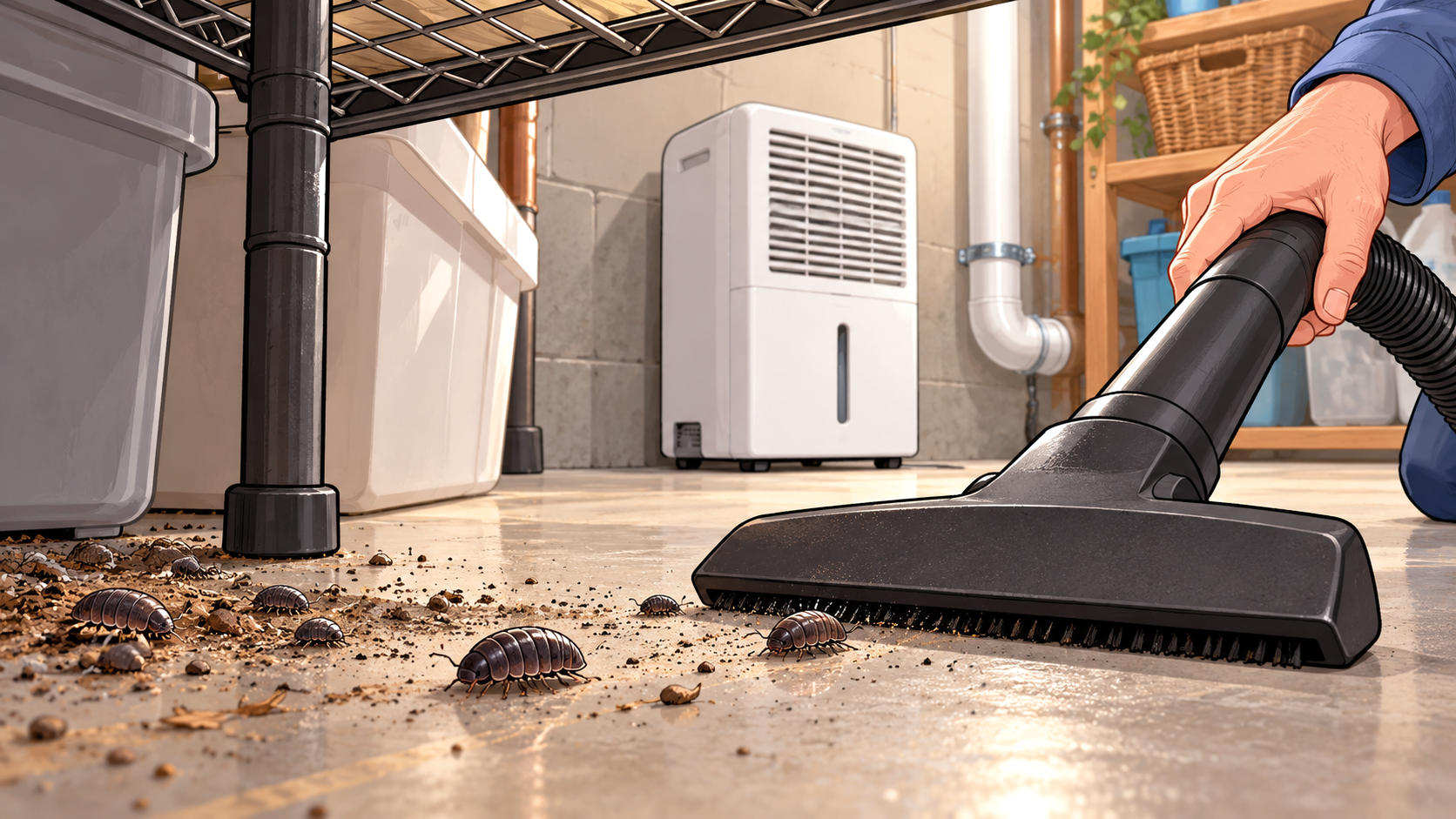
To get rid of roly-polies indoors, vacuum or sweep up the ones already inside, dry damp basements and crawl spaces, and seal the ground-level openings they are using to enter. Indoor pesticides are usually unnecessary because pillbugs cannot persist well in the dry conditions found in most living spaces.
Recurring live roly-polies deserve more attention than an occasional dead one. Their dependence on moisture means repeated indoor survival can reveal a damp area that needs correction, while continuing arrivals after the interior has dried point toward an exterior access route.
Remove the Roly-Polies Already Inside
Individual roly-polies do not require a special treatment. Pick them up, sweep them into a dustpan or vacuum them. For larger numbers, vacuuming is efficient and avoids applying pesticide to floors, baseboards or living areas. Public-health guidance for occasional invading arthropods specifically recommends vacuuming substantial indoor accumulations and promptly disposing of the collected pests.
Removing the visible animals solves only the immediate nuisance. Roly-polies are primarily outdoor crustaceans, and their normal habitat consists of moist sheltered places rather than ordinary dry rooms. New individuals can continue appearing while an entry route remains open. Sticky monitoring traps placed along walls or near suspected entry points can help show where activity is concentrated, but they are more useful for locating continuing movement than eliminating its source.
Dead roly-polies can also be vacuumed or swept away. Finding them repeatedly does not necessarily mean a colony is established inside. Dry indoor conditions commonly kill pillbugs after entry, so why live and dead roly-polies appear in houses can differ even within the same building.
Persistent Live Roly-Polies Make Moisture the First Indoor Condition to Check
A basement containing living pillbugs day after day deserves a moisture inspection. These animals lose water readily, and their survival under dry conditions can fall sharply as humidity decreases. Frequent live sightings can therefore occur where condensation, plumbing leakage, water intrusion, poor ventilation or persistently high humidity creates a more favorable indoor refuge.
Look beyond visible puddles. Moisture can enter through foundation or wall leaks, collect through condensation on cold surfaces, escape from plumbing, or accumulate where ventilation is inadequate. These are recognized sources of indoor moisture accumulation. A damp cardboard box against a basement wall, wet material beneath a utility sink or humid storage area may provide a local refuge even when the rest of the room feels dry.
Correct the source rather than relying only on a dehumidifier to mask continuing water intrusion. Repair plumbing leaks, address seepage and improve ventilation where appropriate. A dehumidifier or fan can help dry a humid basement; Canadian pest-control guidance specifically recommends drying damp basement areas with a dehumidifier or small electric fan. Foundation cracks that admit water, grow over time or indicate a larger structural issue may require professional assessment rather than a simple pest-control response.
Seal the Routes That Connect the House to the Outdoor Population
Once current visitors are removed, inspect the lower exterior of the building. Roly-polies can enter through foundation cracks, gaps around doors and windows, poorly sealed thresholds and other small openings. Because they can climb textured walls and other rough surfaces, entry points do not have to sit directly at soil level.
Weather stripping and properly fitted door sweeps can close gaps around exterior doors. Seal suitable cracks and openings around window frames, utility penetrations and the foundation, and repair damaged screens where they provide access. Integrated pest management guidance for pillbugs specifically recommends weather stripping, door sweeps, sealing openings and screening gaps to prevent indoor entry.
Treat structural cracks according to what they actually represent. Minor gaps around penetrations may be suitable for ordinary sealing, while significant or changing foundation cracks warrant assessment of the underlying building condition. Current foundation-maintenance guidance recommends inspecting openings around doors, windows, vents and pipes as well as cracks in foundation walls, particularly where moisture is also entering.
Reduce the Damp Shelter Touching the Foundation
Exclusion becomes less demanding when fewer roly-polies are concentrated immediately outside the building. Leaves, decaying vegetation, boards, stones, boxes and continuously damp mulch can provide the shelter and organic matter terrestrial isopods use. Move unnecessary debris away from the foundation and avoid keeping the soil beside entrances continuously wet.
Mulch does not need to disappear from the entire property. Keeping dense organic material back from foundation walls and especially from doorways reduces the sheltered zone directly beside potential entry points. Improving air movement around foundation plantings and allowing appropriate drying between irrigation can also make that narrow perimeter less favorable. Similar habitat changes are recommended for reducing pillbug populations around buildings.
These exterior adjustments concern structural entry rather than plant protection. Roly-polies feeding among decomposing material elsewhere in the landscape can perform a useful role in organic-matter breakdown, so there is little reason to eliminate distant outdoor populations solely because a few individuals entered the house.
Check Whether Your Changes Stopped New Arrivals
After cleaning up the existing animals, note where any new ones appear. A small sticky monitor beside a basement door, foundation wall or other suspected route can reveal continued movement without requiring repeated pesticide applications. Monitoring is particularly useful when several possible entry points exist and the original sightings were scattered.
The pattern after repairs can reveal what remains unresolved. No new sightings after sealing a door gap suggests the access route was successfully interrupted. Continued live activity in a damp basement warrants another moisture inspection. Repeated dead animals appearing near one exterior wall suggest that entry is continuing even though the interior itself is unfavorable for survival.
Their tendency to become more active under darker conditions means an evening inspection can sometimes reveal movement missed during the day. Roly-polies are predominantly nocturnal surface foragers, although humidity and other environmental conditions also influence when they move.
Indoor Pesticide Treatment Is Usually Unnecessary
Routine spraying inside a house is rarely justified for roly-polies. They do not damage food, clothing or structural wood, and ordinary indoor dryness commonly limits their survival. Canadian guidance specifically states that indoor pesticide use for pillbugs and sowbugs is not recommended because they soon die from dehydration indoors.
An IPM approach instead removes the existing animals, corrects the water source and blocks further entry. General indoor pest guidance likewise prioritizes removing water and shelter and sealing pest entry points before chemical intervention.
If a pesticide is still being considered, use only a product legally registered and labeled for the pest, location and intended application, and follow the label exactly. Individual substances have limitations that are better evaluated separately rather than automatically added to an indoor-control routine.
Indoor Situations That Need a Different Response
What if roly-polies keep appearing after all visible cracks are sealed?
Inspect doors, basement windows, utility penetrations and other ground-level interfaces that may have been missed. Continued sightings can also originate from a damp crawl space or another concealed area connected to the room.
Can I flush a roly-poly down the drain?
There is little reason to use a drain for disposal. Sweeping, vacuuming or physically collecting the animal is simpler and avoids introducing debris into plumbing.
Do I need to throw away boxes that roly-polies were hiding under?
Not merely because a roly-poly touched them. Damp cardboard deserves attention because it can retain moisture and deteriorate. Dry reusable items and remove material that has become wet, moldy or badly degraded.
Can roly-polies live in houseplant pots?
Moist potting material and decaying organic matter can provide much more suitable conditions than a dry floor. An isolated population associated with a plant pot therefore needs to be distinguished from roly-polies continually entering through the building exterior.
One thought on “How to Get Rid of Roly-Polies Indoors”