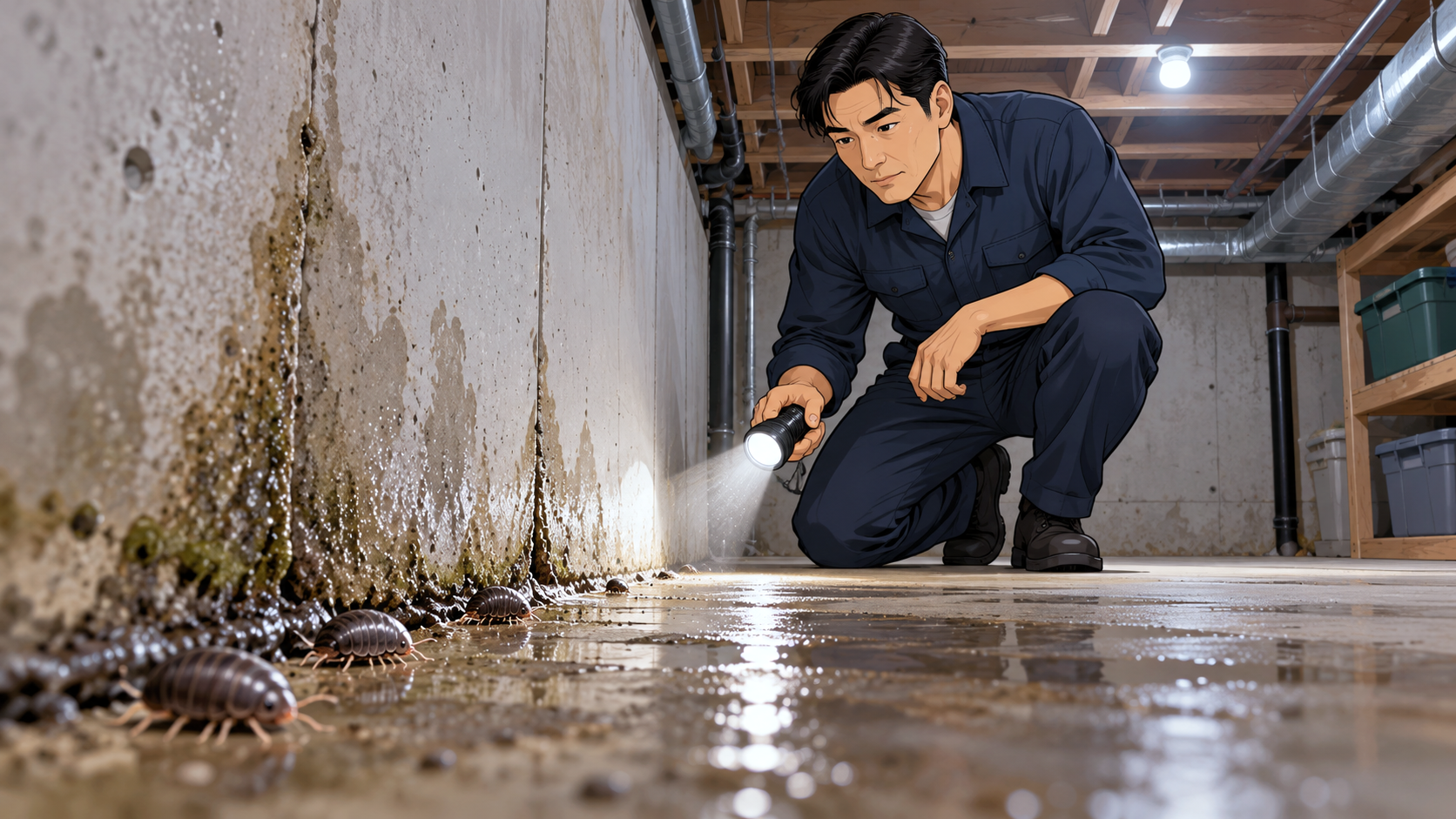
Call pest control for roly-polies when large numbers keep returning despite reasonable moisture and exclusion measures, plant losses remain significant, you cannot locate their entry source, or persistent indoor activity suggests a hidden moisture problem. A professional can identify the pest, inspect conducive conditions and apply targeted treatment when warranted, but treatment alone cannot repair moisture or structural defects. An occasional roly-poly indoors or a normal population beneath garden debris rarely requires professional service. These terrestrial crustaceans are generally nuisance invaders rather than destructive structural pests.
Persistent Live Roly-Polies Indoors Can Justify a More Thorough Inspection
A few roly-polies wandering through a basement door are usually straightforward. Hundreds appearing repeatedly, especially while still alive, deserve more investigation. Roly-polies require humid conditions, and they ordinarily die fairly quickly inside dry homes. Health Canada specifically warns that a persistent indoor infestation can indicate a serious moisture problem, potentially accompanied by a food source such as rotting wood.
Location helps determine whether professional investigation is worthwhile. Continuing activity around a crawl space, utility area, basement wall or inaccessible void can point toward conditions that are difficult to inspect from the occupied part of the house. Frequent live sightings also carry more information than finding dried carcasses because indoor moisture strongly affects roly-poly survival.
A pest professional can inspect likely entry points and conditions supporting the animals, but moisture outside the scope of pest control may require another trade. Plumbing leaks may need a plumber. Foundation seepage, drainage defects, damaged building materials or suspected rot can require an appropriate building, drainage or remediation professional. Pest treatment cannot substitute for those repairs.
Repeated Entry After Exclusion Work Is Another Reason to Get Help
Professional help becomes more useful when roly-polies continue appearing after obvious access points have been addressed. They can enter around thresholds, ground-level windows, foundation cracks and other exterior openings. Guidance for occasional invaders emphasizes foundation sealing and moisture control, but the actual route may be difficult to locate when a building has numerous penetrations, additions, patios or concealed foundation interfaces.
A professional inspection can trace where activity is concentrated and look for less obvious access. That may involve examining exterior doors, utility penetrations, expansion joints, window wells, crawl-space openings and the relationship between landscaping and the foundation. Experienced pest-control personnel can also distinguish an entry problem from an indoor moisture condition that allows animals to persist after arrival.
If the animals have not been identified confidently, professional identification has additional value. Pillbugs can be confused with sowbugs and occasionally with other segmented arthropods. Their ability to roll into a tight defensive ball helps distinguish common pillbugs from sowbugs, but photographs or damaged specimens may still create uncertainty. Pest-management guidance recommends confirming the organism before deciding whether professional treatment is necessary.
Garden Damage Has to Be Significant Enough to Justify Professional Treatment
Roly-polies are abundant in healthy landscapes without causing economically meaningful plant injury. They primarily occupy damp organic material and contribute to decomposition, although they can feed on seedlings, tender plant parts and produce contacting moist soil. Professional treatment makes more sense when plant damage has been positively attributed to roly-polies and continues to cause substantial losses.
Repeated destruction of valuable transplants, greenhouse seedlings or a commercially important planting can raise the threshold for professional involvement. A homeowner losing one leaf from an established ornamental faces a different decision from a grower repeatedly losing newly emerged plants. The significance of the damage, value of the plants, size of the affected area and practicality of changing the habitat all affect whether paid intervention is proportionate.
Population size by itself is not a sufficient threshold. Roly-polies naturally aggregate beneath favorable cover, and large numbers can remain beneficial or harmless in a garden. A professional assessment is more defensible when abundance is accompanied by verified, continuing plant injury rather than when a gardener simply uncovers a crowded group beneath a pot.
A Professional Should Be Looking for the Conditions Behind the Population
A useful roly-poly service is not simply a pesticide application. These animals depend strongly on moisture and shelter, so an inspection should consider drainage, irrigation, mulch depth, accumulated organic debris, foundation conditions and damp areas around the structure. Around buildings, reducing moisture and hiding places is described as the most effective long-term approach to limiting indoor entry.
Ask what the inspection found and what is sustaining the activity. If a company proposes repeated spraying without discussing a visibly wet crawl space, leaking pipe, saturated foundation perimeter or dense damp material beside the building, the underlying conditions may remain unchanged. General IPM guidance similarly prioritizes identifying water sources, hiding places and exterior entry points rather than treating pest presence in isolation.
Moisture findings can also change who needs to perform the next step. Pest professionals can recognize pest-conducive conditions, but they do not automatically diagnose every plumbing, waterproofing or structural failure. A good inspection can identify where further investigation is warranted without claiming that pesticide treatment will repair the building.
Professional Pesticide Treatment Has a Limited Role
A licensed applicator may use an appropriately registered product when a severe exterior population continues invading a structure or damaging plants and nonchemical measures have not been sufficient. Some products and application methods are restricted to licensed professionals, and a trained applicator can select a treatment permitted for the pest and site while limiting unnecessary exposure.
Indoor spraying is rarely the centerpiece of roly-poly control. Pillbugs normally struggle to survive in dry buildings, and indoor insecticide applications are described as typically of little use for pillbugs and sowbugs. Where treatment is justified, an exterior or highly targeted approach may make more sense than spraying rooms where dehydrating animals will soon die anyway.
The same limitation applies to individual products. A professional may have access to treatment options unavailable to homeowners, but no pesticide changes the biological requirement for humid shelter. Likewise, choosing between substances such as diatomaceous earth for roly-polies and other registered products requires attention to the label, site conditions and expected exposure rather than assuming stronger treatment guarantees lasting control.
Know What You Are Paying the Pest-Control Company to Accomplish
Before authorizing service, ask the company to identify the pest, explain where it appears to be coming from, describe the conditions supporting it and state what outcome the proposed work is intended to produce. Guidance on hiring a pest-control company recommends asking about long-term solutions rather than focusing only on immediate pesticide application.
For an indoor problem, a realistic outcome may be identifying access routes and substantially reducing new arrivals. In a garden or greenhouse, it may be bringing damaging activity below a level that threatens plants. Complete eradication from an outdoor property is generally an unrealistic target because roly-polies naturally occupy soil, litter and other moist outdoor habitats.
Be cautious with guarantees based solely on repeated chemical applications. Recurring populations can originate in surrounding habitat, and exterior moisture can continue producing favorable conditions after a pesticide residue declines. A service plan tied to the actual source of the problem offers more useful information than a promise to make every roly-poly disappear.
Situations Where a Professional Usually Is Not Necessary
Do you need pest control for one roly-poly in the basement?
Usually not. A single animal can enter accidentally through a ground-level opening. Professional involvement becomes more reasonable when sightings persist, occur in unusually large numbers or remain concentrated in a damp area.
Should you call an exterminator because roly-polies are under your mulch?
Not without evidence of a problem. Moist mulch is normal habitat, and roly-polies help process decomposing organic matter. Their presence beneath it does not by itself justify treatment.
Is professional treatment necessary if you keep finding dead roly-polies?
Not automatically. Repeated dead individuals can indicate continuing entry into an environment too dry for survival. If the arrivals are numerous or persistent, identifying and correcting the access route is more relevant than treating the carcasses.
Can a pest-control company permanently eliminate every roly-poly outside a house?
That is not a realistic management goal. Outdoor populations can occupy surrounding soil, mulch, leaf litter and neighboring habitat. Professional service is better judged by whether it resolves the specific nuisance, invasion or plant-damage problem.
Do you need a pest professional if ordinary indoor measures are working?
No. If indoor removal, moisture correction and exclusion have stopped new sightings, escalation provides little additional value.
One thought on “When Should You Call Pest Control for Roly-Polies?”