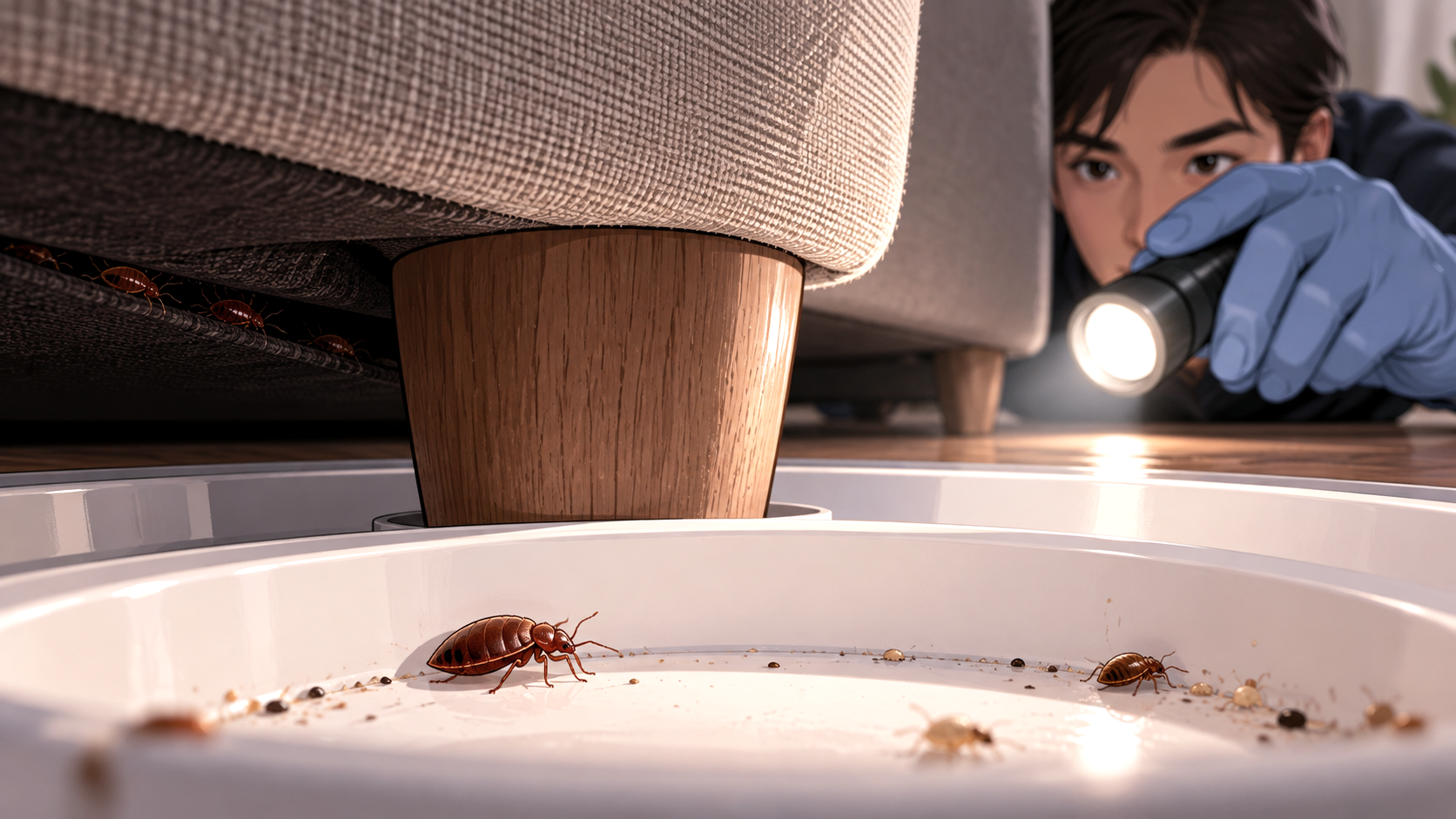
The most reliable way to make hidden bed bugs move is to use the same cues associated with a nearby host, especially carbon dioxide, with heat and human odors providing additional information. For household detection, sleeping normally with properly positioned interceptors or using a purpose-built active bed bug monitor is safer and more useful than trying to flush bugs from cracks. Bed bugs do not all emerge on command. Recently fed insects may remain concealed while hungry bugs respond more strongly to host cues, so monitoring over multiple nights is more informative than expecting every hidden bug to appear at once.
Your Presence Is Already One of the Strongest Lures in the Room
A sleeping person naturally produces several signals involved in bed bug host seeking. Exhaled carbon dioxide disperses through the room, exposed skin provides odor cues, and the body supplies warmth at close range. Hungry bed bugs respond to this combination by leaving harborages and searching for a blood meal.
Carbon dioxide has a particularly strong effect on movement. In laboratory and apartment experiments, traps releasing CO₂ captured substantially more bed bugs than comparable traps without it. One occupied-apartment experiment recorded 5,898 captures from traps using CO₂ compared with 656 from traps without CO₂, demonstrating the strong attraction produced by carbon dioxide under field conditions.
Heat contributes differently. Controlled experiments found that heated targets activated bed bugs and produced oriented movement, but reliable orientation toward heat alone occurred only at distances shorter than about three centimeters in the experimental system. Bed bugs therefore do not simply detect a warm body from across a bedroom and walk directly toward it. Heat becomes particularly useful at close range, while CO₂ and odors can contribute to earlier stages of host searching.
The combination explains why bed bugs can locate a sleeping host after leaving a concealed crack. A person remaining in the usual sleeping location can therefore serve as the attractant while a monitoring device intercepts bugs attempting to reach or leave the bed.
Turn the Bed Into a Monitoring Point Instead of Trying to Flush the Room
If the objective is to determine whether hidden bed bugs are present, forcing them into open floor space is unnecessary. It is more useful to concentrate their normal movement along routes where they can be captured.
Move the bed slightly away from the wall, keep sheets and blankets from touching the floor, and remove objects that create alternate bridges between the bed and surrounding room. Interceptor traps can then be placed beneath each accessible bed leg. Federal preparation guidance recommends this arrangement because interceptors capture bed bugs attempting to climb furniture legs.
The person sleeping in the bed remains the attractant. Hungry insects attempting to reach that person must approach the isolated bed, increasing the chance that they encounter the traps. Bugs leaving the furniture may also be captured depending on the interceptor design. Proper bed bug interceptor placement therefore turns ordinary host-seeking movement into evidence without requiring someone to chase insects as they emerge.
Do not interpret an empty trap after one night as proof that nothing is hiding. Bed bugs do not necessarily feed every night, and recently fed individuals may have little reason to leave their harborages immediately.
Active Bed Bug Monitors Can Supply Host-Like Cues Without a Sleeping Person
An active monitor differs from a passive interceptor because it supplies an attractant rather than waiting for a bug to encounter it during normal movement. Designs have used carbon dioxide, heat, chemical lures or combinations of these cues.
Experiments comparing pitfall traps found CO₂ more attractive than heat alone. Adding heat or chemical cues to CO₂ produced high capture rates in laboratory tests, while a CO₂-baited trap placed in lightly infested apartments captured an average of 15 bugs by the following morning after visual inspections had already removed visible specimens. The results showed that baited traps can reveal insects missed during inspection.
Different monitors do not perform equally. Field comparisons of commercially available and experimental devices have found meaningful differences in capture rates, while a scientific review identified numerous detection products that lacked sufficient independent evaluation. Monitor design, lure composition and CO₂ delivery can substantially affect performance. A product marketed as a bed bug lure should therefore not be assumed effective merely because it produces warmth or scent.
Validated active monitors can be especially useful in an unoccupied room where the normal human attractant is absent. They can also complement a careful inspection of the mattress and bed structure when visual searching fails to locate insects.
Carbon Dioxide Is Powerful, but More Is Not Automatically Better
Bed bugs respond to changes in carbon dioxide rather than treating every concentration as increasingly attractive. Trap experiments have tested controlled release rates and found strong responses within specific conditions. Research on tropical bed bugs similarly found attraction across a range of CO₂ concentrations but a declining exploratory response as concentrations became much higher, with attraction disappearing at the highest tested concentrations.
For detection, a controlled lure that has been designed and evaluated for bed bugs is preferable to attempting to fill a room with CO₂. Experimental traps use measured delivery systems and defined release rates. Those conditions are not equivalent to placing an arbitrary CO₂ source in a bedroom.
Dry ice also produces concentrated carbon dioxide as it sublimates. Although dry-ice traps have been used successfully in bed bug research, carbon dioxide can displace oxygen in poorly ventilated spaces. Improvised use is unnecessary when passive interceptors and purpose-built monitors can provide household monitoring without reproducing laboratory equipment.
Recently Fed Bugs May Ignore the Invitation
Not every bed bug hiding in a room is actively searching for a person. Physiological state changes what cues an insect follows.
Recent experiments found that unfed bed bugs strongly preferred host odor, while recently fed insects responded differently and were more oriented toward aggregation-related cues. Adding carbon dioxide enhanced host-oriented responses among hungry bugs, reinforcing the importance of hunger state in determining attraction to host signals.
A hidden population can contain hungry adults, engorged adults, nymphs at different stages and eggs simultaneously. An active monitor may attract the host-seeking portion without emptying every crack and crevice. Eggs cannot walk toward a lure at all.
Monitoring therefore works best as sampling over time. A negative result on one particular night cannot establish that the room is clear, particularly when bed bugs can remain concealed without being seen.
Sleeping Somewhere Else Can Move the Target Instead of Solving the Detection Problem
Moving from an infested bedroom to a couch may seem like a way to starve hidden bugs until they emerge. Bed bugs can survive much longer without blood than the few days most people are willing to abandon a room, so waiting for them to starve is not a dependable detection strategy.
Changing sleeping locations can also change where host-seeking bugs travel. Bed bugs are capable of moving substantial distances away from a bed, and established populations are not necessarily confined permanently to one bedroom. Remaining in the normal sleeping location while isolating and monitoring the bed generally produces cleaner evidence than repeatedly changing where the host spends the night.
Bed isolation should not be confused with treatment. Capturing mobile insects can reduce access to the sleeper and reveal activity, but eggs and bugs already concealed within furniture or other harborages still require appropriate control.
Do Not Use Repellents, Sprays or Bug Bombs Just to Force Bugs Into View
Applying an insecticide into random cracks to see what runs out combines detection and treatment in a way that can make both less reliable. Pesticides need to be selected and applied according to their labels, not used as flushing experiments.
Total-release foggers are particularly unsuitable for this purpose. Bed bugs frequently occupy protected cracks and crevices that aerosol droplets may not reach, so foggers should not be relied upon as the sole bed bug control method. Improper fogger use can also create fire, explosion and exposure hazards.
Steam has a legitimate role in some bed bug control programs, but blasting hiding places merely to make insects scatter is counterproductive. Federal DIY guidance specifies that steam needs sufficient temperature for treatment while warning that forceful airflow can scatter bed bugs instead of controlling them.
Repellent smells are similarly poor detection tools. Even substances that affect bed bug behavior do not provide a controlled way to determine how many bugs occupy a harborage or where displaced insects go. The limitations of purported bed bug-repelling smells make capture-based monitoring more useful when the objective is simply to establish whether bugs remain present.
Use What Comes Out as Evidence, Then Search Where It Came From
A captured bed bug confirms activity, but the monitor does not necessarily identify the exact harborage. Once a trap produces a specimen, inspect outward from the sleeping or monitoring location. Mattress seams, box springs, headboards, bed-frame joints, nearby furniture and protected cracks deserve particular attention.
Do not dismantle the entire room before examining the highest-probability locations. Bed bugs commonly remain near regularly occupied sleeping and resting areas even though they can travel farther. Evidence such as eggs, fecal marks and shed skins left during nymphal development can help locate established harborages after a monitor confirms that mobile bugs are present.
For an infestation already under treatment, repeated monitoring also provides a more useful measure than trying to provoke a dramatic emergence. Integrated pest management uses monitoring devices to help verify eradication, and declining captures over time can be evaluated alongside inspections and other treatment evidence.
Questions About Drawing Bed Bugs Out
Will leaving the lights off make bed bugs come out?
Darkness commonly overlaps with bed bug activity because people usually sleep at night, but host availability is more important than the light switch alone. Hungry bed bugs can feed during daylight when a suitable host is available.
Will breathing near a suspected hiding place draw them out?
Exhaled breath contains CO₂ and other host-associated cues, but deliberately breathing beside a crack is not a practical detection method. A bug may not be hungry, may approach from another direction or may remain concealed during the observation period.
How long should you wait for hidden bed bugs to appear?
There is no reliable number of minutes or hours. Feeding state varies among individuals, so monitoring across multiple nights provides much stronger evidence than watching a suspected crack for one evening.
Can a flashlight make bed bugs run out of hiding?
A flashlight is useful for inspecting seams and crevices but is not a dependable lure. Using a flashlight to find bed bugs works by improving visibility rather than attracting hidden insects toward the light.