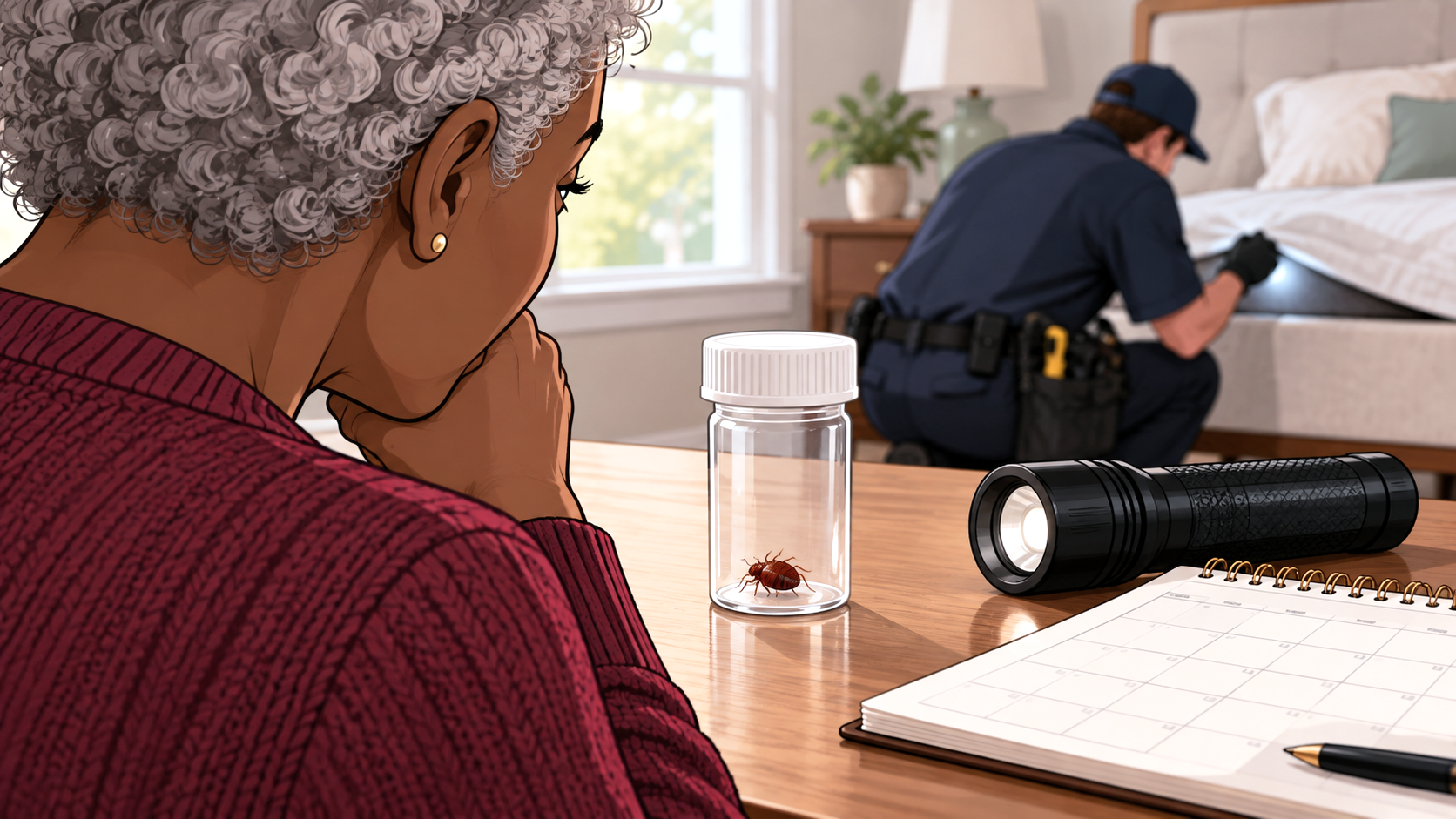
If you find a confirmed bed bug months after treatment, capture it, record exactly where and when you found it, inspect the surrounding sleeping area, and restart monitoring immediately. One bug does not reveal whether an old infestation survived or a new bug was introduced, but a months-long gap makes the finding worth investigating rather than dismissing. Avoid immediately spraying the room or throwing away furniture. Preserving the specimen and gathering evidence over the following days gives you a much better chance of determining what has happened.
Save the Bed Bug Before You Do Anything Else
A late sighting is far more useful when the insect can be identified. Capture it in a sealed clear container or secure plastic bag rather than crushing or discarding it. Photograph it clearly if possible. Bed bugs can be confused with bat bugs and several other small insects, and treating a home again before confirming the identification can waste money and expose occupants to unnecessary pesticides.
Record the date, exact room and location where the insect appeared. Note whether it was on the bed, inside an interceptor, on furniture, on clothing or walking somewhere unusual. Federal bed bug control guidance recommends keeping records of the dates and exact locations where insects are found because a pattern of detections provides more information than isolated sightings.
If a pest-control company performed the previous treatment, contact it and keep the specimen available for identification. The original treatment paperwork is useful too. Check what methods were used, how many visits occurred, whether there was a warranty or monitoring period, and what evidence had been used to declare the infestation eliminated.
A Bed Bug Months Later Can Have More Than One Explanation
The first possibility is survival from the original infestation. Bed bugs can tolerate prolonged periods without feeding, and their physiology is unusually well adapted to conserving water during extended fasting. Laboratory research has documented adaptations that allow unfed bed bugs to survive for long periods, although survival varies with temperature, life stage and other conditions. A bug that escaped treatment in a protected void could therefore remain difficult to detect.
Treatment failure does not always require one extraordinary survivor. Eggs can be missed, harborages can escape treatment, pesticide deposits may provide inadequate coverage, and some populations possess substantial insecticide resistance. Federal pesticide guidance identifies infestation size, preparation, application quality, coverage of all life stages and resistance as factors that can determine whether bed bug treatment succeeds. A large systematic review has also documented widespread resistance to pyrethroid insecticides, although finding a live bug cannot establish resistance without appropriate testing.
A new introduction is equally possible. Bed bugs can arrive on luggage, used furniture, bags and other belongings after the original infestation has been eliminated. Someone who recently traveled could have brought a bed bug home without noticing, while secondhand furnishings and other transported possessions provide additional opportunities. The elapsed time alone cannot tell you whether the insect belongs to the previous infestation.
Inspect the Area Where the Bug Appeared Before Expanding the Search
Use the location of the captured insect to determine where to start. A specimen found on a bedroom wall warrants an inspection centered on that room, while one found on a living-room couch shifts attention toward the couch and nearby resting areas.
Examine mattress piping, seams and labels, followed by the box spring, frame, headboard and nearby furniture. Look for live bugs, eggs, dark fecal spotting and cast skins produced as bed bugs develop. Health Canada recommends checking on, beneath and beside beds, couches and upholstered furniture, then widening the search when evidence appears.
Do not assume the mattress is responsible simply because the insect is a bed bug. Their daytime hiding sites can extend beyond the bed into furniture joints, baseboards and structural gaps. Federal inspection guidance includes drawer joints, electrical receptacles, loose wallpaper, wall hangings and even screw heads among possible harborages when infestations extend beyond the immediate sleeping surface.
A careful search that finds nothing is useful information, but it does not prove the captured insect was alone. Low-level populations are inherently harder to detect, and bed bugs can remain present without being readily seen.
Restart Monitoring Even If the Inspection Finds Nothing
A single late discovery creates a situation where monitoring is particularly valuable. Place bed bug interceptors beneath the legs of beds and suitable upholstered furniture, provided the furniture design allows them to work correctly. Keep bedding from touching the floor and prevent nearby objects from creating alternate bridges to the bed.
Federal preparation guidance recommends interceptors as part of post-control monitoring and advises keeping them in use for at least a year. Field research supports their usefulness at low population levels. In one apartment study, interceptors were used repeatedly alongside visual inspection, with elimination defined as no trap captures for eight consecutive weeks and no bugs detected visually. Depending on the intervention group, those criteria were eventually reached in 87% to 100% of apartments.
Check the devices regularly and write down every capture rather than relying on memory. Correct interceptor placement around beds and resting furniture can reveal activity that a brief visual inspection misses.
Do not use bites as the monitoring system. Skin reactions vary considerably, some people develop little or no visible reaction, and unrelated conditions can resemble bites. Physical evidence is more useful when deciding whether a population remains in the home.
One Late Bug Is Different From Finding Eggs, Nymphs and Adults
The evidence found during the next inspection helps narrow the possibilities. A lone adult with no additional signs leaves both survival and recent introduction plausible. Discovering several developmental stages changes the picture because an established population produces evidence of reproduction over time.
Bed bugs pass through five nymphal stages before adulthood, taking a blood meal before each molt. Finding small nymphs, older nymphs, adults, eggs and multiple shed exoskeletons from different stages is much harder to reconcile with a single newly introduced insect. Repeated captures from the same room similarly increase concern that an active population occupies the area.
Do not try to estimate the infestation from the number visible during one inspection. Bed bugs spend much of their time concealed, so the number discovered in open areas can substantially underestimate what occupies inaccessible harborages.
Apartments Require a Wider Investigation
In a detached home, the main possibilities are survival from the original infestation or a later introduction through people and possessions. Multi-unit housing adds another route: movement from a neighboring unit.
Field experiments have directly documented bed bug movement between apartments. Marked insects were recovered in neighboring units above, below and beside infested apartments, as well as across hallways. A recurring infestation can therefore persist when the source lies outside the treated unit.
Notify the landlord or property manager promptly if you rent in a multi-unit building. Nearby units may need inspection rather than repeatedly treating only the apartment where the latest insect appeared. The possibility of bed bugs spreading between connected apartments becomes especially relevant when a previously treated unit repeatedly becomes positive after periods with no detectable activity.
Do Not Immediately Repeat the Previous Pesticide Treatment Yourself
Finding a bug can create an understandable urge to spray every crack before another one disappears. Doing so can destroy useful evidence, interfere with professional assessment and expose occupants to pesticides without establishing where the infestation is located.
If additional bed bugs or convincing signs appear, the next treatment needs to account for why the previous control program may have failed. Federal guidance lists incorrect identification, missed hiding places, failure to follow up after eggs hatch, inadequate time for products to work and pesticide resistance among possible reasons bed bug treatments fail. Resistance is only one possibility and cannot be diagnosed from a sighting alone.
Professional programs can combine inspection and monitoring with chemical and nonchemical methods. Health Canada identifies insecticidal sprays and dusts, steam, carbon dioxide snow and professional heat among the methods available for bed bug control. Reusing the exact same unsuccessful approach without establishing why bugs remain may simply repeat the conditions that allowed survival.
Decide the Next Step From the Evidence You Collect
If the specimen is confirmed as a bed bug but repeated inspections and monitoring produce no additional evidence, continue watching rather than assuming either that an infestation definitely exists or that the incident is resolved. A single introduced bug can occur without an established population, while a very small population can also escape an initial search.
Multiple confirmed bugs, newly appearing nymphs, eggs, fresh fecal spotting or repeated interceptor captures justify prompt professional reassessment. Determining whether bed bug treatment truly worked requires evidence accumulated over time rather than the date of the last pesticide application.
Questions After a Bed Bug Reappears Months Later
Could the bed bug have come from a visitor?
Yes. Bed bugs can be transported on bags, clothing and personal belongings, although finding one after a visitor does not prove who introduced it. Avoid assigning a source without evidence.
Should you throw away the mattress after finding one bug?
No. Discarding a mattress does not remove bugs hiding in the frame, furniture or structure, and an intact mattress may be treatable or suitable for an encasement. Unnecessary disposal can also spread bugs while the item is moved.
What if the bed bug was dead when you found it?
Keep it for identification if possible. A dead specimen confirms that a bed bug was present at some point, but its condition alone cannot establish when it entered the home or whether live bugs remain.
Should you sleep in another room while monitoring?
Moving to another sleeping location can change where hungry bugs search for a host and complicate monitoring. Bed bugs can travel away from established harborages to feed, so follow any instructions from the pest professional instead of routinely relocating to a couch or spare room.