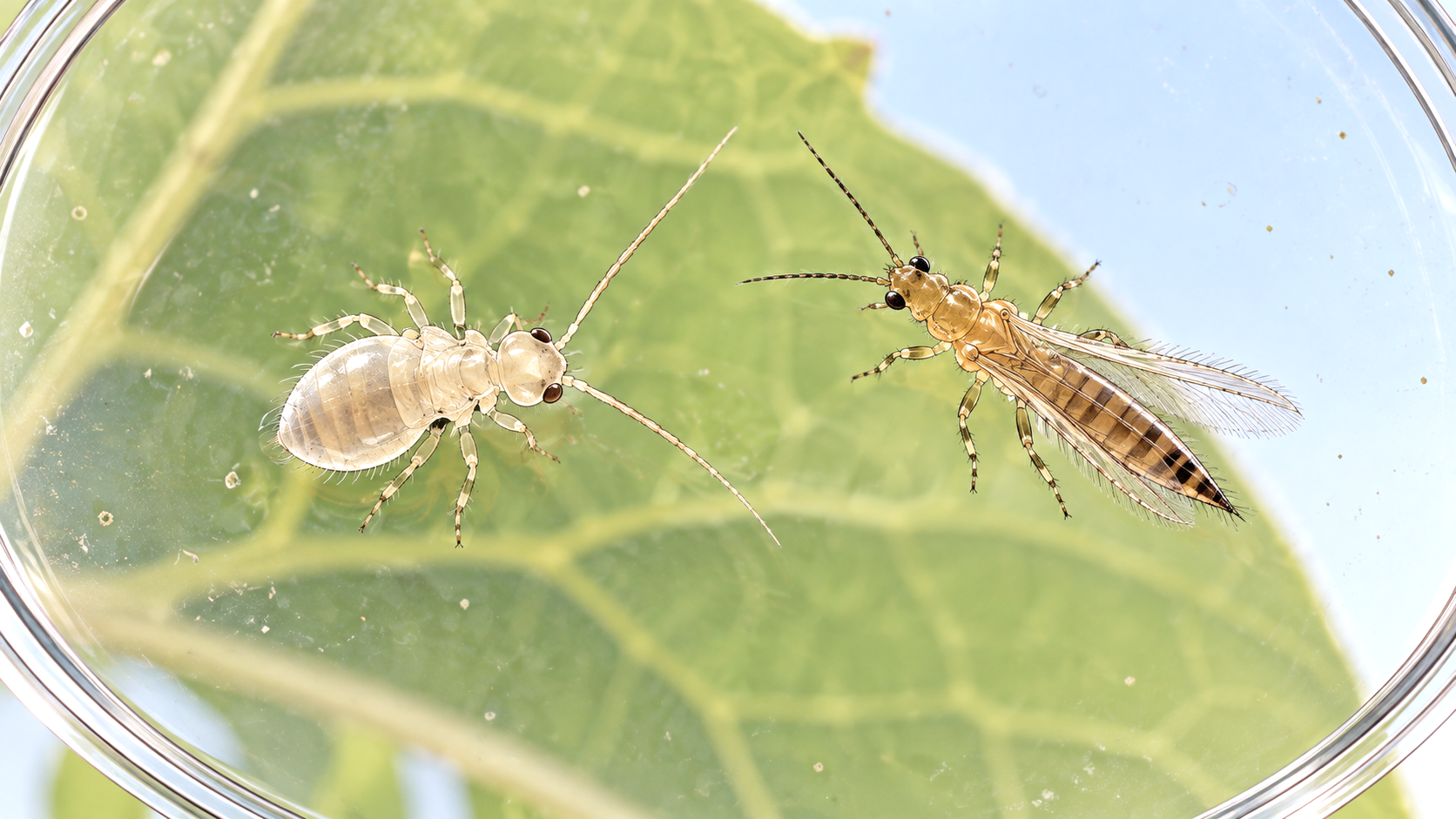
Booklice and thrips can overlap in size and color, but their surroundings often expose the difference before magnification does. Thrips are narrow, elongated insects commonly associated with plants, while booklice have a broader head and softer, less linear body. Adult thrips may have distinctive fringed wings; common indoor booklice are usually wingless.
Start With What the Insect Is Standing On
A tiny insect repeatedly appearing on young leaves, flower buds, petals, or new shoots deserves close comparison with thrips. Many pest thrips spend much of their time in protected parts of plants, and their feeding produces silvering, stippling, scarring, distorted growth, or small dark fecal spots. UC IPM describes thrips as slender insects that puncture plant tissue and remove cell contents, leaving damage that can become more conspicuous than the insects themselves. The combination of insects on foliage and characteristic thrips damage on houseplants provides much stronger evidence than simply finding a one-millimeter brown speck.
Booklice can occur around houseplants, but the plant itself is usually not their target. Damp potting areas, condensation, fungal growth, wooden windowsills, cardboard, or other humid material nearby can provide a suitable environment. Indoor booklice are strongly associated with moisture and fungi, and persistent populations often make more sense once the dependence of booklice on humidity is considered. Canadian conservation guidance similarly describes psocids as insects strongly associated with dampness. A windowsill covered in tiny insects may therefore produce a different diagnosis depending on whether the activity centers on damaged leaves or on a damp, mold-prone surface beside the plant.
Thrips Look Like Tiny Slivers; Booklice Look More Head-Heavy
Adult thrips have a remarkably narrow profile. Many common pest species are only about 1 to 1.5 millimeters long, yet their bodies are distinctly elongated. Colorado State describes adult thrips as long, slender insects about 1 to 1.5 millimeters in length. Viewed without magnification, a dark thrips may resemble a tiny moving dash rather than a rounded bug.
Booklice occupy much of the same size range, but their proportions are different. Common indoor forms are frequently around 1 to 2 millimeters long, with a relatively broad head, long threadlike antennae, and a soft body. Penn State describes booklice as small, flattened insects with a head wider than the thorax. Their overall booklouse body shape therefore appears less uniformly narrow than that of a thrips.
Color adds little certainty. Both groups can include pale yellowish, tan, brown, or dark individuals, and immature stages can be especially light. An elongated silhouette versus a conspicuously broad-headed one provides more identification value than trying to decide whether a tiny insect is beige, yellow, or light brown.
Fringed Wings Are Nearly Diagnostic for an Adult Thrips
The name Thysanoptera, the insect order containing thrips, refers to their characteristic fringed wings. Adult winged thrips have two pairs of extremely narrow wings bordered by long hairs, producing a feathery appearance under magnification. UF/IFAS describes adult thrips as small elongated insects with narrow wings, while UC IPM identifies the long fringe along those wings as one of the group’s most distinctive features.
Those wings can be difficult to see with the naked eye because the entire insect is so small. A phone macro photograph or hand lens may show what initially looks like a thin dark line along the back resolving into two pairs of narrow fringed wings. The broader appearance of adult thrips becomes much easier to recognize once this feature is visible.
Common household booklice, particularly Liposcelis species, are usually wingless. The broader psocid group does include winged species, so wings by themselves do not separate every psocid from every thrips. A minute indoor specimen with conspicuously fringed, strap-like wings nevertheless fits thrips far better than the wingless booklice normally found around damp household materials.
Their Feeding Evidence Points in Completely Different Directions
Plant-feeding thrips damage living tissue. Their asymmetrical mouthparts rupture cells and remove the contents, producing pale stippling, silvery areas, scarring, malformed flowers, or distorted young leaves. UF/IFAS notes that thrips feeding can leave silvered or scarred foliage and dark fecal specks. Those signs belong to the plant, not merely to the surface on which the insect happens to be walking.
Booklice are not plant-sap feeders. Their food includes fungi, mold, grains, and other suitable organic material. In stored products, Canadian grain guidance describes psocids feeding preferentially on exposed or damaged grain material. Finding booklice on a leaf therefore does not mean they are responsible for silver streaks or distorted plant tissue.
This difference is particularly useful when both insects are too small for a confident visual identification. Fresh feeding scars, damaged flowers, and black specks of thrips excrement strengthen a thrips diagnosis. Mold, damp cardboard, humid shelving, or fungal growth with no plant injury fits booklice more closely.
Immature Thrips Can Remove the Wing Clue
Young thrips do not yet have the fringed wings that make adults comparatively easy to recognize. They are usually pale, elongated, and active on plant tissue. UC IPM describes thrips immatures as slender and wingless while retaining the elongated thrips body form. Their appearance can therefore overlap superficially with other tiny pale insects.
Young booklice are also wingless, but their development follows a different pattern. Booklice nymphs resemble smaller versions of adults, including the broad head and long antennae. Thrips pass through feeding immature stages followed by nonfeeding prepupal and pupal stages before adulthood. The exact appearance of thrips larvae and nymph-like stages is consequently more specialized than simply being a miniature wingless adult.
When wings are absent, location and body proportions become especially valuable. A pale elongated immature actively feeding among damaged buds or leaves supports thrips. A broad-headed speck living among damp paper, cardboard, or mold-prone material supports booklice.
Questions That Help Separate Booklice From Thrips
Can booklice damage a houseplant the way thrips do?
Booklice are not typical plant-tissue feeders and do not produce the characteristic silvering, scarring, or distorted growth associated with pest thrips. Their presence around a pot may instead reflect moisture, mold, or organic material nearby.
Can thrips live away from plants inside a house?
Adult thrips can wander onto windows, walls, furniture, or other indoor surfaces, particularly after entering from outdoors or leaving an infested plant. Repeated sightings away from plants should still be traced back to nearby vegetation or another entry source rather than assuming the room itself is their normal feeding habitat.
Do thrips jump like springtails?
Thrips can move quickly and adults can fly, but they do not use the springtail’s specialized jumping organ. If a mystery insect repeatedly springs several body lengths from a damp surface, the comparison between springtails and thrips becomes more relevant than booklice.
Can booklice and thrips occur on the same houseplant?
Yes. Thrips may be feeding on the plant while booklice exploit mold, fungal growth, or damp organic material around the pot. Finding two visibly different tiny insects on one plant does not mean they are different stages of the same species.
What evidence is most useful when the insect is too small to photograph clearly?
Record exactly where it occurs and inspect the surrounding surface. Plant scarring, silvering, distorted shoots, and black fecal dots support the usual signs of a thrips infestation. Dampness, mold, and numerous tiny insects scattered around moisture-affected materials fit booklice more closely.