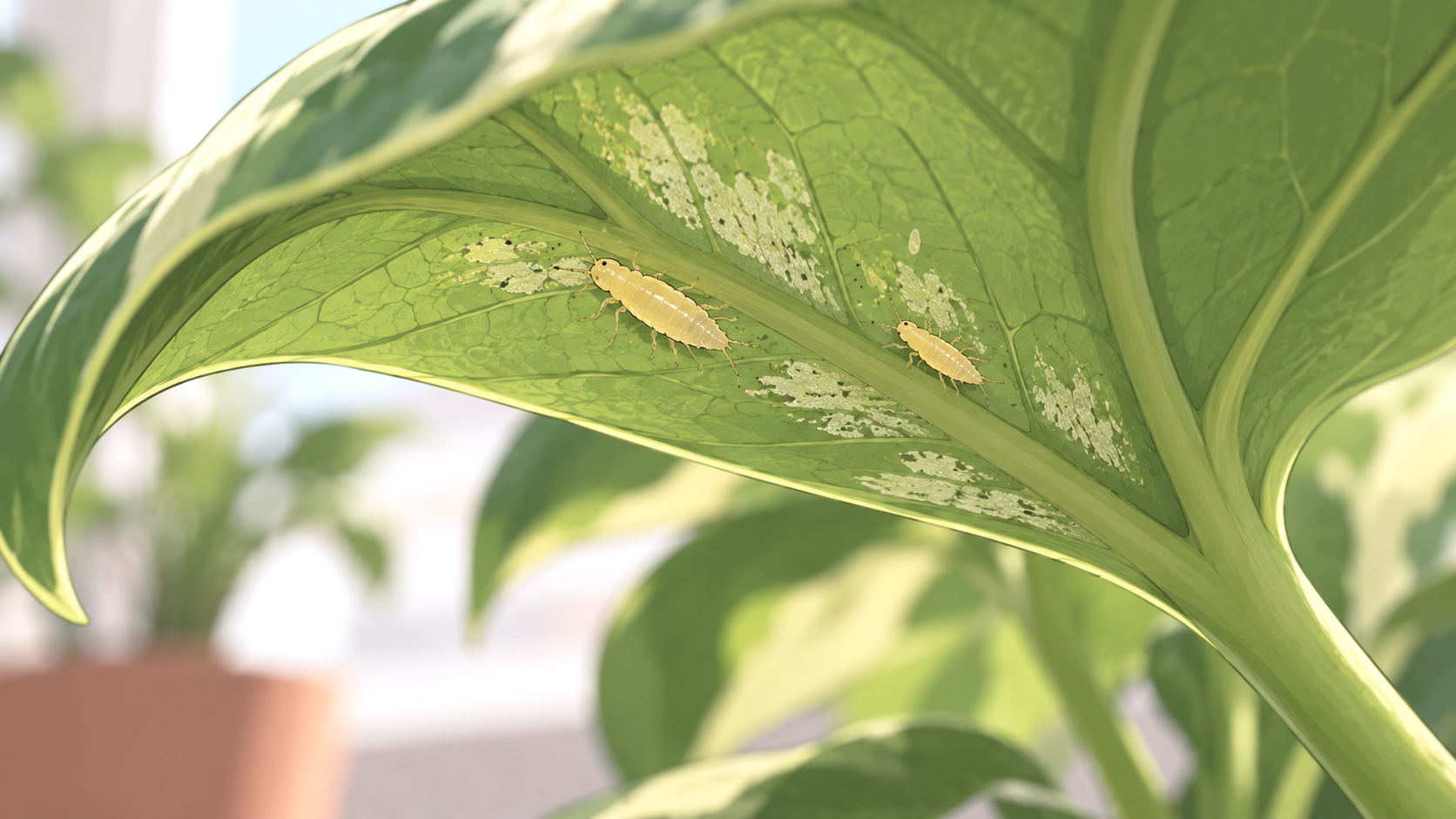
Thrips larvae, also commonly called nymphs, are tiny, wingless insects with slender to oblong bodies. Most pest species have immature thrips that are translucent white, cream, pale yellow, yellow, or light orange, although color varies by species and age. They resemble simplified versions of adult thrips, but they lack the adults’ fully developed fringed wings and are generally smaller and paler. Thrips pass through two actively feeding immature stages before becoming nonfeeding prepupae and pupae.
If you find tiny pale insects moving across leaves, flowers, buds, or tender new growth, immature thrips are one possibility. However, color alone is not enough for identification because many small arthropods can appear white or yellow. The combination of an elongated body, lack of adult wings, movement, location on the plant, and the presence of adult thrips or characteristic feeding injury provides a much stronger identification.
What Is a Thrips Larva?
A thrips larva is one of the first two immature stages that develops after the egg hatches. Thrips have a somewhat unusual developmental sequence consisting of egg, first instar, second instar, prepupa, pupa, and adult. The first and second instars are actively feeding larval or nymphal stages, while the prepupa and pupa do not feed. Therefore, when people talk about thrips larvae on an infested plant, they are generally referring to those first two mobile, feeding stages.
These young thrips are already recognizable as elongated insects rather than wormlike larvae. They have legs and antennae and can move around the plant while feeding. What they do not have are the fully developed narrow, fringed wings that characterize most adult thrips. If you want to see where these immature stages fit between the egg and adult, the thrips life cycle covers the complete developmental sequence.
Are They Called Thrips Larvae or Thrips Nymphs?
You will encounter both terms. Authoritative pest-management references describe the first and second instars as larvae or nymphs, so either word may appear when you research immature thrips. The terminology becomes more complicated because thrips development does not fit perfectly into the familiar incomplete-versus-complete metamorphosis categories people often learn first. After the two feeding immature stages, thrips pass through nonfeeding stages called the prepupa and pupa even though they do not have a true pupal stage in the same sense as butterflies or beetles.
For practical identification, the terminology matters less than recognizing which stage you are looking at. The first and second instars are wingless and actively feed. Prepupae and pupae are comparatively inactive, do not feed, and develop visible wing pads. Adults have completed development and, in winged species, carry the characteristic narrow wings edged with long hairs. Those differences are much more useful during a plant inspection than debating whether “larva” or “nymph” is the better everyday term.
What Does a First-Instar Thrips Look Like?
The first instar is the youngest mobile stage and begins immediately after the thrips hatches. It is extremely small, wingless, and usually pale. Western flower thrips first instars, for example, are white, while older instars commonly become orange to yellow. The first and second instars of western flower thrips are also active feeders that commonly occupy protected areas such as buds, flowers, and growing tips.
At normal viewing distance, a first instar may look more like a tiny pale moving sliver than a clearly recognizable insect. Magnification reveals the elongated body, legs, antennae, and other features that are difficult to resolve with the naked eye. Because this stage is smaller than the older larvae and adults, finding it can be especially difficult on pale flowers or light-colored plant tissue. A hand lens and good lighting can make a substantial difference when you are trying to determine whether those moving specks are actually thrips.
What Does a Second-Instar Thrips Look Like?
The second instar is larger and more developed than the first but remains wingless. Its exact shape and color depend on the species. In citrus thrips, for example, first instars have relatively narrow bodies with nearly parallel sides, whereas the second instar becomes broader and develops a noticeably bulging abdomen. Western flower thrips second instars remain more elongated by comparison. These differences between first- and second-instar citrus and western flower thrips demonstrate how much immature body shape can vary even among small plant-feeding species.
Color can change as the insect ages as well. Citrus thrips larvae can be white, yellow, or light orange and become darker as they mature. Western flower thrips larvae can appear whitish, yellow, or orangish. Therefore, finding pale and more strongly colored larvae together does not necessarily mean that multiple pests are present. You may simply be looking at different developmental stages or individuals of different ages.
What Colors Are Thrips Larvae and Nymphs?
Many pest thrips have pale immature stages. Translucent white, whitish, cream, yellow, and light orange are common descriptions, although they should not be treated as universal. Chilli thrips larvae, for example, are pale yellow to whitish, while greenhouse thrips nymphs are whitish to slightly yellowish. Western flower thrips begin with white first instars and commonly become orange to yellow as they develop.
There are also striking exceptions. The predatory Franklinothrips species have first instars that begin pale yellow or whitish, but older larvae develop a bright red, swollen abdomen and can resemble a moving red dot without magnification. The distinctive appearance of older Franklinothrips larvae is a reminder that not every red, orange, or unusually colored thrips is a plant pest. Our broader article on thrips colors covers color variation across developmental stages and species.
Do Thrips Larvae Have Wings?
No. The first and second feeding instars do not have functional adult wings. Their wingless appearance is one of the most useful differences between an immature thrips and a typical winged adult. Adults of many species possess two pairs of narrow wings fringed with long hairs, although those wings can still be difficult to see without magnification.
Wing development becomes more obvious after the second feeding instar. During the prepupal and pupal stages, visible wing pads develop as the insect approaches adulthood. The presence of wing pads therefore suggests that you have moved beyond the actively feeding larval stages. Once adult development is complete, the wings take their mature form. Our separate article on whether thrips can fly deals specifically with adult wings and flight rather than the immature stages.
What Do Thrips Prepupae and Pupae Look Like?
Prepupae and pupae can easily be mistaken for larvae because they are still immature thrips and can remain pale. However, their appearance and behavior change as they prepare for adulthood. Wing pads become visible, and the insects become relatively inactive. The prepupa has developing wing structures, while the pupa has longer, more developed wing pads. These stages do not feed.
Antenna position can provide another clue under magnification. In Cuban laurel thrips, the prepupa has visible wing pads and forward-pointing antennae, while the pupa has longer wing pads and antennae folded back over the head. Sixspotted thrips show a similar distinction, with forward-projecting antennae in the prepupa and antennae folded over the head in the pupa. These features are subtle, but they help separate a late immature thrips from the actively feeding larvae that came before it.
Where Do Thrips Larvae Hide on Plants?
Immature thrips often occupy protected plant areas where they can feed without being immediately obvious. Depending on the species and host, that can include flowers, buds, growing tips, young leaves, beneath sepals, curled foliage, or other crevices. Western flower thrips adults and nymphs commonly feed within buds, flowers, growing tips, and other protected plant tissues, although they can also feed on exposed leaf surfaces on some hosts.
Chilli thrips commonly concentrate around buds and young leaves, while other species have different preferences. Gall-forming thrips can remain within distorted or folded plant tissue, making their larvae particularly difficult to notice until the affected growth is opened. Therefore, examining only the broad, exposed surface of mature leaves can miss a substantial portion of a population. When you are investigating suspected signs of a thrips infestation, tender and protected growth deserves close inspection.
What Do Greenhouse Thrips Nymphs Look Like?
Greenhouse thrips (Heliothrips haemorrhoidalis) nymphs are whitish to slightly yellowish, making them much paler than the dark adults. They also have a particularly interesting identification feature. The nymphs produce a globule of fecal fluid at the end of the abdomen. This globule grows until it drops away, after which another begins forming.
Repeated deposition of that material contributes to the dark fecal spotting associated with an infestation. The combination of pale greenhouse thrips nymphs and their abdominal fecal globules can therefore provide a more useful identification clue than pale body color alone. This species also demonstrates how dramatically adults and immatures can differ. Someone who sees whitish nymphs followed by dark adults could easily assume that two unrelated insects are present unless the developmental connection is understood.
What Do Cuban Laurel Thrips Larvae Look Like?
Cuban laurel thrips (Gynaikothrips ficorum) have pale immature stages that contrast strongly with their dark adults. The first instar is translucent white and approximately 1/25 inch long, while the second instar is pale yellow and grows to roughly the length of an adult. Both first and second instars have red eyes. Older second instars can also hold the rear end of the body raised upward.
These larvae typically occur inside the curled or folded ficus leaves associated with their feeding. The protected location is an important part of the identification because several life stages can occur together inside the distorted foliage. Dark adults, pale larvae, eggs, prepupae, and pupae can therefore share the same protected plant structure. This is one reason species context matters when interpreting the appearance of immature thrips, as discussed in our overview of different thrips species.
What Do Predatory Thrips Larvae Look Like?
Not every thrips larva feeding on another tiny arthropod is a plant pest. Several thrips are beneficial predators, and their immature stages can look quite different from the pale larvae associated with common pest species. Franklinothrips are especially distinctive because older larvae develop a bright red, bulbous abdomen and an orangish swollen area around part of the thorax. From the side, this gives them a somewhat humped appearance.
Sixspotted thrips (Scolothrips sexmaculatus) provide a less dramatic example. Their larvae are translucent white to yellowish and can resemble pale pest thrips, but they are commonly found where spider mites are abundant because they prey on mites and their eggs. The larvae of sixspotted thrips therefore show why appearance should be considered alongside behavior. Seeing a pale thrips larva does not automatically mean you have found a plant-feeding pest.
How Can You Tell a Thrips Larva From an Adult?
The easiest structural difference is the wings. Larvae are wingless, whereas adults of the familiar winged species have narrow, fringed wings. Larvae are also generally smaller and frequently paler. Under magnification, an adult tends to look more completely developed, with mature body proportions and wings extending along the back. A larva looks simpler and softer-bodied, although it still has the recognizable elongated thrips form.
Color alone is less dependable. Some adults are pale enough to resemble immature thrips at a glance, while certain larvae develop surprisingly strong coloration. Size also overlaps among species, so a relatively large larva from one species could approach the dimensions of a small adult from another. For that reason, wings and developmental structures provide better clues than asking whether the insect looks “too small” to be an adult. The general adult features are covered more fully in what thrips look like.
Can Thrips Larvae Be Seen With the Naked Eye?
They can be visible as tiny moving specks or slivers, but recognizing their anatomical details without magnification is much harder. First instars are particularly easy to overlook because they are extremely small and often pale. A yellowish larva on a similarly colored flower can nearly disappear, while the same insect may become obvious when it walks across a dark green leaf.
A hand lens gives you a much better chance of seeing the elongated body, legs, antennae, and lack of adult wings. Another practical method is to hold white paper beneath suitable foliage or flowers and gently tap or shake the plant so mobile thrips fall onto the contrasting surface. Once there, their movement can make them easier to notice. Even then, identifying the exact species from a tiny larva may require much greater magnification and specialist characteristics.
Do Thrips Larvae Cause Plant Damage?
The first and second instars of plant-feeding thrips actively feed, so they can contribute to plant injury alongside adults. The exact symptoms depend on the thrips species, host plant, and plant tissue being attacked. Feeding can be particularly difficult to notice when larvae remain inside buds, flowers, growing tips, or other concealed areas. By the time damaged tissue expands, the resulting discoloration, scarring, distortion, or other injury may be much more obvious than the insects that caused it.
However, finding a pale larva near damaged tissue does not prove that thrips caused every symptom on the plant. Other pests and environmental problems can produce superficially similar changes. It is better to confirm the insects and examine the pattern of injury together rather than diagnose the problem from either clue alone.
How to Check a Plant for Thrips Larvae
Begin with the parts of the plant where thrips are most likely to feed. Inspect tender growth, buds, flowers, leaf undersides, and protected crevices, using a hand lens when possible. Look for tiny elongated insects that move when disturbed, then check whether some are wingless and pale while others have adult wings. Finding several developmental stages together can make the identification much stronger than relying on a single specimen.
Also pay attention to what the insects are doing. Plant-feeding larvae may occur around damaged tissue, whereas a predatory thrips can appear where mites or other small arthropods are abundant. If the evidence points toward a damaging population rather than an isolated or beneficial insect, identify the affected plant and determine what species are plausible before choosing a response. That gives you a better foundation for deciding how to get rid of thrips without treating every tiny wingless insect as the same pest.
More Questions About Thrips Larvae and Nymphs
Do thrips larvae look like tiny worms?
Not when viewed clearly. Their elongated, wingless bodies can look somewhat wormlike from a distance, but magnification reveals legs, antennae, and a recognizable insect body rather than the legless form people usually associate with a worm or maggot.
Do thrips larvae jump?
Thrips larvae are mobile and can move around plant surfaces, but jumping is not their defining form of movement. If a tiny insect repeatedly makes obvious jumps, other small arthropods should also be considered.
Do thrips larvae stay beside the eggs after hatching?
Not necessarily. Once they hatch, the first instars begin the active feeding portion of development and can move around suitable plant tissue rather than remaining attached to the egg site.
Can a plant have larvae but no visible adult thrips?
Yes. Adults can move between plants, while larvae remain on suitable feeding sites. Eggs and later developmental stages may also be concealed, so the stages visible during one inspection do not necessarily represent the entire population.
Are all pale thrips larvae harmful to plants?
No. Some thrips are predators rather than plant pests, and their immature stages can also be pale. Identification should consider species characteristics, behavior, prey, host plant, and plant symptoms rather than color alone.