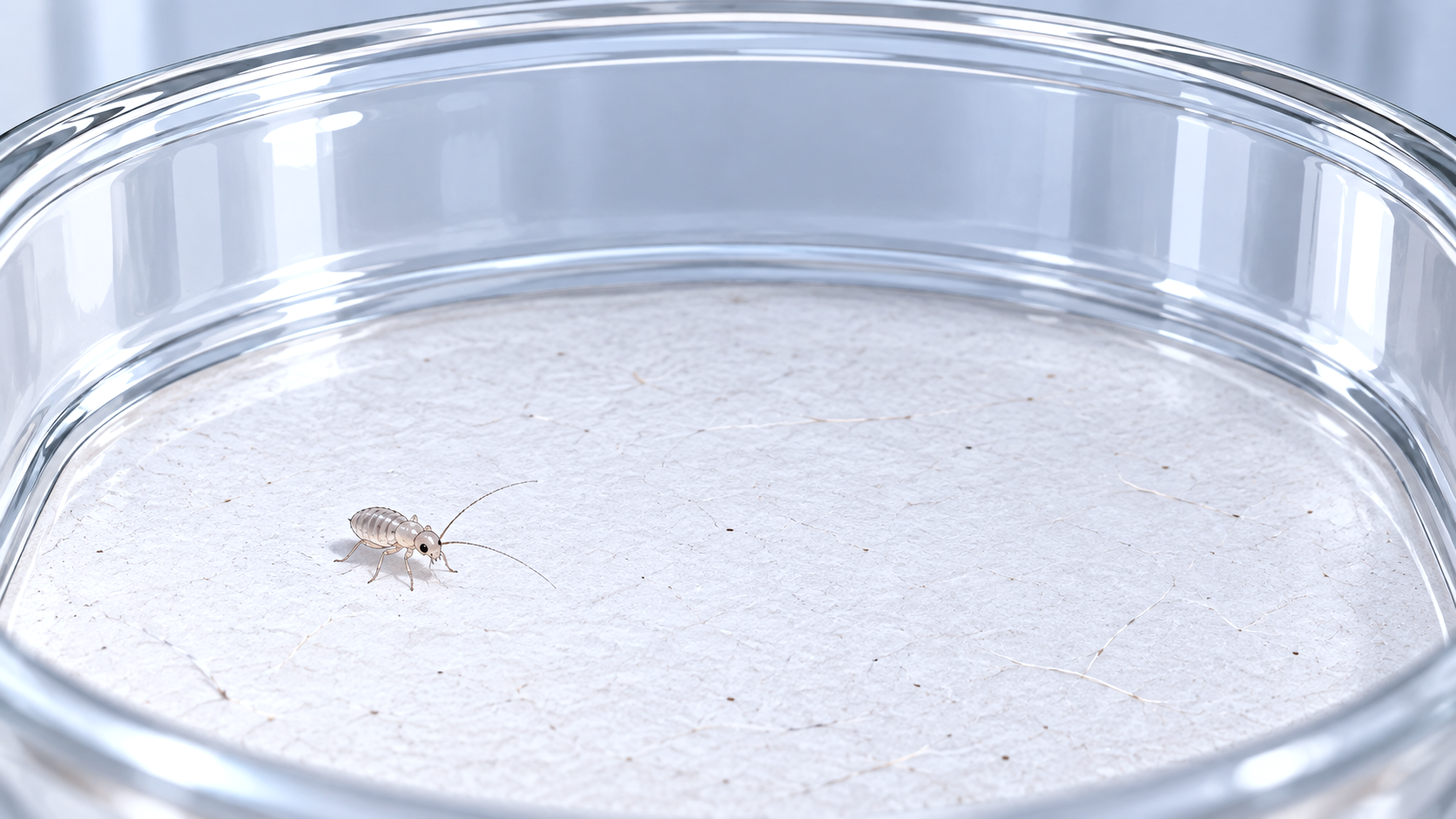
Booklice can survive surprisingly long periods without food. Laboratory research on Liposcelis bostrychophila found that adults could live for up to about two months without food at around 20°C when relative humidity stayed above 60%. Under still more humid conditions, survival can exceed 100 days. Lack of food alone is therefore a poor way to eliminate an infestation.
Starvation Is Not the Immediate Weak Point You Might Expect
Removing an obvious food source does not necessarily cause booklice to die within a few days. Experiments with the common stored-product booklouse Liposcelis bostrychophila found survival approaching two months without food under household-like temperature and humidity. Other summaries of the same biology report survival beyond 100 days when relative humidity exceeds 70%, showing how strongly environmental moisture changes the outcome.
Those figures apply to a particular species under controlled conditions rather than every booklouse in every room. Booklice comprise numerous species with different tolerances, and temperature, age, humidity, physiological condition, and life stage can alter survival. A precise household countdown such as “booklice die after 60 days without food” would therefore be misleading. The useful point is that some common indoor booklice tolerate prolonged starvation far better than their tiny size suggests.
Their normal booklice diet includes fungi, molds, grains, starches, and other organic material, but temporary loss of those foods does not immediately exhaust a healthy adult.
Humidity Can Matter More Than Whether Food Is Available
The longest starvation survival occurs when booklice can maintain their body water. Liposcelis species are able to absorb water vapor from sufficiently humid air, allowing them to replace water lost through their body even while no food is available. Canadian conservation data describe indoor psocids as capable of maintaining water balance above their critical relative humidity, while prolonged exposure below that threshold eventually depletes their internal water reserves.
This produces a counterintuitive result: a booklouse with no food in a humid crack may outlive one surrounded by potential food in air that is too dry. Controlled tests on four stored-product psocid species found complete adult mortality within days to roughly two weeks at 43% or 50% relative humidity, depending on the species and humidity treatment. L. bostrychophila adults lasted longest in that experiment but still reached 100% mortality within 12 days at 50% RH.
The strong connection between survival and booklice humidity requirements explains why removing food while leaving a damp wall void, cupboard, or storage box unchanged can produce disappointing results.
Cooler Conditions Can Extend Fasting Survival
Temperature also changes how quickly a starving booklouse uses its stored energy. The starvation experiments with L. bostrychophila found greater survival at lower temperatures, provided humidity remained favorable. Cooler insects generally operate at a lower metabolic rate, allowing their reserves to last longer than they would under warmer conditions.
This does not mean cold temperatures always protect booklice. Temperatures outside their viable range eventually become harmful, and development and reproduction respond differently from adult starvation survival. The broader question of how long booklice normally live therefore cannot be answered by adding a starvation figure to their usual lifespan.
A cool, humid storage room is nevertheless capable of preserving unfed insects for longer than a warm, dry room. Food availability, temperature, and atmospheric moisture interact rather than working independently.
Removing Visible Mold May Leave Other Food Behind
Starvation is difficult to create in an occupied building because booklice eat more than one substance and can exploit microscopic resources. A shelf may look clean after visible mold is removed while still containing fungal material in cracks, cardboard fibers, wall surfaces, bindings, or nearby damp materials. Booklice also show documented preferences for foods containing yeast and suitable cereal substrates, so a household environment rarely offers the perfectly food-free conditions used in starvation experiments.
The close relationship between booklice and microscopic mold growth makes visual inspection especially unreliable. A person may believe the insects have nothing left to eat simply because no fuzzy mold patch or exposed food is visible. Fungal material can persist at a scale that is difficult to recognize without magnification.
Stored foods create the same complication. Flour dust, crumbs, damaged grains, packaging residues, and fungal contamination can supply enough organic material that true starvation never occurs.
Starved Booklice Can Resume Reproduction After Feeding Again
Surviving starvation does not necessarily leave the insect permanently unable to reproduce. In the classic starvation experiments, unfed L. bostrychophila females returned to normal egg production within about a week after food and favorable conditions were restored. Their ability to recover means a dormant-looking population can regain reproductive momentum after reaching a suitable food source.
That recovery helps explain why removing one food item does not always end an infestation. Adults hidden elsewhere can survive a period of deprivation and later exploit newly available fungi, stored products, or organic residues. L. bostrychophila also reproduces parthenogenetically in many populations, while its rapid development and high reproductive capacity allow populations to increase quickly once favorable food returns.
The complete booklice life cycle still depends on successful development of eggs and nymphs, so long adult starvation survival should not be interpreted as every life stage surviving equally well without resources.
A Sealed Empty Room Is Not Automatically Food-Free
Leaving an infested room unused does not reliably starve booklice. They do not require human food scraps or a person to remain present. Microscopic fungi can grow on damp paper, cardboard, wood, plaster, wall surfaces, stored belongings, and other materials, while individual insects may persist for extended periods even if those food sources temporarily disappear.
The same principle applies to empty cupboards. Removing all packaged food may be appropriate when a pantry product is infested, but a humid cabinet can still contain fungal material and surviving insects in seams or cracks. Indoor booklice naturally occupy warm, damp, relatively undisturbed places, making an unused but humid space potentially more favorable than a frequently cleaned dry one.
Repeated insects after a cupboard has been emptied may therefore reflect survivors or an overlooked source rather than proof that booklice can live indefinitely without eating.
Food Removal Works Best When the Habitat Changes Too
Food reduction is useful when a clear source exists. Infested stored products can be discarded, food residues cleaned away, damp cardboard removed, and visibly fungal material handled appropriately. Those actions reduce what remains available to the population.
Drying the habitat has a different effect because it attacks a physiological requirement rather than waiting for starvation. Booklice that can survive many weeks without feeding under humid conditions die much faster when the atmosphere itself becomes unsuitable. A management approach built around removing the conditions that sustain booklice therefore does more than simply deprive them of one meal.
A falling population after drying also provides better evidence that the habitat has changed. Continued signs of an active booklice infestation despite removal of obvious food should prompt another look for damp microhabitats and concealed fungal growth rather than an assumption that starvation just needs more time.
Questions About Booklice Surviving Without Food
Can booklice survive a month without food?
Yes. Liposcelis bostrychophila can survive well beyond a month under sufficiently humid, moderate-temperature conditions.
Can booklice live longer without food than without water?
For common indoor species, maintaining body water is generally the more immediate survival constraint. High humidity can allow prolonged starvation, while low relative humidity can kill psocids within days or weeks even when potential food is nearby.
Will putting books in an empty sealed container starve booklice?
Not reliably. Booklice may already have fungal or starchy material available within the books or debris, and adults can tolerate extended periods without feeding. A sealed container can also preserve humidity if damp materials are enclosed.
Do baby booklice survive without food as long as adults?
Survival varies by life stage and species. Research on dehumidification shows different tolerances among eggs, young nymphs, and adults, so the adult starvation figure should not be automatically applied to baby booklice.
Can booklice live without mold?
Yes. Mold is an important food, but booklice are not exclusively mold feeders. Depending on the species, they can consume yeasts, grains, starches, insect fragments, and other suitable organic material.
Will removing every visible food source eventually kill them?
It can reduce the population, but visible food removal alone is not a dependable control method because some booklice can endure prolonged starvation and microscopic food sources are easy to miss. Sustained drying creates a much less survivable environment than attempting to maintain perfect food deprivation.