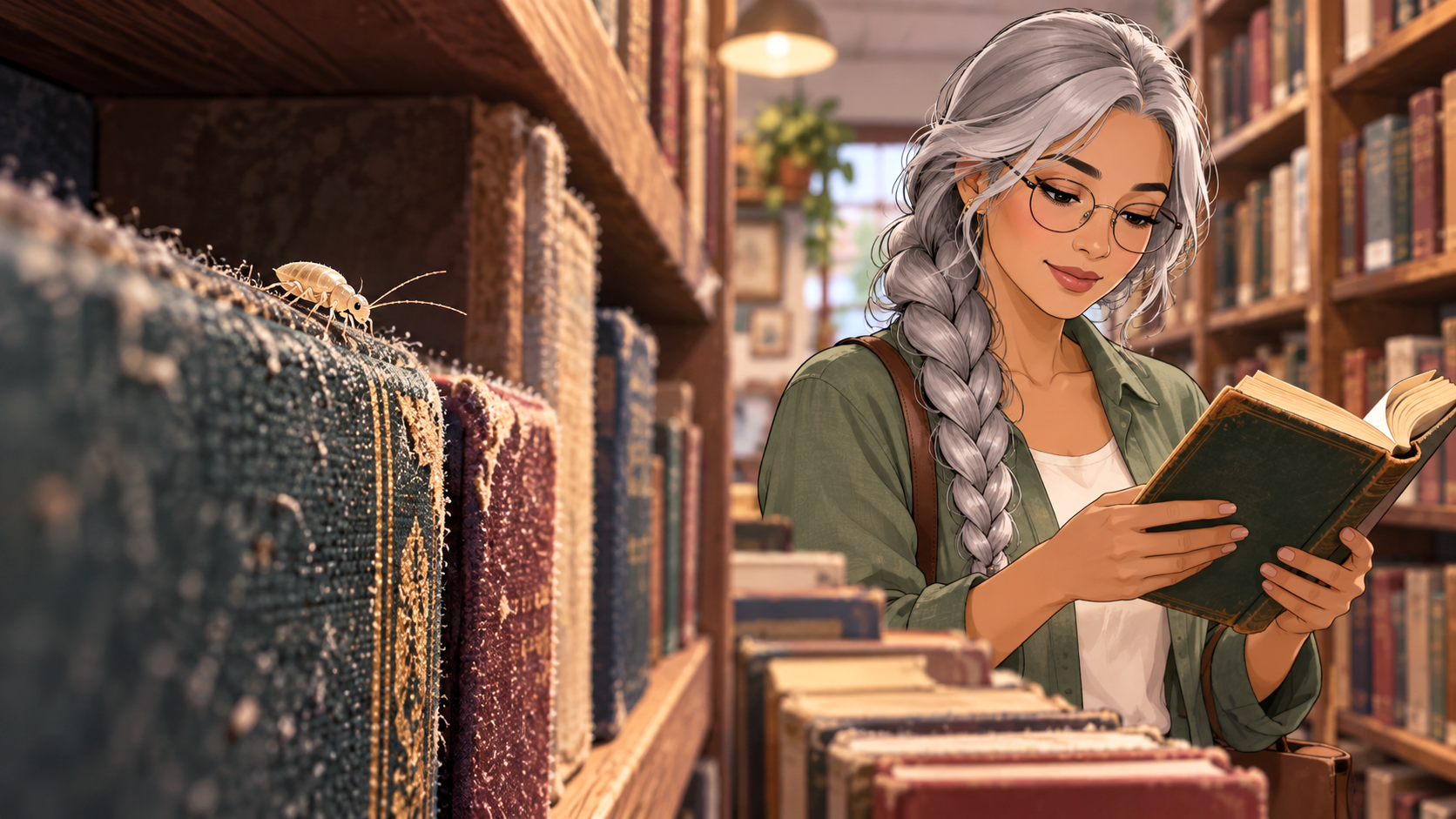
Booklice can hitchhike home in library books, secondhand books, boxes of books, and other paper materials. The risk is greatest when books have spent time in humid storage or show signs of dampness or mold. Borrowing or buying a normal dry book does not mean you are likely to start a household infestation.
The Previous Storage History Matters More Than Whether a Book Is Used
A secondhand book may have passed through a dry home, a humid basement, a warehouse, a storage unit, a donation center, and a shop before reaching you. Those environments are not equally favorable to booklice. Psocids are strongly associated with damp paper collections because high humidity supports fungal growth, their major food source, and conservation guidance specifically identifies books and paper kept under humid conditions as susceptible to booklice.
Age and ownership are poor predictors by themselves. A fifty-year-old volume that has remained in dry, climate-controlled storage can present less booklice risk than a nearly new book left for months in a wet cardboard box. Libraries likewise vary enormously in their buildings, environmental controls, storage rooms, and collection condition. The transfer question is therefore about the individual book and its history, not a blanket risk attached to libraries or used bookstores.
Booklice Can Travel in More Than the Pages
A transported booklouse does not have to sit visibly between two pages. Hardcover joints, spine gaps, dust jackets, binding materials, pasted endpapers, page edges, and the space between books packed tightly together all create protected areas for tiny insects. Booklice associated with collections commonly feed on mold growing on paper and on susceptible starchy materials such as binding glue, while damp books are a recognized psocid habitat.
Boxes create another route. A group of dry books placed inside damp cardboard may acquire insects from the container rather than from the books themselves. Booklice are specifically known to occur in cardboard boxes, manuscripts, books, and other collection materials. This makes a boxed estate collection from a basement or garage a more plausible transport scenario than one clean hardcover borrowed briefly from a dry library shelf.
The same mechanism forms part of the wider range of ways booklice can enter a house, although this page is concerned only with books as the vehicle.
Bringing One Home Does Not Mean Your House Will Become Infested
Transport and establishment are separate events. A book may carry one adult, a nymph, or even an egg without creating a permanent population after it reaches your home. Booklice require enough environmental moisture to survive successfully, and their populations decline when conditions remain sufficiently dry. Canadian conservation guidance describes indoor psocids as highly dependent on relative humidity, with prolonged dryness eventually killing them.
A dry bookshelf in a climate-controlled room therefore acts very differently from shelving against a damp basement wall. The biological reason behind booklice needing high humidity determines whether a transported insect merely survives briefly or finds conditions suitable for continued development.
This is one reason a person can handle thousands of library books over many years without experiencing a booklice infestation at home. Exposure opportunity alone is not enough.
Damp or Musty Books Deserve More Attention
A used book with obvious water staining, active mold, a persistent musty odor, softened covers, swollen pages, or prolonged storage in a damp environment presents a different situation. Mold growth provides potential food, while moisture helps the insects themselves maintain water balance. The Library of Congress recommends keeping books in a relatively dry environment because relative humidity above about 60% increases the risk of mold growth.
Booklice can exploit fungal material before a book develops dramatic visible mold. Their association with mold does not require a large visible colony, so absence of fuzzy growth is not absolute proof that a previously damp volume has never supported them.
Visible live insects provide stronger evidence than odor alone. If tiny pale or tan insects repeatedly emerge from the binding or crawl among several books from the same box, isolate those materials from the rest of the collection while you identify what is present.
Library Books Are Not Automatically a Booklice Risk
Public and academic libraries are not natural reservoirs that make every borrowed book hazardous. Professional collections generally aim to control humidity, monitor pests, and store books under conditions that protect paper from moisture and mold. The Library of Congress recommends cool, relatively dry book storage with approximately 30% to 55% relative humidity, conditions that also make sustained booklice activity less favorable.
Problems can still occur in any institution after leaks, floods, HVAC failures, damp storage, or movement of affected materials. Museums and archives use integrated pest-management programs partly because books, manuscripts, cardboard, and other organic collections can occasionally harbor insects. National Park Service collection guidance treats environmental monitoring and pest inspection as central parts of protecting museum materials.
A book’s library label therefore tells you almost nothing about whether it currently contains booklice. Its physical condition and storage environment are more informative.
Booklice on a Used Book Do Not Mean the Pages Are Being Destroyed
Their common name makes the insects sound like specialized paper eaters, but household booklice are primarily surface grazers associated with fungi and suitable starchy materials. They do not normally chew large holes through books. Conservation guidance notes that psocid feeding is largely restricted to surface grazing rather than boring through objects.
The separate issue of whether booklice eat paper and books depends heavily on the material present in bindings, adhesives, and fungal growth. Likewise, booklice damage to books is usually far less dramatic than damage caused by silverfish, beetle larvae, or termites.
A damp, moldy secondhand book may therefore be worth attention even when there is almost no direct insect feeding damage, because the moisture and fungal deterioration can be more consequential than the booklice themselves.
Inspect the Binding and the Other Books That Traveled With It
A sensible inspection concentrates on protected areas rather than flipping rapidly through every page. Look along the spine, beneath the dust jacket, around pasted endpapers, inside damaged binding gaps, and around the edges of books that were stored tightly together. Also inspect the box, wrapping, and neighboring books from the same source.
Finding one unidentified speck is weak evidence. An intact specimen showing the typical booklouse body shape, especially alongside smaller nymphs, is much more useful. Repeated insects emerging from the same group of books fit the signs of an established booklice problem better than a single wandering individual.
For incoming personal collections, keeping questionable books temporarily separate from established shelving can also prevent any overlooked insects from immediately dispersing among other materials. The broader measures for preventing booklice from getting into stored books are most useful when large secondhand collections or books from damp storage are involved.
Questions About Booklice From Used and Library Books
Can booklice stay inside a book while you carry it home?
Yes. Their small, flattened bodies allow them to remain in binding gaps, beneath covers, around page edges, or among books packed together during transport.
Can booklice eggs come home in a used book?
They can. Booklice lay extremely small individual eggs on suitable substrates, so eggs may be much harder to notice than active insects.
Should every secondhand book be quarantined?
No. Routine quarantine of every clean, dry used book is unnecessary. Extra separation is more reasonable for books from damp storage, visibly moldy collections, or lots where live insects are already present.
Can one borrowed library book infest an entire house?
It is biologically possible for transported insects to establish if suitable species and environmental conditions coincide, but a dry home is far less favorable. One borrowed book should not be treated as an automatic infestation risk.
Should a book with booklice be thrown away?
Not necessarily. Ordinary books can often be retained if the insects and moisture problem are addressed. Valuable or irreplaceable books deserve more cautious handling, especially when mold is also present.
Can freezing a used book kill booklice before shelving it?
Low-temperature treatment can kill insect pests when the material, temperature, duration, packaging, and freezing process are appropriate, but not every book is suitable for improvised freezing. The Library of Congress notes that freezing is among the methods used for infested books, while the specific question of whether freezing kills booklice depends on achieving conditions lethal to all relevant life stages.
What should you do if several used books contain booklice?
Keep the affected group away from the rest of your collection, inspect the box and surrounding storage area, and determine whether the books are damp or mold-affected. If insects continue appearing after the materials are dry, the wider approach to eliminating booklice should focus on the environment supporting them rather than treating the books as the only possible source.