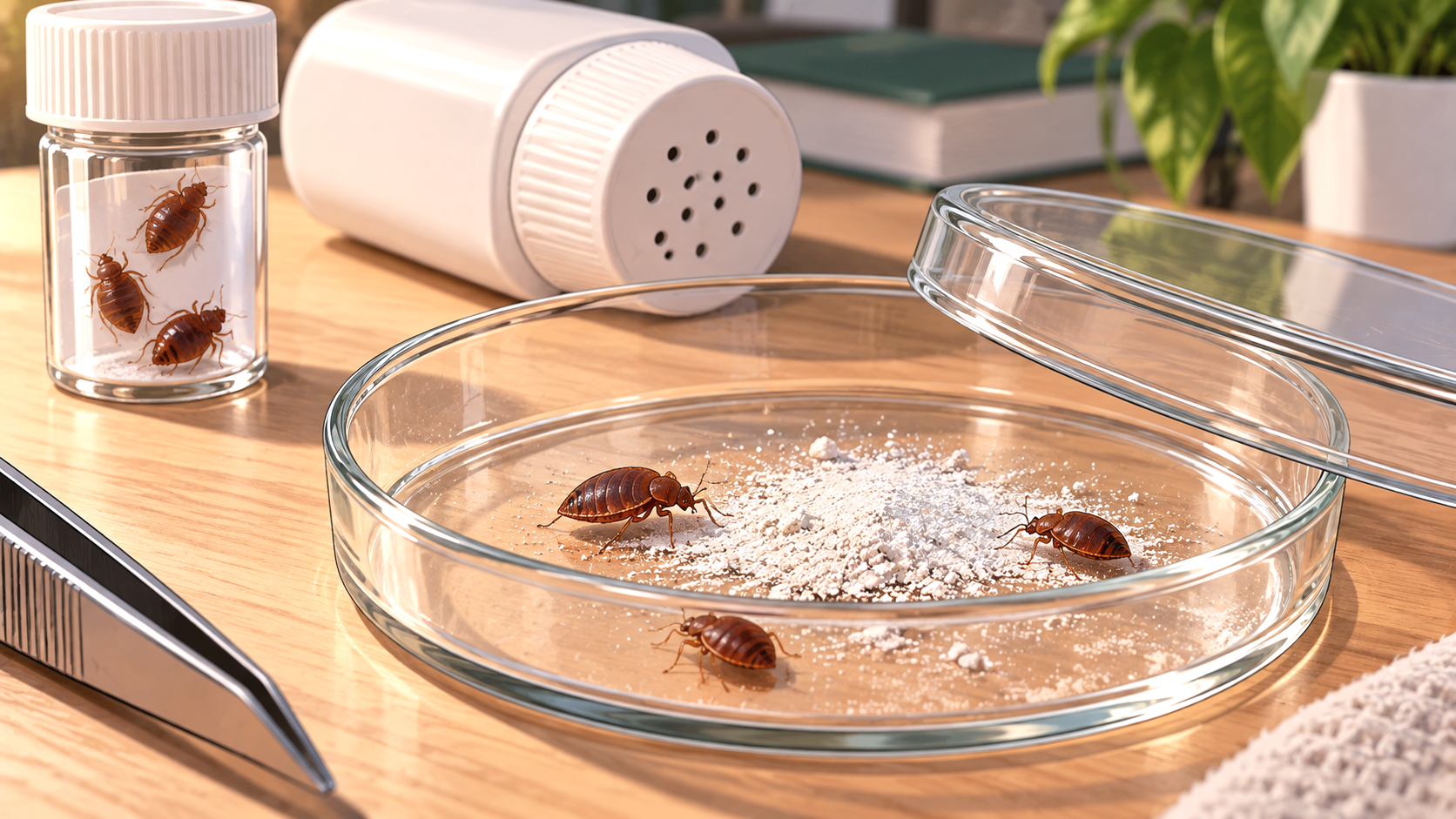
Among currently available bed bug powders, CimeXa is the strongest overall choice because its amorphous silica kills through desiccation, works against pyrethroid-resistant bed bugs, performs well after brief contact, and can remain effective for years when left dry and undisturbed. Pesticide-grade diatomaceous earth is a reasonable alternative when a registered DE product is preferred, while chemical dusts such as Alpine D and DeltaDust have narrower advantages.
Best Bed Bug Powders at a Glance
| Powder | Best Use | Active Ingredient | Main Limitation |
|---|---|---|---|
| CimeXa Insecticide Dust | Best overall | 92.1% amorphous silica | Very light dust requires careful application |
| Pesticide-grade diatomaceous earth | Best simple desiccant alternative | Diatomaceous earth | Usually slower and product quality varies |
| Alpine D Dust | Best combination-style dust | Dinotefuran plus silica-based carrier | Less impressive than CimeXa in comparative bed bug testing |
| DeltaDust | Best moisture-resistant chemical dust | 0.05% deltamethrin | Pyrethroid resistance can sharply reduce bed bug control |
| Tempo 1% Dust | Best specialist pyrethroid dust | 1% cyfluthrin | Intended for professional/commercial applicators and vulnerable to pyrethroid resistance |
The strongest powder for a particular crack or void is not necessarily the best treatment for the entire infestation. Powders are residual tools, and a complete bed bug treatment strategy usually assigns different methods to different harborages.
CimeXa Is the Best Bed Bug Powder Overall
CimeXa Insecticide Dust contains 92.1% silicon dioxide in the form of synthetic amorphous silica. Bed bugs crossing a treated surface pick up microscopic particles that remove protective waxes and oils from the cuticle, accelerating water loss until the insect dies. Unlike pyrethroids and neonicotinoids, this physical action does not depend on a vulnerable nerve receptor, which makes it particularly useful against populations resistant to conventional insecticides.
Its advantage over competing powders is supported by comparative research rather than manufacturer claims alone. When researchers tested eight commonly used dust formulations under continuous, choice, and brief-exposure conditions, CimeXa was the only product that produced 100% mortality in every exposure method. Competing dusts, including cyfluthrin, deltamethrin, dinotefuran plus diatomaceous earth, and pure DE, produced no more than 65% mortality following brief exposure. Bed bugs exposed to CimeXa could also transfer enough dust to untreated bugs to cause substantial secondary mortality.
Speed provides another advantage. A study comparing silica gel with DE against susceptible and highly pyrethroid-resistant common bed bugs found 100% mortality from both at label rates, but CimeXa killed in about three to four days while DE required about 14 days. The resistant bugs were somewhat more tolerant at reduced CimeXa rates, reinforcing the need for adequate deposition rather than proving the dust had lost its usefulness.
CimeXa also has unusually broad label flexibility. Current manufacturer instructions permit appropriate applications to cracks, crevices, voids, bed frames, box springs, upholstered furniture and specified mattress locations, including brush and wettable-dust application methods. Only a light film is needed. Visible piles waste product and increase airborne dust without improving control.
Pesticide-Grade Diatomaceous Earth Is the Best Alternative Desiccant
Diatomaceous earth can kill bed bugs without relying on neurotoxic chemistry, making it useful where resistance to the main chemical classes used against bed bugs is a concern. Effective DE damages the protective surface of the insect and causes progressive dehydration after contact.
DE should not be dismissed simply because CimeXa usually acts faster. Laboratory testing of an appropriate commercial DE product against tropical bed bugs produced 100% mortality after two days of exposure, and extended field work showed substantial suppression when DE and steam were used against naturally occurring infestations.
Product selection is unusually important with DE. Powders sold for food handling, swimming pools, animal care, or miscellaneous household uses are not interchangeable with a registered bed bug pesticide. EPA specifically warns against using food-grade or pool-grade diatomaceous earth for bed bug treatment because products intended for other purposes have not been registered for this application and may create additional inhalation concerns.
DE also tends to be less forgiving of brief encounters. Bed bugs do not necessarily remain inside a treated band long enough to acquire a heavy coating, and behavioral research has found that bugs can hesitate before entering some DE-treated areas. That gives lighter, highly adherent amorphous silica an advantage in the short contacts typical of real rooms.
Alpine D Dust Is More Interesting for Its Chemistry Than Its Comparative Performance
Alpine D Dust combines 0.25% dinotefuran with a predominantly silica-based carrier. Dinotefuran is a Group 4A neonicotinoid, so the product does not depend on the same sodium-channel target attacked by pyrethroid powders. Its current label lists bed bugs and permits indoor crack, crevice, void, and spot applications in homes, hotels, apartments, and other structures. The current Alpine D product information confirms bed bugs among its labeled pests.
That chemistry sounds attractive on paper, but independent bed bug comparisons have not placed Alpine above CimeXa. In the brief-exposure dust study, the dinotefuran/DE formulation failed to match the silica gel treatment. Long-term residual testing likewise found substantially weaker bed bug control from Alpine Dust than CimeXa after treated surfaces had aged.
Alpine D therefore makes more sense when its broader pest spectrum or neonicotinoid chemistry fits a professional treatment plan than when the sole objective is choosing the strongest residual bed bug powder.
DeltaDust Has a Moisture Advantage but a Resistance Disadvantage
DeltaDust contains 0.05% deltamethrin, a pyrethroid. Its current label lists bed bugs, allows indoor and outdoor use, and states that the dust does not clump or absorb moisture. DeltaDust is labeled to provide residual crawling-insect control for up to eight months when left undisturbed, which can make it convenient in protected voids where dampness would compromise a desiccant.
For bed bugs specifically, however, deltamethrin resistance limits the appeal. Pyrethroid resistance is widespread, and EPA notes that resistant populations may survive or simply relocate after exposure to pyrethrin and pyrethroid treatments. Desiccants avoid that specific vulnerability because they destroy the protective outer coating rather than attacking the nervous system.
A pyrethroid dust can still kill susceptible bed bugs, but there is little reason to make DeltaDust the default choice when resistance status is unknown and a proven silica desiccant can occupy the same residual role.
Tempo 1% Dust Is a Specialist Option, Not the Best Homeowner Pick
Tempo 1% Dust contains 1% cyfluthrin, another Group 3A pyrethroid. The current label lists bed bugs and specifies use by pest-management professionals and commercial applicators. Its specimen label identifies cyfluthrin as the sole active ingredient.
Its strengths are broad professional pest labeling and residual application in hard-to-reach sites. Its weakness for bed bugs is the same one affecting other pyrethroid-only products: a resistant population can substantially reduce mortality. Comparative dust testing also placed 1% cyfluthrin behind silica gel when insects experienced only brief exposure.
Tempo can have a place in a professional program where susceptibility, site restrictions, and other treatments are being considered together. It is difficult to justify as the first powder to purchase specifically for bed bugs when CimeXa offers stronger evidence against resistant populations.
A Powder Works Only Where Bed Bugs Eventually Contact It
Residual longevity is useful only if insects pass through the deposit. Bed bugs can occupy mattress folds, screw holes, hollow furniture, wall junctions, upholstery, and other protected spaces, and their ability to hide in extremely narrow harborages means indiscriminately dusting a bedroom floor provides poor coverage of the locations that matter.
Use the powder only where its label permits, applying a thin film in selected cracks, crevices, voids, furniture joints, or other identified travel paths. Thick white bands are unnecessary and can encourage avoidance while increasing the chance that particles become airborne. A hand duster or small brush provides much better control than shaking powder directly from a large container.
Existing bugs and debris can be removed before residual treatment, since vacuuming can physically reduce exposed bed bug numbers. Once a dust has been placed, repeatedly vacuuming the same cracks removes the residual treatment as well.
Keep Desiccant Powder Away From Moisture
Silica gel and DE are most useful in dry locations. Steam, washing, persistent humidity, and other moisture can reduce how effectively particles remove protective lipids from an insect. Controlled experiments found that steam exposure significantly reduced the efficacy of CimeXa, Alpine, and Tempo dust, while prolonged high humidity also weakened aged CimeXa deposits.
When both methods are part of treatment, complete steam treatment of suitable bed bug harborages before applying desiccant dust nearby, then allow the surfaces to dry. Putting fresh powder down and immediately steaming over it wastes the residual treatment.
Wall voids, protected frame cavities, dry baseboard cracks, and other locations unlikely to be washed or disturbed are generally better residual sites than exposed flooring or damp surfaces.
Do Not Judge a Powder by How Much of It You Can See
A barely visible coating can be more effective than a pile because bed bugs need particles to adhere to their bodies as they walk through. Excess product does not accelerate the physiological process once a lethal quantity has been acquired.
Heavy applications also create avoidable human exposure. EPA advises limiting bed bug desiccants to labeled crack-and-crevice uses and using only products registered as pesticides. Powders should never be scattered across pillows, sheets, clothing, children’s play areas, or other occupied surfaces merely because bed bugs might cross them.
Dust treatment should be matched to the infestation’s actual distribution. A few localized harborages can be treated much more precisely than a severe infestation spread through multiple furnishings or rooms, where residual powder alone is unlikely to reach every population pocket.
CimeXa Is the Strongest First Choice for Most Bed Bug Dust Applications
For a bed bug-specific purchase, the available evidence gives CimeXa the clearest advantage: fast desiccant activity, strong performance after brief exposure, usefulness against resistant strains, long residual life in dry undisturbed areas, and a bed bug label flexible enough for common harborages. Pesticide-grade DE remains a legitimate alternative but generally works more slowly. Alpine D, DeltaDust, and Tempo offer specialized chemical options without surpassing silica gel as the general first choice.
Powder should still be evaluated by what happens to the infestation rather than by how long the residue remains visible. Continuing live insects, trap captures, fresh spotting, or other new signs of bed bug activity indicate that additional inspection or treatment is required.