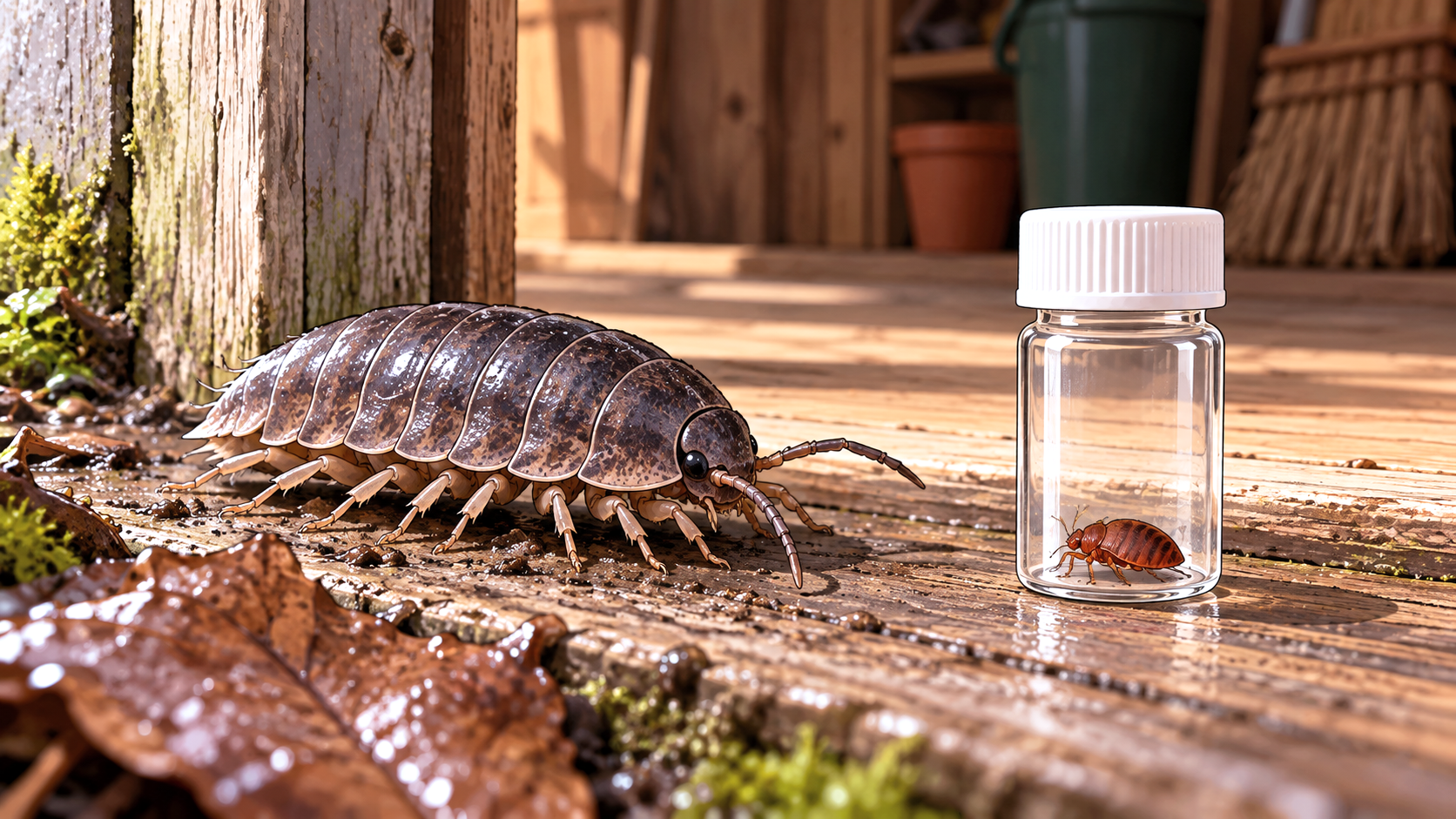
Woodlice and bed bugs may both appear as small brown or gray crawling creatures indoors, but they are very different animals. Woodlice are land-dwelling crustaceans with seven pairs of legs and hard overlapping body plates. Bed bugs are six-legged insects with soft-looking, flattened oval bodies that feed on blood. A specimen with obvious armored segments and more than six legs is not a bed bug.
Count the Legs and Look at the Back
Woodlice have 14 walking legs, arranged as seven pairs beneath a distinctly segmented body. Penn State describes terrestrial isopods as having seven pairs of legs, two antennae, and a hard segmented outer shell. Their upper surface is divided into visible overlapping plates, producing the armored appearance familiar in sowbugs and pillbugs. Depending on the species, adults may be gray, slate-colored, brown, or mottled.
Bed bugs have only six legs because they are true insects. Adults are generally 5–7 mm long with a broad, flattened abdomen and no series of hard dorsal plates resembling a woodlouse. EPA describes adult bed bugs as flat, oval, wingless insects, reddish-brown before or after feeding depending on how recently they have taken blood. Their overall proportions are easier to judge against the normal appearance of a bed bug than against color alone.
| Feature | Woodlouse | Bed Bug |
|---|---|---|
| Animal group | Crustacean | Insect |
| Walking legs | 14 | 6 |
| Back | Hard, visibly segmented plates | Flattened abdomen without armored plates |
| Typical color | Gray, brown, slate, mottled | Tan to reddish-brown |
| Main habitat | Cool, damp places | Near sleeping or resting hosts |
| Food | Decaying organic material | Blood |
| Bites people | No | Yes |
| Indoor infestation pattern | Usually accidental moisture-related intrusion | Reproduces around beds and furniture |
Dampness Points Toward Woodlice, Not Bed Bugs
Woodlice depend heavily on moisture. The Natural History Museum explains that they are terrestrial crustaceans whose respiratory structures require moist conditions, which is why they are strongly associated with damp soil, leaf litter, logs, mulch, stones, basements, crawl spaces, and wet foundation areas. Frequent indoor sightings often indicate excess moisture or large outdoor populations close to the building.
University of Minnesota Extension notes that sowbugs commonly enter homes from moist material around foundations and usually cannot survive for long in dry indoor rooms. A gray segmented creature repeatedly appearing around a basement drain, damp bathroom threshold, foundation crack, or wet plant pot therefore fits woodlice far better than bed bugs.
Bed bugs have no comparable dependence on damp conditions. Their distribution indoors is shaped by access to a host. CDC notes that infestations usually occur around places where people sleep or spend long periods, including mattresses, box springs, bed frames, headboards, furniture, and nearby crevices. Moisture around a foundation has little relevance to whether a bed bug population can establish.
Woodlice Do Not Feed on People
Woodlice are scavengers that consume decaying plant material, fungi, and other decomposing organic matter. They do not seek blood meals and are harmless to people. University of Minnesota describes sowbugs as non-harmful indoor visitors that feed on decaying organic material.
Bed bugs are obligate blood feeders. Adults and nymphs take blood from humans and other warm-blooded animals, then retreat into sheltered cracks. CDC describes both major human-associated Cimex species as blood-feeding insects whose immature stages must feed before progressing through development. That feeding biology is fundamental to what bed bugs are and explains why their populations center on beds and furniture rather than decomposing vegetation.
Finding woodlice in a room therefore does not explain unexplained nighttime bites. If bite-like marks are appearing, another cause should be investigated rather than assuming the visible woodlice are responsible.
A Woodlouse Can Roll Up, but Only Certain Species Do It
Some woodlice, commonly called pillbugs or roly-polies, can curl their entire body into a tight ball when disturbed. Penn State notes that this behavior occurs in particular isopod groups rather than in every woodlouse species. Sowbugs generally cannot form a complete ball, although they still retain the unmistakable segmented armor and numerous legs.
Bed bugs never roll into a defensive ball. When disturbed, they crawl away and attempt to enter a narrow crevice. They also lack the rigid shell architecture needed for the behavior. If a suspected “bed bug” curls into a nearly spherical armored shape, identification as a bed bug can be ruled out immediately.
The Evidence Around the Insect Usually Settles the Identification
A woodlouse found alone on a basement floor normally has little surrounding evidence because it has wandered indoors rather than established a blood-feeding harborage. Several woodlice may enter through the same moisture-prone area, but they do not produce the mattress spotting, cast skins, glued eggs, and clustered bugs associated with bed bug infestations.
EPA recommends confirming bed bugs from live specimens, fecal spots, shed skins, eggs, and characteristic hiding sites. Those early signs of bed bug activity are especially useful when a tiny brown organism has been found near a bed but its identity is uncertain.
Where necessary, preserve the specimen rather than crushing it. Counting the legs under magnification is decisive: fourteen belongs to a woodlouse, while six fits a bed bug or another insect. A structured check of the sleeping area can then establish whether there is independent evidence of bed bugs instead of assuming every crawling household arthropod is responsible.
Woodlice Indoors Usually Call for Moisture Control, Not Bed Bug Treatment
Indoor woodlice are often best addressed by correcting the conditions allowing them to enter or survive. Drying damp basements and crawl spaces, repairing leaks, improving drainage, removing wet leaves or mulch from the foundation, and sealing ground-level gaps address the environment that supports them. Persistent live woodlice indoors can serve as an indicator of excessive moisture.
Those measures are fundamentally different from controlling an established bed bug infestation, where treatment must target insects and eggs around human resting areas. Applying bed bug pesticides because woodlice were found near a bedroom wastes treatment and leaves the actual moisture issue unresolved.
For uncertain specimens, identification should come before control. EPA specifically warns that many household arthropods are mistaken for bed bugs and that incorrect identification can lead to unnecessary and costly treatment.