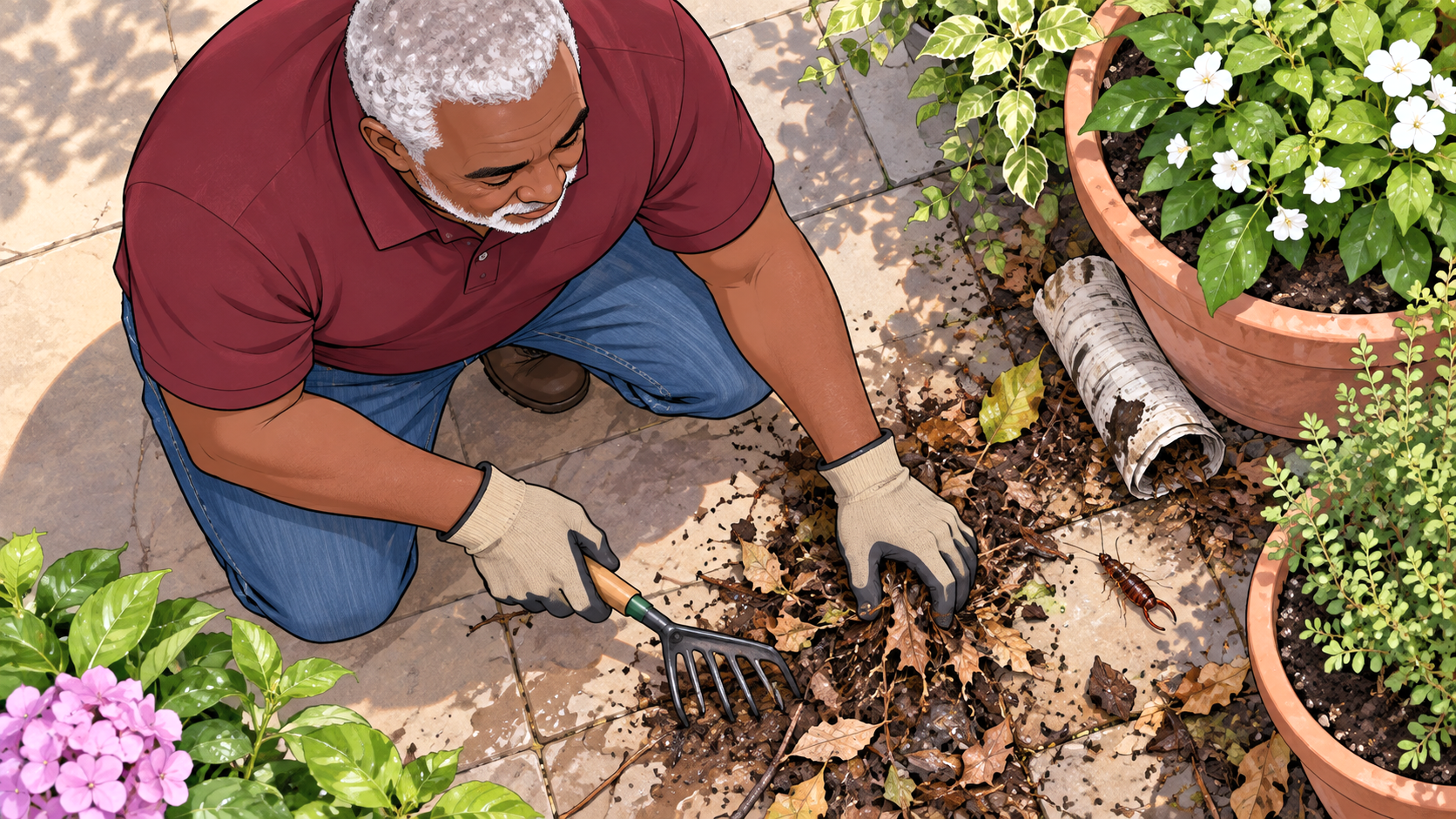
The most effective way to get rid of earwigs naturally is to eliminate damp hiding places, block their entry into your home, and capture them with simple traps. Rolled newspaper, corrugated cardboard, and shallow oil traps can reduce earwig numbers without commercial insecticides. Trapping works best alongside moisture control because earwigs will continue occupying sheltered areas that remain suitable.
A few earwigs outdoors rarely justify extensive control. They consume decaying organic material and sometimes prey on other insects, so removing every earwig from a property is unnecessary. Concentrate on locations where they repeatedly enter the house or cause identifiable problems rather than trying to eliminate them from the surrounding environment.
Start With Moisture and Shelter, Not Homemade Sprays
Earwigs spend daylight hours in protected places where humidity remains relatively high. Stones, boards, dense vegetation, damp mulch, and accumulated leaves can provide these conditions. Their preference for shelter explains why earwigs often appear around houses with moist soil and abundant ground-level cover. Removing or changing these shelters makes an area less accommodating even when no insects are directly killed.
Inspect the foundation perimeter for objects resting on damp soil. Move unused flowerpots, timber, discarded containers, and other materials away from exterior walls. Clear accumulated leaves from corners and avoid letting thick mulch sit directly against the building. Vegetation touching the foundation can create concealed routes, while overgrown groundcover retains moisture. The habitat changes recommended for earwig management focus on reducing these protected spaces before relying on insecticides.
Water management deserves equal attention. Repair dripping outdoor faucets, correct leaking irrigation fittings, and keep downspouts discharging away from the foundation. Where soil stays saturated, address the drainage problem rather than repeatedly removing insects from the surface. Excess moisture around buildings supports the conditions earwigs favor, although irrigation should still meet the needs of nearby plants. The goal is to eliminate unnecessary wetness, not dry out an entire garden.
Rain can temporarily change where earwigs seek shelter. Their appearance after wet weather does not necessarily indicate a new infestation. An increase in sightings is a reason to inspect water accumulation and entry points, particularly when the insects gather repeatedly along the same exterior wall.
Make Simple Earwig Traps From Household Materials
A shelter trap takes advantage of the insect’s preference for narrow, protected spaces during the day. Unlike a scented repellent, it encourages earwigs to collect in a location where they can be removed. These traps require little preparation, although they must be checked regularly because they do not retain insects permanently.
Rolled Newspaper and Corrugated Cardboard
Take a sheet of newspaper or a strip of corrugated cardboard and roll it loosely into a tube. Secure it with string or a rubber band, leaving the ends open so insects can crawl inside. Place the roll horizontally near an established earwig hiding area in the evening. A slightly damp newspaper can make an attractive shelter, but avoid soaking it.
Check the roll the following morning. Earwigs sheltering inside can be shaken into a container for removal. A dry, enclosed container is suitable if you intend to relocate them. For lethal disposal, established physical earwig trapping methods include emptying the insects into soapy water. Keep the container away from children and pets.
Corrugated cardboard offers numerous narrow channels, making it especially convenient where earwigs are gathering along a wall or beneath outdoor objects. The trap can be reused if it stays intact. Replace newspaper that has become waterlogged or deteriorated, since its effectiveness depends on providing an accessible shelter rather than simply remaining damp.
Short Garden Hoses and Bamboo Tubes
An unused section of garden hose or a hollow bamboo cane can serve the same purpose without disposable paper. Lay it near a location where earwigs have been observed, preferably with an opening accessible from the ground. The confined interior provides temporary cover as the insects seek shelter after nighttime activity.
In the morning, hold the tube over a collection container and tap it to dislodge any occupants. Hose sections and rolled paper traps are established approaches to collecting earwigs without applying a pesticide. Their effectiveness depends heavily on placement. A tube placed far from active earwig shelter is unlikely to capture many insects, even when the design itself is suitable.
Oil Traps for Earwigs
A shallow container containing vegetable oil can trap earwigs that enter it. For outdoor placement, sink a small, stable can into the soil so its rim is level with the surrounding ground, then add a shallow layer of oil. Fish oil can increase attraction, but the container should remain shallow enough to inspect and empty easily.
Oil traps differ from shelter traps because the insects become trapped in the liquid. They are therefore unsuitable if your goal is live capture. They can also catch other small animals, so avoid placing open containers where pets, wildlife, or children can reach them. A secure cover with suitable insect access can reduce unintended exposure.
The attraction of earwigs to oil is used in established mechanical trapping recommendations. Adding soy sauce is unnecessary for a basic vegetable-oil trap, although soy sauce and oil earwig traps are another household variation. Empty oil traps regularly and dispose of the contents appropriately rather than pouring used oil onto soil or into drains.
The trap comparison below is based on how each method captures earwigs and the maintenance it requires.
| Trap | Capture method | Main limitation |
|---|---|---|
| Rolled newspaper | Temporary daytime shelter | Insects can leave if not collected |
| Corrugated cardboard | Shelter within narrow channels | Needs frequent inspection |
| Garden hose or bamboo | Reusable enclosed refuge | Does not retain insects |
| Shallow oil container | Attracts and traps insects in liquid | Kills captured insects and can catch non-target animals |
For households concerned about non-target animals, removable shelter traps offer greater control over which insects are collected. Oil traps can capture insects without daily manual removal, but their lethal action and exposure risks make placement more restrictive.
Seal the Openings That Allow Earwigs Inside
Removing the insects already inside a house offers limited relief when new ones can continue entering. Examine exterior door thresholds, torn window screens, gaps where utility lines pass through walls, and cracks along the junction between siding and the foundation. Repair damaged weatherstripping, fit door sweeps where necessary, and seal appropriate openings with exterior-grade caulk. Follow the building’s requirements for ventilation and drainage rather than sealing functional vents or weep holes.
Use a broom or vacuum to collect earwigs already indoors. Empty the vacuum contents into a sealed bag and dispose of them outside. An insecticide application along interior baseboards is not needed for occasional invaders, especially when their access route remains open. Preventing household pest entry through exclusion also avoids unnecessary pesticide exposure around occupants and pets.
Exterior lighting deserves consideration when insects regularly congregate near doorways. Some earwig species are attracted to lights, and earwig responses to artificial lighting are not identical across species. Where lighting contributes to the problem, reducing unnecessary illumination or using less attractive bulbs may decrease insect activity near an entrance. Lighting changes alone cannot seal an accessible doorway or correct damp shelter around the foundation.
Are Vinegar, Essential Oils, and Other Natural Remedies Effective?
Household remedies are frequently promoted as inexpensive alternatives to commercial earwig treatments, but their ability to kill an exposed insect should not be confused with dependable population control. A useful natural method must either remove earwigs, prevent entry, or change the conditions supporting them. Spraying an unpleasant-smelling liquid around the house accomplishes none of those tasks reliably without evidence that it prevents future activity.
Vinegar is primarily a household cleaning ingredient, not an established earwig-control treatment. There is no sound basis for recommending ordinary vinegar sprays as a lasting barrier around foundations or indoor surfaces. Questions about vinegar’s direct effects on earwigs are separate from whether it can prevent an infestation. Its acidity can also damage certain finishes and materials.
Peppermint and other essential oils are similarly marketed as insect deterrents. Their natural origin does not establish reliable repellency against earwigs or make concentrated oils harmless. The proposed use of peppermint oil against earwigs also raises exposure considerations around pets and children. We would not substitute an essential-oil spray for trapping and exclusion, particularly when the source of the insects remains accessible.
Diatomaceous earth is different because insecticidal formulations act physically by damaging the protective waxy layer of an insect’s exterior. However, the material must contact the insect under suitable conditions, and moisture reduces the usefulness of many dust applications. Earwigs commonly occupy damp environments, so diatomaceous earth used against earwigs has placement limitations. Inhalation exposure is another concern. Products sold as natural are not automatically suitable for unrestricted use around people or animals.
Table salt, baking soda, and similar kitchen powders are also poor substitutes for established mechanical controls. Scattering them across entryways does not repair cracks or remove protected shelter. Even when an individual insect reacts to direct exposure, that observation provides no reliable measure of whether the wider earwig problem has been reduced.
Know When Your Nonchemical Control Is Working
A practical assessment requires more than counting dead insects. Place the same type of shelter trap in the same location for several consecutive nights and inspect it each morning. Record the number collected before and after correcting moisture or removing nearby shelter. Consistent trap placement provides a more useful comparison than moving traps around the property every day.
For example, a homeowner could compare catches from three cardboard traps along one foundation wall before and after clearing damp leaves from that area. Keeping the traps, positions, and inspection intervals consistent makes changes easier to interpret. Weather and seasonal activity can still influence the numbers, so an empty trap establishes only that no earwigs were collected there during that inspection.
This monitoring approach follows the broader principles of integrated pest management, which uses observation and prevention to determine whether additional intervention is warranted. Continue removing unwanted insects while checking for fresh activity. If captures remain high, look for a shelter or entry route that was missed instead of adding more homemade sprays.
The most useful endpoint is a tolerable level of activity, not the disappearance of every earwig outdoors. Once unwanted indoor encounters have stopped and troublesome concentrations have declined, regular upkeep of drainage, vegetation, and exterior openings is generally sufficient. Continued heavy intrusion despite those corrections warrants a more detailed inspection, particularly where professional earwig control may be needed to investigate inaccessible moisture or structural entry problems.