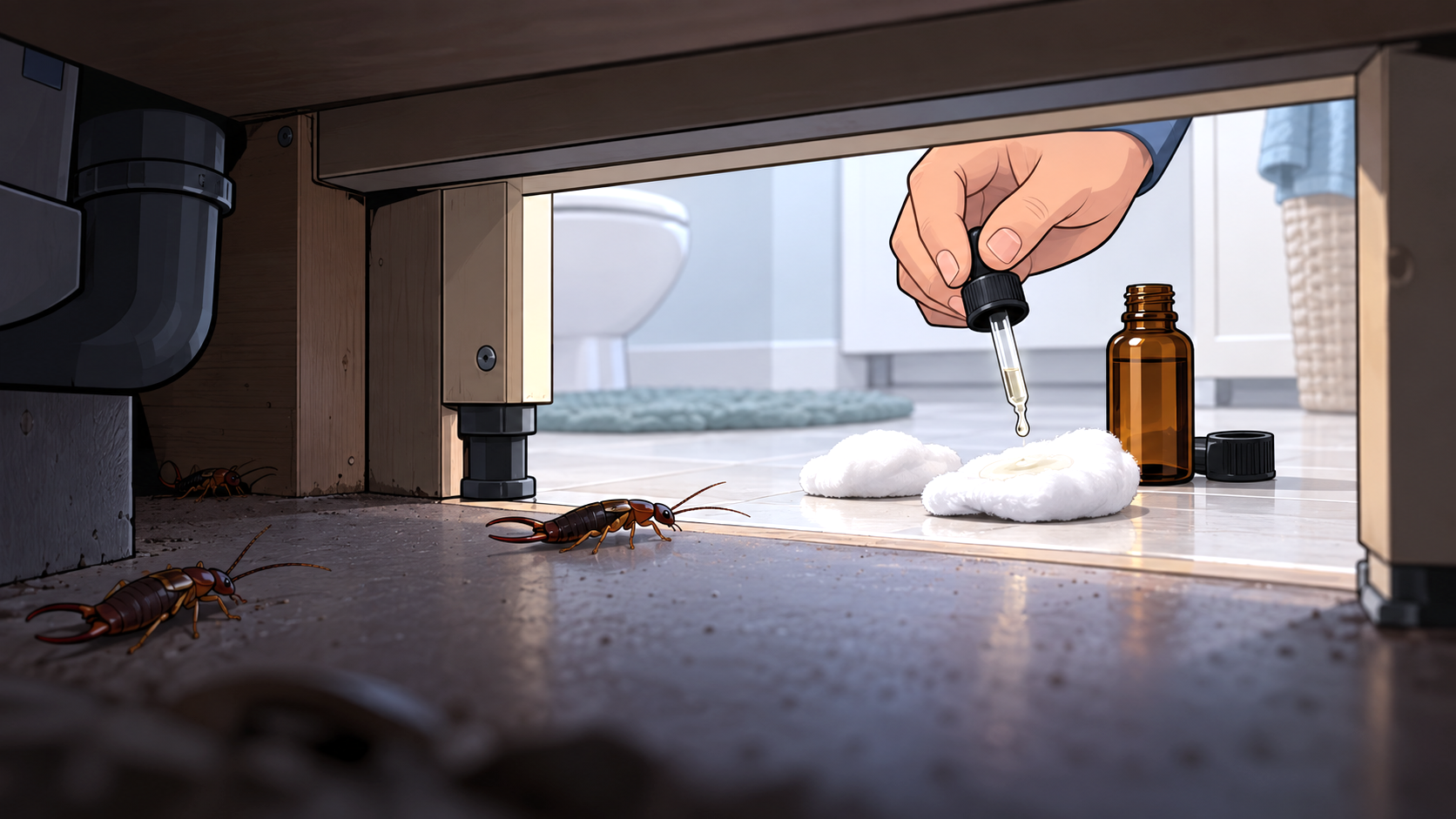
A bottle of peppermint essential oil and an insecticide that lists peppermint oil as an active ingredient may sound like versions of the same thing. For pest control, they are not interchangeable. That difference becomes important when peppermint oil is suggested as an easy way to kill earwigs around a house or garden. Peppermint oil should not be treated as a proven DIY earwig killer. Peppermint oil is an allowed active ingredient in certain minimum-risk pesticide products, and commercial peppermint-based insecticides can be sold for controlling earwigs. That does not establish that ordinary peppermint essential oil, mixed into a homemade spray, will reliably kill them.
The product distinction is more useful than debating whether an earwig might die after being soaked in concentrated oil. A homeowner usually wants control that can be repeated safely and predictably. That is a different standard from showing that a concentrated substance can harm one insect on direct contact.
Peppermint Oil Can Be a Pesticide Ingredient
Peppermint oil occupies an unusual place in pest control. It is an essential oil familiar from household and personal-care products, but it can also function as a pesticide active ingredient. A pesticide is defined by its intended purpose, which can include killing, repelling or otherwise controlling a pest.
Peppermint oil is also included among the active ingredients permitted in certain minimum-risk pesticide products. Products meeting all of the federal exemption conditions do not require the same EPA registration process as conventional registered pesticides. However, the exemption should not be mistaken for proof that every peppermint product works against every insect.
That distinction is particularly important here. Peppermint oil appearing on a list of eligible pesticide ingredients tells us that it can legally serve as an active ingredient in qualifying products. It does not tell us that a few drops of essential oil in a spray bottle have been demonstrated to eliminate European earwigs, Forficula auricularia.
This is where DIY advice often skips a step. An ingredient having pesticidal uses and a homemade mixture being an effective earwig treatment are two separate claims.
Commercial Peppermint Insecticides Are Not the Same as Essential Oil From a Bottle
There are commercial insecticide formulations containing peppermint oil that list earwigs among the insects they kill. That gives peppermint a legitimate connection to earwig control, but the formulation matters.
A commercial product can contain several active ingredients rather than peppermint oil alone. Peppermint may be combined with rosemary oil, geraniol or other pesticidal ingredients. Once multiple active ingredients are involved, the performance of the finished product cannot simply be assigned to one ingredient.
The formulation itself matters as well. A manufactured insecticide has defined ingredients, concentrations, directions and treatment sites. By contrast, household peppermint essential oil was not necessarily sold as a pesticide at all. Turning it into a homemade spray does not transform it into the commercial insecticide whose pest claims appear on a different label.
That is why choosing a pest-control product by its stated use makes more sense than trying to reverse-engineer one from an essential oil. The same distinction matters with neem oil and earwigs, where the name of the botanical ingredient alone does not tell you what a particular formulation can do.
Killing One Earwig Is the Wrong Test
There is an easy trap in evaluating home remedies. Spray an earwig directly with enough concentrated liquid, watch what happens and decide whether the substance “works.” Even when an insect dies, that experiment tells you remarkably little about whether you have found a useful control method.
Earwigs are primarily active at night and spend the day concealed in cracks, crevices and protected refuges. An insect sitting exposed on a floor is therefore the easiest individual in the population to reach. The hidden earwigs creating repeated garden damage or entering a building are the more important control problem.
This difference between an individual kill and actual control is especially relevant to peppermint oil because essential oils are volatile. A strong peppermint smell immediately after application should not be interpreted as proof of lasting protection. Even for skin-applied repellents containing ingredients such as peppermint oil, federal guidance notes that exempt products have not been evaluated by the EPA for effectiveness.
A room smelling intensely of mint therefore does not tell you how many earwigs were affected, whether concealed insects encountered the treatment or whether another one can enter later.
Peppermint Oil Does Not Remove What Is Bringing Earwigs There
Earwig behavior gives us a better way to approach recurring activity. They are associated with protected daytime refuges, and outdoor conditions around a building can provide numerous places for them to hide. When they repeatedly turn up indoors, the long-term question is how they are reaching the interior.
European earwigs do not reproduce indoors, so repeated sightings do not usually point to an indoor breeding population. Physical removal handles insects that have already entered. Sealing access points and changing favorable conditions around the exterior deal with the continuing route.
Peppermint oil cannot seal a door gap, repair a damaged screen or remove a protected refuge beside the foundation. Even if a peppermint-based product affects an earwig that encounters it, those physical conditions remain. For persistent indoor activity, keeping earwigs out of the house addresses the entry problem directly rather than repeatedly scenting the places where they appear.
The same reasoning applies outdoors. Earwigs can be both plant feeders and predators, so finding them in a garden does not automatically justify treatment. First determine whether they are causing unacceptable damage. When control is warranted, trapping and habitat management give you options that directly exploit the way earwigs shelter and move.
Repelling Earwigs and Killing Them Are Different Claims
Peppermint gets particularly confusing because discussions of essential oils often slide between “repels” and “kills.” Those outcomes should remain separate.
A repellent changes where a pest is willing to go. An insecticide kills or otherwise controls the target pest. A substance could potentially do one without doing the other, so evidence for repellency cannot automatically be used as evidence for mortality.
A strong odor disappearing also does not mean a treatment “stopped working” if its effectiveness was never established in the first place. Before repeatedly reapplying an essential oil, decide whether you need to kill earwigs, intercept them, exclude them or protect a particular plant.
Questions about scent-based deterrence are also broader than whether peppermint oil kills an earwig. Smells that may affect earwig behavior should therefore be considered separately from claims that peppermint oil is an effective insecticide.
What to Do Instead of Making Peppermint Spray
For a single earwig indoors, spraying it with homemade peppermint oil adds a treatment step to a problem that can usually be handled by simply removing the insect. Vacuuming or sweeping is direct, and it does not leave essential-oil residue across household surfaces.
Repeated indoor sightings deserve a different response. Look for where the activity is concentrated, then inspect nearby exterior conditions and potential entry points. Repeated appearances in several locations can be among the signs of an earwig infestation worth investigating.
Garden activity should begin with confirming damage, preferably when earwigs are active after dark. If control becomes necessary, refuge traps and oil traps are established options for concentrating and removing earwigs. DIY earwig traps can target their sheltering behavior without relying on an unproven homemade peppermint mixture. A properly selected pesticide is another option when the situation justifies it and the product label covers the pest and treatment site.
If you specifically want a peppermint-based pesticide, buy it as a pesticide rather than treating a bottle of essential oil as one. Read the product’s entire ingredient list and directions, because a peppermint insecticide may contain other active ingredients. That lets you judge the actual formulation instead of assuming the word “peppermint” explains everything the product does.
Other Questions About Peppermint Oil and Earwigs
Can I put peppermint oil around doors to stop earwigs coming inside?
A scented doorway is not a substitute for exclusion. Earwigs can enter through physical openings, so door sweeps, screens and sealed gaps address the route itself. Preventing earwigs from getting into the house provides a more durable approach than depending on an essential-oil odor.
Can I put peppermint oil directly on my plants for earwigs?
Do not apply household peppermint essential oil to plants as though it were a pesticide with established crop directions. When earwigs are damaging plants, use a pest-control product whose labeling permits that treatment site, or use nonchemical controls appropriate to the plant. This is particularly important with edible crops.
Will planting peppermint keep earwigs out of my garden?
Growing a peppermint plant is not equivalent to applying a pesticide containing peppermint oil. The concentration, exposure and formulation are completely different. Peppermint plants should not be treated as a dependable earwig-control barrier. If earwigs are actually damaging plants, getting rid of earwigs in the garden addresses the problem more directly.
Are peppermint-based insecticides automatically safer because they use essential oils?
No. “Essential oil” and “minimum risk pesticide” should not be read as instructions to ignore a product’s precautions. Pesticide risk depends on both hazard and exposure, and the directions for the finished product still matter. Store and apply any pest-control product according to its label.