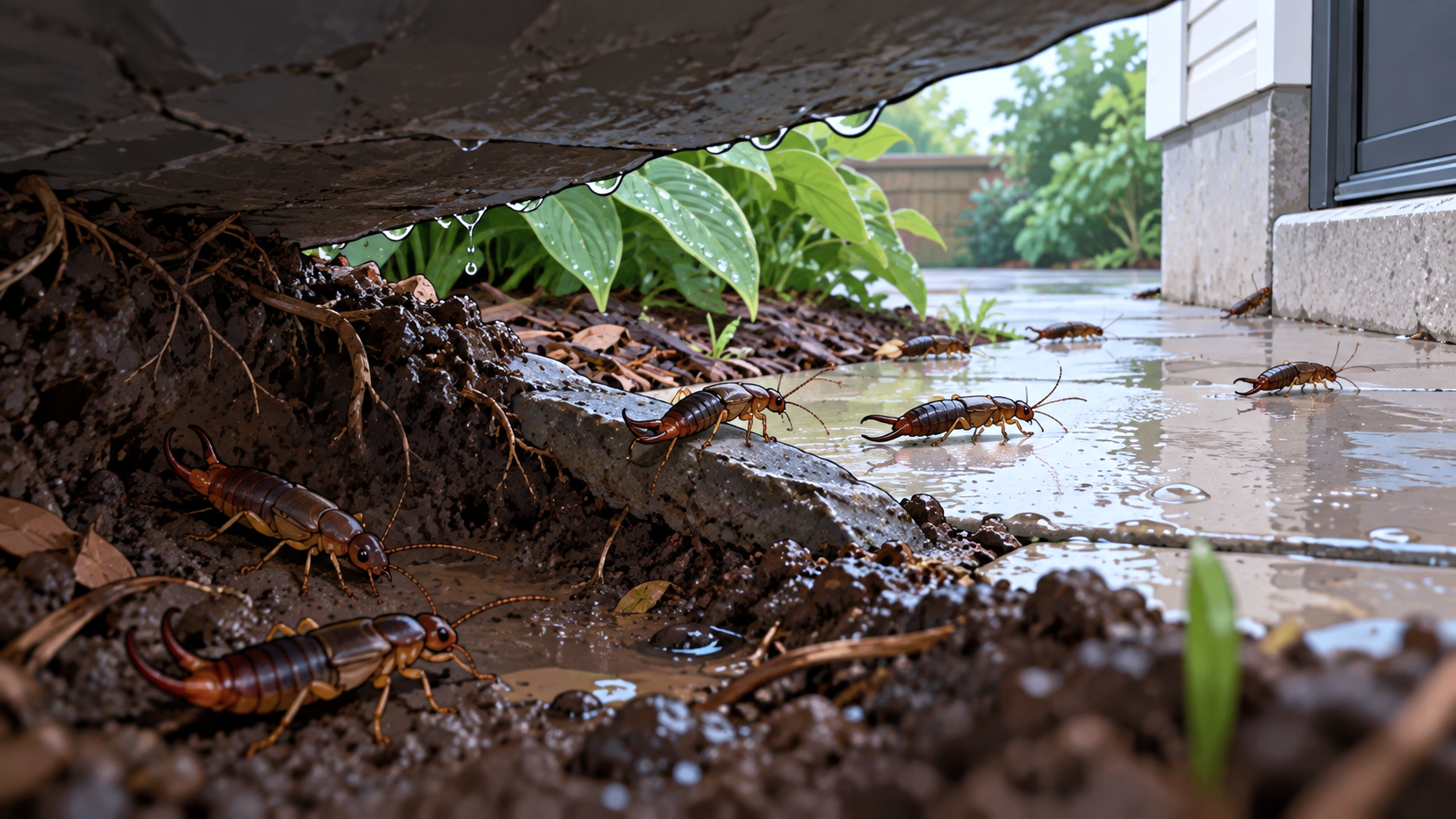
A rainstorm can make it look as though earwigs came down with the rain. The patio was clear yesterday, then the next morning they are under flowerpots, beside the foundation, on the porch or even inside the house. The timing is real, but the rain did not create a new population overnight.
Earwigs can show up after it rains because rainfall changes the moisture and shelter conditions around them. They naturally seek dark, protected, damp places, and wet weather changes which hiding places remain suitable. As earwigs move between shelters and forage after dark, they can suddenly become much easier to notice around yards and buildings.
The useful way to understand the pattern is to think about movement rather than multiplication. A sudden post-rain appearance can involve earwigs that were already living nearby but were hidden before the weather changed.
Rain Changes Where Earwigs Can Hide
Earwigs spend much of the day out of sight. They commonly shelter beneath rocks, boards, mulch, plant debris and other objects that provide a confined space. Moisture is an important part of that habitat. Earwigs favor dark, tight and moist daytime shelters, then leave those refuges at night to forage.
Rain alters those small hiding places across an entire yard at the same time. Soil becomes wetter. Mulch absorbs water. Spaces beneath pots and landscape objects become damp, while water can collect in low areas. The environment that earwigs use at ground level can therefore look very different after a storm than it did during a dry spell.
That helps explain one of the stranger post-rain sightings. You move a flowerpot, board or container the morning after a storm and discover several earwigs beneath it. The object is providing two things they already seek, a tight refuge from daylight and a damp surface underneath.
Earwigs can also congregate rather than remaining evenly distributed across a property. Chemical cues associated with other earwigs help bring individuals together in suitable shelters. Consequently, one good refuge can hold several earwigs while apparently similar ground a few feet away has none.
Rain makes that patchiness much easier to notice.
Heavy Rain Can Also Disrupt the Places They Were Using
Moisture is favorable to earwigs, but that does not mean more water is always better.
There is an important difference between a damp hiding place and a location overwhelmed by water. Earwigs are terrestrial insects, not aquatic animals. Their preference for moist shelter should not be interpreted as a preference for standing water or flooded soil. We make the same distinction when looking at whether earwigs can swim or will drown.
After substantial rainfall, some of the tiny spaces earwigs were using can change dramatically. Water moves through soil, runs beneath landscape materials and collects in depressions. An earwig that remains concealed during normal damp conditions may have to move when its immediate refuge no longer provides usable shelter.
This is where the post-rain effect can become misleading. Seeing an earwig crossing a driveway after a storm does not necessarily mean the driveway attracted it. The exposed surface may simply be part of the route between one protected location and another.
We think this distinction is especially useful because it prevents almost every wet surface from being labeled an “earwig attractant.” Rain changes the landscape, and earwigs respond to those changes by repositioning themselves.
Why Earwigs Sometimes Move Toward the House After Rain
A house provides an enormous number of potential shelters compared with an exposed patch of wet ground. Gaps around doors, foundations, siding and other exterior openings can give wandering earwigs access to protected spaces.
European earwigs can enter buildings in large numbers, particularly during periods when outdoor conditions encourage movement. Once inside, they may turn up in bathrooms, basements and other areas where the environment is relatively cool or damp.
However, finding them after a storm does not mean rain drove them through the plumbing. A bathroom sink or bathtub can simply be where a wandering insect becomes trapped and noticeable. The location where you find an earwig is not proof of the route it used to enter.
The same caution applies to basements. An earwig found downstairs after heavy rain may have entered through a small exterior opening and continued moving once inside. It does not establish that the insect emerged from the foundation or reproduced somewhere below the house.
European earwigs do not reproduce indoors. Therefore, a burst of indoor sightings after wet weather is better approached as an entry problem than as evidence that a new indoor population suddenly developed.
The Rain Is Only Part of the Story
Two homes on the same street can receive the same storm and have completely different earwig problems afterward. What surrounds the buildings helps explain why.
A yard with abundant daytime shelter can already support more earwig activity. Mulch, landscape debris, dense vegetation, stacked materials and objects resting on the soil can create protected spaces. Earwigs are also more abundant in highly irrigated or mulched areas, so consistently favorable habitat can matter before the first raindrop falls.
The storm then acts on the population that is already there. If numerous earwigs are living close to the foundation, even a relatively small change in their movement can produce conspicuous sightings. A property with few earwigs nearby may experience the same rainfall without anyone noticing a single one.
This is why what attracts earwigs to begin with is a broader question than why they appear after rain. Rain is a weather event. Moisture, shelter and food determine whether the surrounding property is useful earwig habitat in the first place.
Season matters as well. Populations can reach high densities during summer in some regions, so a storm occurring during the seasonal peak has more earwigs available to become visible. Understanding when earwig season occurs helps put that annual pattern into context.
Rain Can Make Garden Earwigs Easier to Notice Too
The post-rain effect is not limited to houses. Vegetable beds and flower gardens contain many of the protected spaces earwigs use during daylight.
Moisture can favor earwig activity and damage in crops. In cucurbits, for example, keeping the tops of beds dry is one recommended cultural measure because moisture favors increased earwig damage. That does not mean every rainy night results in plant damage. Earwigs are omnivores, and merely finding one near a plant does not prove it ate the leaves.
When damage appears at the same time as earwigs, a nighttime inspection is much more informative. Earwigs emerge to feed after dark, and a flashlight can reveal whether they are actually on the affected plant. This matters because irregular feeding damage can overlap with damage caused by other garden pests.
The same principle applies when you are trying to protect young plants or determine what damaged a mature ornamental. Rain may increase the number of earwigs you notice, but observation still matters before assigning blame.
What to Check the Morning After Heavy Rain
When earwigs repeatedly appear after storms, the best clues are usually outside rather than in the room where the last insect was found.
Check the ground immediately around the building once conditions are safe. Look beneath movable pots, boards and other objects close to the foundation. Notice where mulch or debris stays persistently wet and whether drainage leaves particular sections saturated long after surrounding ground begins drying. Earwig management guidance specifically recommends minimizing excess landscape moisture and maintaining good drainage.
Then look at the building itself. Small openings around ground-level doors, windows and the junction between siding and the foundation can provide entry routes. Physical exclusion is particularly important because indoor earwigs are generally wandering nuisance insects rather than an indoor breeding population. Our guide to keeping earwigs out of the house covers those entry points in detail.
Do not try to make the entire yard bone-dry just because earwigs prefer moisture. Plants still need appropriate watering, and rainfall is obviously outside your control. The practical target is persistent, unnecessary moisture combined with shelter close to places where earwigs are causing problems.
For indoor stragglers, physical removal is usually enough. Persistent post-rain invasions are more useful as a clue that you should inspect exterior shelter and entry points than as a reason to repeatedly spray the rooms where earwigs happen to end up.
Other Questions About Earwigs and Rain
Do earwigs predict that rain is coming?
An earwig sighting is not a reliable weather forecast. Their activity responds to environmental conditions, but seeing several earwigs does not tell you that rain is about to occur. Weather forecasts are considerably more useful than insect sightings for predicting an approaching storm.
Will earwigs disappear when the ground dries again?
The earwigs themselves do not necessarily disappear. Their distribution and visibility can change as conditions dry. Some shelters become less favorable, while earwigs continue seeking protected locations that provide suitable moisture. Therefore, fewer sightings after drying does not prove the local population is gone.
Why are earwigs under my doormat after rain?
A doormat can create a dark, tight space against a damp surface, which closely matches the kind of daytime refuge earwigs use. Finding several underneath one can reflect sheltering behavior rather than an infestation originating from the mat itself.
Can heavy rain wash earwigs into my basement?
Water can move insects and debris, but finding an earwig in a basement after rain does not establish that floodwater carried it inside. Earwigs can enter buildings through exterior gaps and then wander indoors. Repeated basement sightings are a reason to inspect moisture conditions and exterior entry points rather than assume the insects arrived through flowing water.