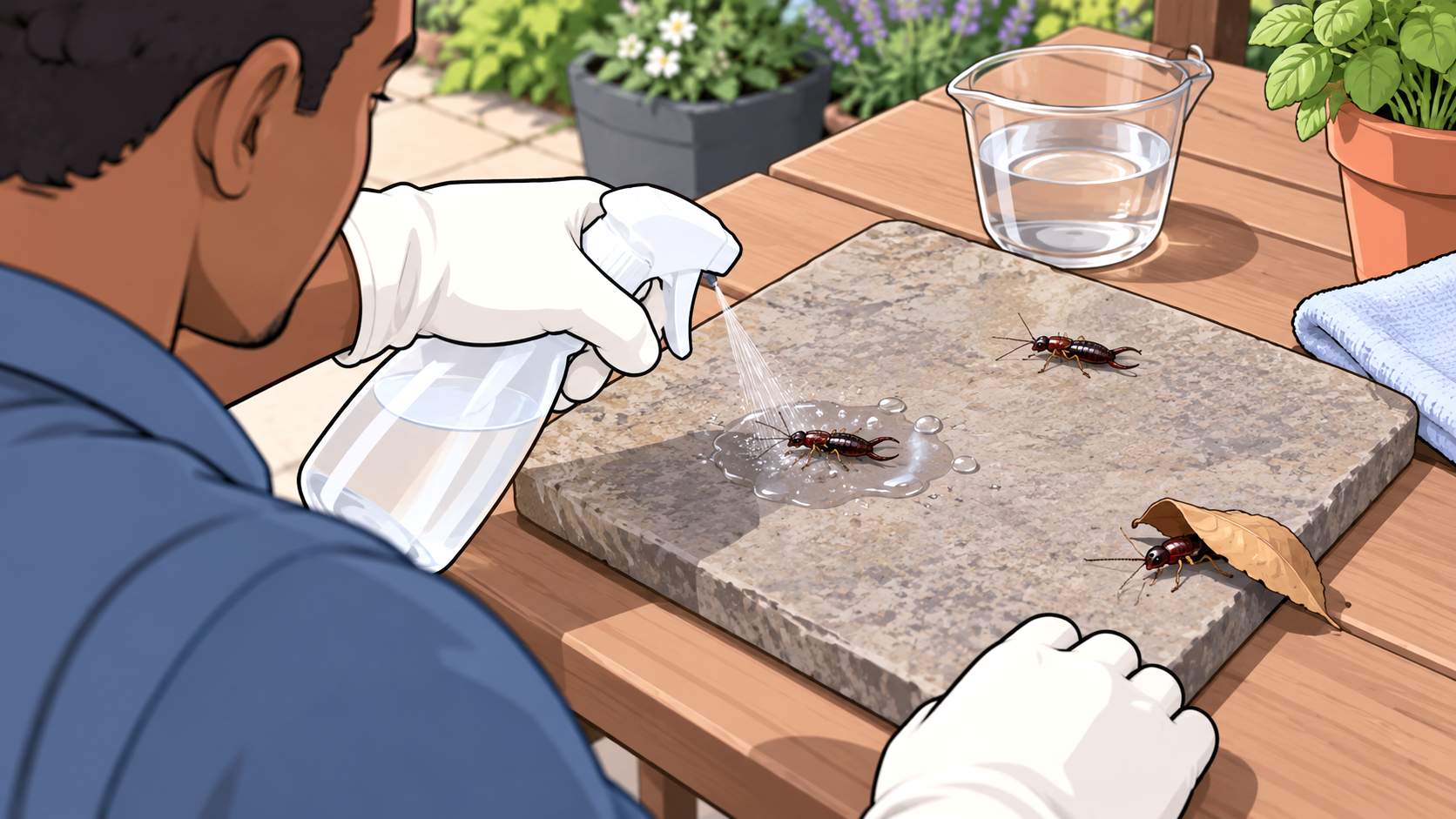
Vinegar has enough legitimate pest-control associations to make the earwig claim sound believable. Acetic acid appears in registered pesticide products, and ordinary vinegar is acidic enough to affect some living tissues. That makes it tempting to put white vinegar in a spray bottle and treat it as a cheap insect killer. The missing piece is whether household vinegar is actually an established treatment for earwigs.
Household vinegar is not a reliable or recommended way to kill earwigs. Ordinary white vinegar contains a relatively low concentration of acetic acid, and established earwig-management guidance does not use household vinegar as a control method. Even if direct spraying kills an individual earwig, that would not make vinegar an effective treatment for an earwig problem.
We would skip the vinegar. Earwigs are unusually well suited to showing why a household substance that might affect an exposed insect can still be a poor pest-control method.
Vinegar and Acetic Acid Are Not All the Same Thing
The word “vinegar” covers products with very different concentrations and intended uses. Ordinary household vinegar used for cooking or cleaning generally contains about 4% to 6% acetic acid. Horticultural vinegar can contain 20% acetic acid or more. That difference matters because stronger acetic acid is substantially more hazardous than the bottle of white vinegar in a kitchen cupboard.
Acetic acid does have pesticidal uses. For example, concentrated acetic acid appears in registered herbicides because it damages plant tissue on contact. However, that does not establish household vinegar as an earwig insecticide. Low concentrations of acetic acid can also appear in insect lures, which illustrates another important distinction. A chemical appearing somewhere in pest management does not mean every concentration, formulation or application of that chemical will kill a particular pest.
This is where many homemade-pesticide claims go wrong. They start with a real property of an ingredient and stretch it into a treatment claim that the evidence does not support. We would rather separate those questions than assume an earwig will respond to household vinegar simply because acetic acid has other pesticidal applications.
Earwig Control Guidance Points Somewhere Else
Established earwig management has a remarkably consistent theme. Earwigs feed mainly at night and spend the day in dark, protected places. Therefore, successful control usually revolves around those hiding places rather than finding a liquid to spray onto every insect.
For outdoor problems, removing unnecessary boards, debris, dense vegetation and other daytime shelter can make an area less favorable. Moisture also matters because earwigs favor cool, moist hiding places. When numbers need to be reduced, rolled newspaper, short pieces of hose and oil traps can exploit the insect’s normal behavior instead of depending on a direct spray.
That difference is useful when evaluating vinegar. A spray bottle only helps while you are standing in front of an exposed earwig. A refuge trap keeps working after you leave because the earwig’s own search for daytime shelter brings it into the trap. Our guide to DIY earwig traps explains how to use that behavior deliberately.
Earwig control around buildings follows the same principle. Repeated indoor sightings are better addressed by finding favorable exterior shelter and potential entry points than by spraying individual insects after they have crossed the threshold. Earwigs do not reproduce indoors, so an indoor earwig is generally a nuisance invader rather than evidence that vinegar needs to be sprayed around the room.
Vinegar Can Create a Different Problem in the Garden
The garden is one place where experimenting with vinegar deserves particular caution. Acetic acid is a contact herbicide at appropriate concentrations because it damages plant tissue. Consequently, spraying vinegar around a plant simply because an earwig is sitting on a leaf can put the plant itself in the path of the treatment.
Concentrated horticultural vinegar is an even worse product to improvise with. Higher-strength acetic acid can seriously injure skin and eyes, and registered herbicidal products containing high concentrations carry safety instructions for a reason. “Natural” does not make concentrated acetic acid harmless, and higher concentrations create greater exposure risks.
The better starting point is to determine whether the earwigs are actually damaging the plant. Earwigs can chew seedlings, flowers, soft fruit and other susceptible plant material, but they also consume aphids and other insects. Seeing one in a garden is therefore not enough reason to spray anything. Our guide to whether earwigs are good or bad for the garden explains why their presence and their damage need to be treated as separate questions.
When leaves or fruit are being chewed, inspect the affected plants after dark. Earwigs are nocturnal feeders, and nighttime inspection can confirm whether they are responsible. This matters because slugs and other chewing pests can leave damage that resembles earwig feeding. Once earwigs are confirmed, concentrate control around the affected plants rather than spraying vinegar across the garden.
The Smell of Vinegar Does Not Make It a Proven Earwig Repellent
There is another version of the vinegar claim that sounds less dramatic but creates the same problem. Instead of saying vinegar kills earwigs, some advice treats its strong odor as an earwig repellent.
A smell being strong to us does not establish that it will create a useful barrier against an insect. Earwigs respond to environmental conditions that provide food, shelter and suitable moisture. They can also aggregate in favorable hiding places. None of that gives household vinegar a dependable role as a perimeter repellent.
Even a temporary behavioral response would be a poor substitute for changing the conditions supporting the insects. Vinegar does not remove a damp board, thin excessive shelter, repair a poorly fitting door or stop an earwig from finding another route around a sprayed patch. If deterrence is the goal, our guide to how to deter earwigs focuses on the property conditions that can actually be changed.
We would apply the same standard to claims about other household smells. An odor should not be promoted as an earwig repellent merely because it is pungent. The dedicated guide to smells earwigs hate separates useful evidence from the much longer list of scents repeated online.
What to Do With the Earwig Instead
For an earwig crawling across an indoor floor, vinegar solves a problem that barely needs a treatment. Sweep it up or vacuum it. If another appears later, pay attention to where the sightings are occurring. Repeated activity near the same exterior door, window, basement area or other location gives you a better reason to investigate nearby entry points and outdoor shelter.
Outside, turn the question around. Instead of asking what household liquid will kill the earwig you can see, look for the place where you would expect to find more during the day. Earwigs commonly shelter beneath objects and in other dark, protected locations. Removing unnecessary refuge and using traps around active areas targets that behavior directly.
Garden infestations need an equally selective response. Protect the plants that are experiencing confirmed damage rather than trying to eliminate every earwig from the property. The broader guide to getting rid of earwigs in the garden covers shelter reduction, trapping and other established options. Insecticides are rarely necessary for ordinary earwig management, but when pesticide treatment is justified, the product should be labeled for the intended pest and application site.
That is why vinegar does not earn a place in our earwig-control plan. The issue is not that vinegar is too ordinary to affect an insect. It is that household vinegar gives you no good reason to abandon methods built around how earwigs actually live.
Other Questions About Vinegar and Earwigs
Will cleaning floors with vinegar keep earwigs away?
Do not count on a vinegar-cleaned floor to act as an earwig barrier. Earwigs entering a home are better addressed through exclusion and changes around the exterior. Sealing accessible entry points and reducing favorable shelter close to the building are more useful parts of keeping earwigs out of the house.
Can I pour vinegar where earwigs are hiding?
There is little reason to do so. Finding several earwigs beneath an object has already given you valuable information because you have located a daytime refuge. Removing or changing that shelter, where practical, addresses why the insects gathered there instead of simply pouring a household product onto them.
Is horticultural vinegar better for killing earwigs than household vinegar?
Do not substitute horticultural vinegar for an insecticide. Horticultural vinegar contains much higher concentrations of acetic acid and is commonly sold for weed control, not earwig control. Concentrated acetic acid can cause serious eye and skin injury, so increasing the concentration is not a sensible way to turn an unproven household earwig remedy into a stronger one.
Can I mix vinegar with dish soap to make an earwig spray?
We do not recommend inventing pesticide mixtures from household products. Homemade remedies lack the pest-specific application directions, exposure precautions and first-aid information that come with registered products, a problem highlighted in guidance on household pesticide remedies. Dish soap also has its own limitations as an earwig treatment, which we cover separately in whether dish soap kills earwigs.