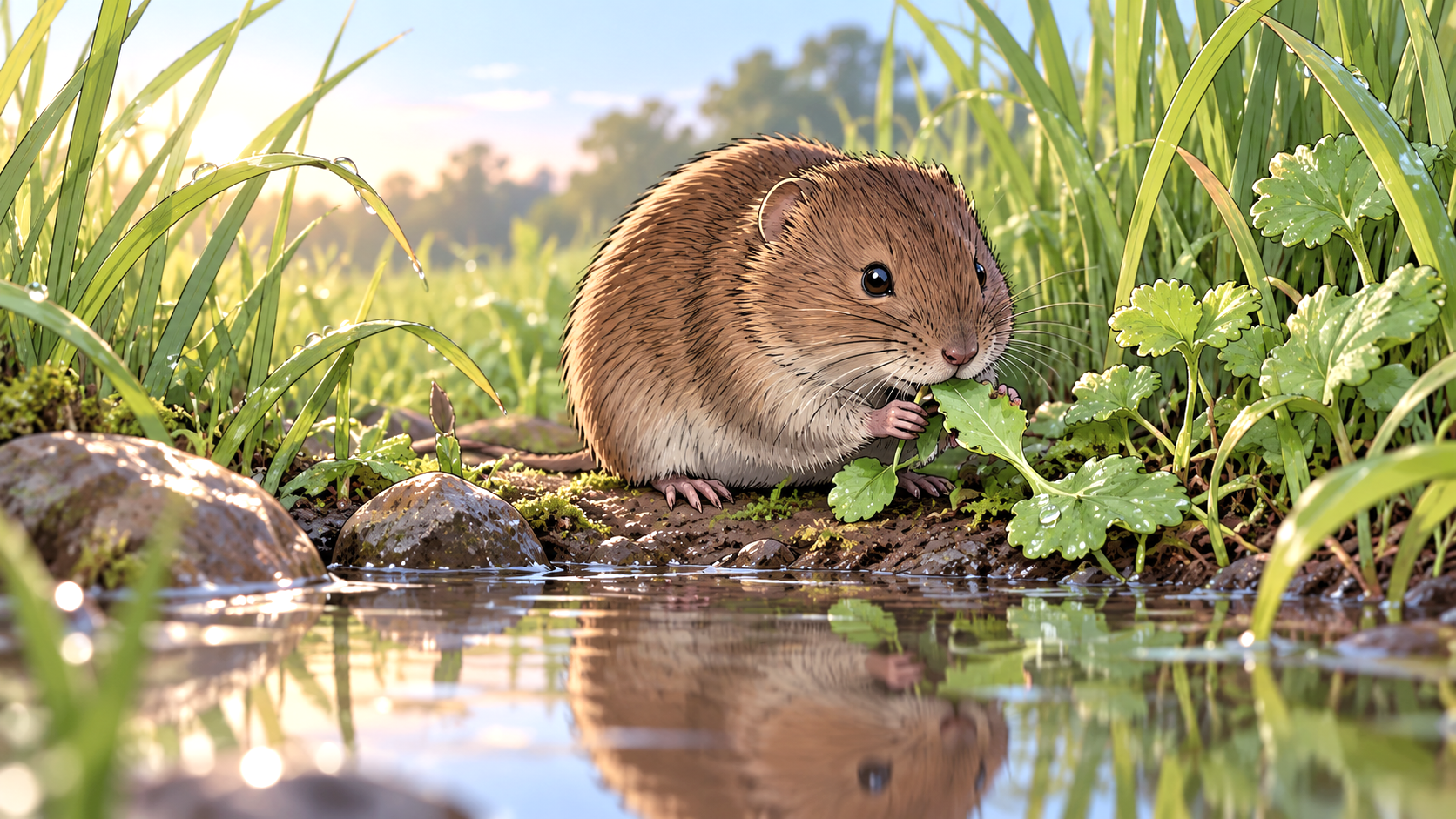
Voles need water to survive, but many obtain much of it from the plants they eat rather than drinking directly from ponds, puddles, or streams. They also tolerate food deprivation poorly. Research on several vole species has found serious metabolic changes within hours of fasting, and some can die in less than 24 hours without food under unfavorable conditions. There is no single survival time that applies to every vole.
Water availability and food availability are closely connected for these animals. A vole eating fresh, moisture-rich vegetation receives both nourishment and hydration, whereas one restricted to dry food may need access to considerably more drinking water. Temperature, species, physical condition, and the quality of available food further influence its requirements.
Do Voles Have to Drink Water?
Voles require water physiologically, but they do not necessarily need a separate source of liquid drinking water when their food provides enough moisture. Plant tissues contain water that becomes available during digestion, and animals also produce smaller amounts of metabolic water as nutrients are processed.
This is particularly relevant to meadow voles and prairie voles. Measurements of grasses and broadleaf plants in three Illinois habitats following a severe two-month drought found sufficient moisture within green vegetation to satisfy their estimated water requirements. The plants remained a usable hydration source even though rainfall had been unusually low.
The finding does not mean that voles never drink. It demonstrates that liquid water obtained directly from a stream or puddle is not always essential when enough moisture is available through vegetation. The plant-based feeding habits of voles help explain how they can occupy grasslands without remaining close to permanent standing water.
The distinction also depends on the animal’s diet. Fresh shoots and leaves generally contain more moisture than dried stems or seeds, so two voles eating different foods may have substantially different needs for additional water.
Some Vole Species Depend More Heavily on Water Than Others
Water requirements differ considerably across the vole group. Woodland voles, formerly called pine voles, exhibit rapid water turnover and poor tolerance of restricted water availability. Their physiology makes access to adequate moisture particularly important, whether it comes from food or an external source.
Southern red-backed voles also have substantial water requirements. Experimental measurements found that their water needs changed with environmental temperature, with consumption increasing outside certain moderate conditions. Cooler or warmer surroundings can therefore change water demand rather than simply reducing it whenever the weather is cold.
Red tree voles provide a contrasting example. These specialized rodents feed heavily on conifer foliage and can obtain nearly all the water they need from that material. In a small captive study involving seven red tree voles, consumption of additional drinking water was extremely low. That result should not be extended to meadow or woodland voles eating different vegetation.
A property’s vegetation and habitat conditions consequently provide more useful information about potential moisture availability than the presence or absence of a birdbath, garden pond, or other obvious water source.
How Long Can Voles Survive Without Food?
Voles generally require frequent feeding because they have relatively high metabolic demands and limited capacity to tolerate prolonged fasting. Their usual plant foods can also be comparatively low in energy, requiring regular consumption to meet their needs.
In a study of fasting meadow voles (Microtus pennsylvanicus), severe reductions in blood glucose occurred within six hours. The animals also exhibited metabolic changes affecting their resting metabolism and body temperature. These findings demonstrate that physiological stress can begin well before prolonged food deprivation.
Experiments involving common voles (Microtus arvalis) and tundra voles (Microtus oeconomus) identified additional changes during fasting. After several hours without food, the animals began mobilizing stored energy, while markers associated with liver and muscle stress increased during longer deprivation periods.
Some arvicoline voles can starve in less than 24 hours, particularly under demanding conditions. However, experiments involving 12-hour fasting periods in common and tundra voles do not establish that every individual dies after a particular number of hours.
A vole that has recently eaten, remains warm, and has adequate body reserves may respond differently from a cold, weakened animal with depleted energy stores. Laboratory observations are useful for understanding metabolic vulnerability, but they cannot establish a universal outdoor survival deadline.
Why Does Food Deprivation Affect Voles So Quickly?
Small mammals lose heat relatively rapidly because they have a high surface-area-to-volume ratio. Maintaining body temperature requires energy, and a vole’s compact size limits how much fuel it can store.
Food deprivation forces the animal to draw on internal energy reserves while continuing to support circulation, movement, and temperature regulation. The sequence of metabolic changes differs with species and conditions, but the ability to reduce energy expenditure is limited.
Unlike mammals capable of entering deep torpor during food shortages, common and tundra voles did not enter torpor during the controlled fasting observations. Modest changes in body temperature occurred, but these were not equivalent to the substantial energy savings associated with true hibernation.
Their energy requirements also explain why the normal lifespan of voles cannot be used to estimate how long an individual might endure starvation. Long-term survival under ordinary environmental conditions and acute survival without food represent different physiological questions.
Does Winter Change How Long Voles Can Go Without Eating?
Cold weather can increase the energetic burden of maintaining body temperature, although insulation, shelter, activity, and acclimatization all influence the amount of energy required.
Voles commonly remain active through winter rather than relying on prolonged hibernation. Snow cover can insulate the ground beneath it, reducing direct exposure to extreme outdoor temperatures. Nevertheless, animals must continue obtaining sufficient energy from available food.
Seasonal changes also affect moisture intake. When fresh green vegetation is unavailable, vole feeding may shift toward less succulent plant material, potentially changing how much water is obtained from food.
The conditions experienced by voles during winter should not be interpreted as evidence that they can safely endure extended periods without eating. Their persistence beneath snow depends partly on continued access to usable food and sheltered conditions.
Can Voles Survive Without Water During a Drought?
A drought does not necessarily eliminate the water available to voles. Green plant tissues may retain usable moisture even when the surrounding soil appears dry and no standing water is visible.
However, prolonged drought can reduce plant growth, alter the vegetation available for feeding, and eventually diminish food-derived moisture. Water shortage and reduced food quality may occur together, making their effects difficult to separate.
Research on meadow voles found that water turnover remained substantial across seasonal conditions. Their need to continually replace lost water does not disappear merely because the environment becomes drier.
Even voles occupying coastal salt marshes cannot necessarily use any available water. Investigations of salt-marsh meadow voles found that the animals could obtain usable moisture from certain marsh plants, while highly saline sources were unsuitable.
The relevant question is therefore whether an animal can obtain enough usable water, not whether its surroundings contain visibly wet soil or vegetation.
Does Removing Food or Water Make Voles Leave?
Removing a water dish or eliminating an obvious drinking location does not establish that voles will become dehydrated. Moisture may remain available through grass, garden plants, roots, and other vegetation.
Likewise, reducing a particular food source does not establish that every vole has lost access to nourishment. The range of vegetation used by voles around yards means they may continue feeding elsewhere.
Deliberately depriving wildlife of food or water is not an appropriate substitute for a lawful, targeted management strategy. The physiological evidence describes how voles respond to deprivation, not a safe or reliable method for controlling them.
For a confined, injured, or dependent vole, these short fasting tolerances also make delays in obtaining qualified wildlife assistance concerning. The care of injured or orphaned voles should be directed by a wildlife rehabilitator rather than attempting an improvised feeding or deprivation regimen.