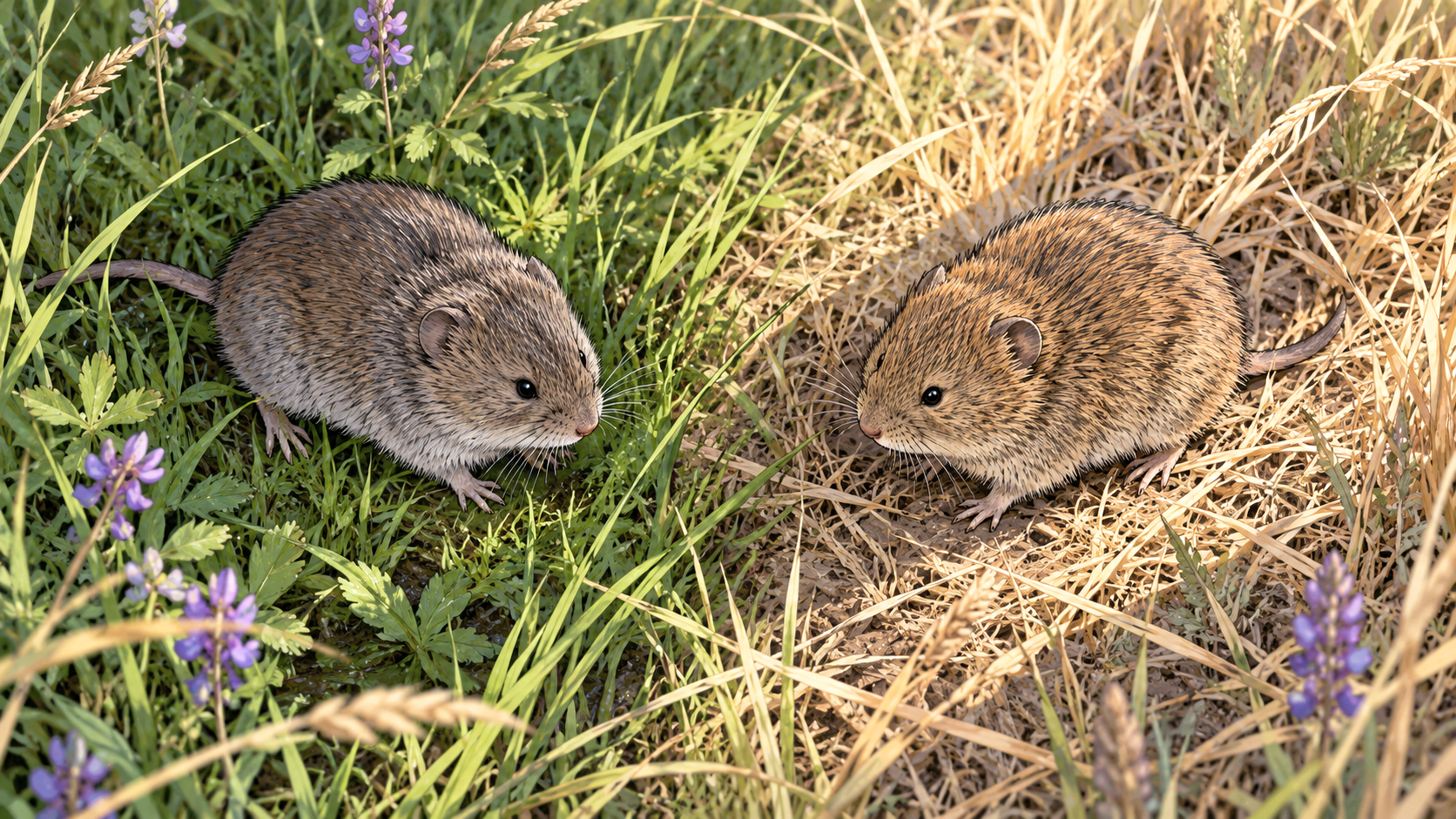
The meadow vole (Microtus pennsylvanicus) and prairie vole (Microtus ochrogaster) look remarkably similar, but meadow voles generally have longer tails and grayer undersides, while prairie voles tend to have shorter tails, darker mottled coats, and buff or yellowish bellies. Meadow voles also favor dense, moist vegetation, whereas prairie voles are more frequently associated with comparatively dry grasslands.
These differences are useful clues rather than absolute identification rules. The two species overlap geographically, and research has demonstrated that even experienced observers can struggle to separate them using external appearance alone. In some populations, reliable identification requires examination of dental features or genetic evidence.
Which Physical Features Are Most Useful?
Both species are small, stocky rodents with blunt muzzles, rounded bodies, short legs, and ears partly concealed by fur. Their overall sizes overlap considerably, making photographs of an animal without its tail or underside particularly difficult to interpret.
Meadow voles typically measure approximately 14–19.5 centimeters from nose to tail tip. Prairie voles usually measure about 12.5–18 centimeters. These ranges overlap so extensively that an apparently large individual could belong to either species. The body measurements and proportions of meadow voles vary with age, sex, and population, while prairie vole measurements show similar natural variation.
| Feature | Meadow vole | Prairie vole |
|---|---|---|
| Scientific name | Microtus pennsylvanicus | Microtus ochrogaster |
| Total length | Approximately 14–19.5 cm | Approximately 12.5–18 cm |
| Typical tail length | 3.3–6.4 cm | 2.5–4.5 cm |
| Back and sides | Brownish or gray-brown | Darker, often heavily mottled |
| Belly | Usually gray or silvery | Often buff, tan, or yellowish |
| Fur texture | Generally softer and finer | Often somewhat coarser |
| Ears | Small, partly concealed | Small, partly concealed |
| Habitat tendency | Dense, moist grassland | Drier prairie and mixed grassland |
A single measurement seldom settles the identification. An adult prairie vole may be larger than a young meadow vole, and a meadow vole from one region may differ considerably from another population.
The variation in vole body size also explains why judging an animal’s species from its apparent weight in a photograph is unreliable.
The Tail Provides a Useful Proportional Clue
The meadow vole usually has the longer tail, both in absolute terms and relative to its hind foot. Its tail commonly measures at least twice the length of the hind foot, whereas the prairie vole’s tail is generally shorter than twice its hind-foot length.
This proportional difference can be more informative than comparing the animal with a nearby blade of grass or other object of uncertain size. Prairie voles often appear particularly compact from behind because their tails extend only a short distance beyond the rump.
The distinction is not perfectly reliable. Some animals fall near the overlapping portion of the measurement ranges, and a tail curled underneath the body can appear shorter than it actually is.
A morphological comparison of meadow and prairie voles living in the same region found that several measurements differed statistically between the species but overlapped too extensively to identify every individual reliably.
A photograph showing the tail, hind feet, and complete body offers more useful information than one showing only the face.
Belly Color Is Helpful, but Some Prairie Voles Look Gray
A meadow vole typically has brownish upper fur with a gray or silvery underside. Its back may contain mixtures of brown, black, and yellowish hairs, so the animal seldom appears uniformly colored.
Prairie voles often have darker, more heavily grizzled upper coats. Their bellies usually show buff, tan, or yellowish tones, sometimes with a warmer appearance extending toward the chest.
The dark, grizzled coat and buff underside of prairie voles are traditional identification characteristics. However, prairie voles belonging to certain eastern populations can have unusually pale undersides that closely resemble meadow voles.
This variation is particularly important in Kentucky and neighboring areas. Researchers examining overlapping populations found that many animals had intermediate buff-gray belly coloration, making the usual color distinction unreliable.
The natural coat colors found among voles also change with age and individual variation. Poor lighting or wet fur can make an already subtle difference almost impossible to judge.
If the belly cannot be seen, a dark mottled back alone is not sufficient evidence for a prairie vole identification.
Where Their Ranges Overlap
Meadow voles have a much broader North American distribution. They occur across much of Canada and the northern United States, extending into portions of the eastern and western United States.
Prairie voles are concentrated primarily in central North America, from parts of south-central Canada through the Great Plains and Midwest, with populations extending into portions of the southeastern United States.
The extensive North American distribution of meadow voles means that many properties fall outside the normal range of prairie voles altogether. In those locations, an animal resembling these two species is more plausibly a meadow vole, although other vole species may also occur.
Geographical overlap is substantial in parts of the Midwest and central United States. Prairie voles inhabit areas of the Great Plains, while meadow voles also occupy suitable wetter grasslands within portions of that broader region.
Location should therefore be checked before applying a physical comparison. An animal found in coastal New England is not equally likely to belong to both species, whereas one encountered in suitable habitat in Illinois may require closer examination.
The different habitats occupied by North American voles create additional opportunities for geographic ranges to overlap without the animals using precisely the same microhabitats.
Moist Grassland Versus Drier Prairie
Where meadow and prairie voles occur together, they often differ in the vegetation and moisture conditions they prefer.
Meadow voles are strongly associated with dense ground cover, especially moist grasslands, sedge meadows, marsh edges, and fields containing substantial accumulated plant litter. Thick vegetation helps conceal their movement and nesting areas.
Prairie voles commonly occupy prairies, old fields, ungrazed pastures, grassy roadsides, and agricultural margins. They often use comparatively shorter, drier, or more varied vegetation when meadow voles are present nearby. The preference of prairie voles for relatively dry grassland can therefore provide supporting evidence when both species are possible.
Imagine a property bordering two different grassland areas. One contains tall, dense grass beside a wet drainage ditch; the other has comparatively dry prairie vegetation with scattered broadleaf plants. The first area may be more favorable to meadow voles, while the second may favor prairie voles.
Those preferences do not create strict habitat boundaries. Prairie voles can occupy moist areas, and meadow voles also inhabit relatively dry grassland when sufficient cover is available. The habitat preferences of meadow voles are influenced by vegetation density, moisture, and interactions with other small mammals.
A vole found in prairie grass cannot be identified as a prairie vole simply because of the landscape’s name.
Can Their Behavior Help Distinguish Them?
The two species are often discussed together because they differ in social organization.
Prairie voles are particularly well known for forming enduring social pair bonds. Adults may share nests, maintain familiar partners, and participate in care of their offspring. Meadow voles generally have a less pair-oriented social system, although their interactions vary with season and environmental conditions.
The social organization of prairie voles is also more variable than the popular description of lifelong monogamy suggests. Some males maintain territories with partners, while others move among occupied areas without establishing comparable relationships.
An observer cannot reliably identify a prairie vole simply because two animals emerge from the same burrow. Meadow voles may share nesting areas under certain conditions, and prairie voles do not always behave as visibly bonded pairs.
The pair-bonding differences among vole species concern population-level social patterns rather than a dependable method of field identification.
Both species construct sheltered runways through vegetation, excavate shallow burrows, and move between feeding and resting areas. Their surface runways and trails through grass can indicate vole activity but do not establish whether the occupants are meadow or prairie voles.
Why Even Scientists Sometimes Need Dental or Genetic Evidence
The most dependable anatomical differences between meadow and prairie voles are not always visible on a living animal.
Specialists can distinguish the species using patterns in their molar teeth. The middle upper molar generally has five enclosed dentine triangles in meadow voles and four in prairie voles. Female mammary-gland counts also differ, although these are not practical features for an ordinary wildlife sighting.
Other anatomical characteristics, including the number of pads on the hind feet, have been proposed as identification aids. Their reliability is limited by variation among individuals and populations.
Research published in 2023 demonstrated that external measurements and underside coloration can fail to separate meadow and prairie voles reliably, particularly where the species coexist. Genetic analysis may be necessary when an exact identification is important for scientific work.
For an animal observed around a yard, the most reasonable approach is to combine its location, vegetation, tail proportions, and underside color. If those characteristics disagree, a species-level identification should remain uncertain rather than being forced.
A small vole moving through wet, densely vegetated grass with a relatively long tail and gray underside favors meadow vole. One from drier prairie habitat with a shorter tail and buff belly favors prairie vole. Neither combination is definitive without sufficient supporting evidence.
Meta description: Meadow vole vs. prairie vole: compare tail length, belly color, body size, habitat, geographic range, and the limits of identifying these similar rodents.