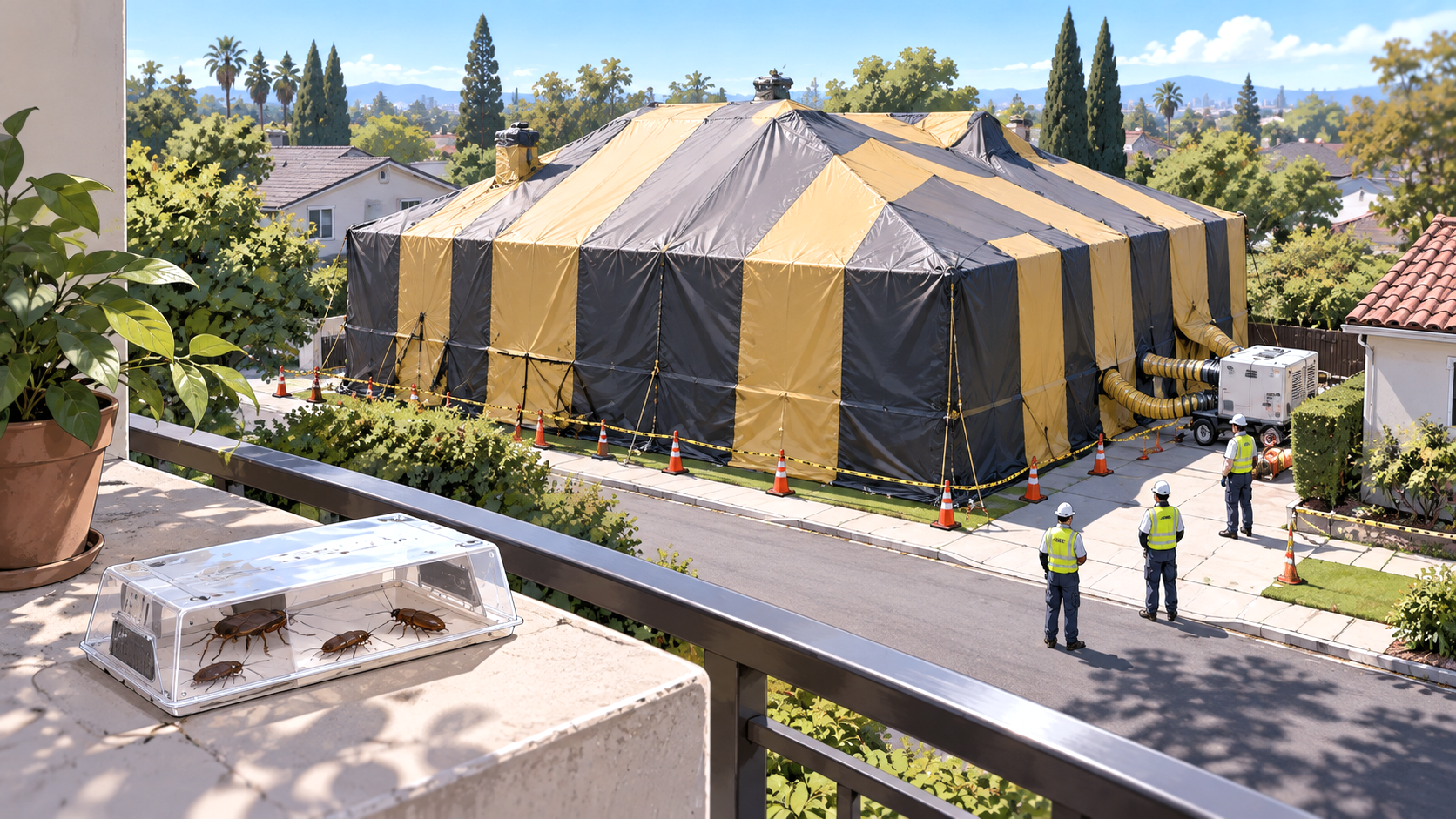
Professional structural fumigation can eliminate exposed cockroaches throughout a treated building, including insects hiding inside wall voids, cabinets, and other spaces that ordinary sprays may not reach. In the United States, sulfuryl fluoride is a registered residential fumigant labeled for German cockroaches and other cockroach species. However, cockroach eggs can be harder to kill than adults, and fumigation leaves no residual insecticide to prevent future infestations.
True fumigation is rarely the first treatment choice for an ordinary household cockroach problem. It requires specialized equipment, evacuation, professional licensing, and controlled reentry procedures. Most German cockroach infestations can be approached with targeted treatments that avoid exposing an entire structure to fumigant gas. Fumigation becomes more relevant when an infestation is extensive, access to harborages is severely restricted, or a qualified specialist determines that whole-structure treatment is justified.
Fumigation, Fogging, and Spraying Are Not the Same Treatment
A company offering to “fumigate” a kitchen may actually be proposing an aerosol or residual spray. The terminology matters because these methods deliver insecticide differently and cannot be expected to reach the same locations.
| Treatment | How the insecticide reaches cockroaches | Structural containment | Main limitation |
|---|---|---|---|
| Structural fumigation | Toxic gas disperses through the enclosed treatment space | Required | No lasting protection after aeration |
| Total-release fogging | Aerosol droplets disperse through the room | Not equivalent to gas-tight fumigation | Poor penetration into concealed harborages |
| Residual spraying | Liquid insecticide is deposited on approved surfaces | Not required | Cockroaches must contact treated deposits |
| Targeted baiting | Cockroaches consume poisoned food | Not required | Depends on bait discovery and feeding |
Structural fumigation involves introducing a gaseous pesticide into an enclosed space at a concentration maintained for a specified exposure period. Residential structures may be covered with a specially installed tent to retain the gas. Unlike suspended aerosol droplets, fumigant gas can move through connected spaces and penetrate materials that ordinary spray droplets cannot readily reach.
A household bug bomb works differently. The aerosol disperses pesticide droplets into the surrounding air, but sheltered insects may receive little exposure. Research comparing total-release foggers with cockroach gel baits found that foggers failed to reduce German cockroach populations significantly under the study conditions, while gel baits produced substantial declines.
The limitations of cockroach foggers and bug bombs are therefore separate from the effectiveness of true structural fumigation. A technician using a handheld fogging machine has not necessarily performed a gas fumigation, even when the service is described that way.
Sulfuryl Fluoride Is the Principal Residential Fumigant
Sulfuryl fluoride is the only structural fumigant currently registered for residential use in the United States. Products containing it are restricted-use pesticides, meaning application requires a certified applicator or someone working under the required direct supervision.
The EPA’s sulfuryl fluoride registration information identifies cockroaches among the pests it can control, alongside termites, bed bugs, and several wood-infesting insects. One registered product, Vikane, contains 99.8% sulfuryl fluoride and is specifically labeled for German and other cockroach species.
The gas enters an insect primarily through its respiratory system and interferes with processes required for survival. Its effectiveness depends on the concentration reaching the pest and the duration of exposure. Temperature, structural conditions, and the target species affect the treatment requirements.
Professional fumigators calculate the required exposure using the registered product’s dosage procedures. A cockroach treatment cannot simply borrow the dosage selected for another pest, because susceptibility differs between species and developmental stages.
Sulfuryl fluoride’s ability to disperse through concealed areas makes it useful for whole-structure treatment. The same characteristic creates serious hazards for people and animals, requiring the structure to be secured against unauthorized entry throughout the procedure.
Can Fumigation Kill Cockroaches Inside Walls and Appliances?
The ability to reach otherwise inaccessible harborages is structural fumigation’s main advantage. Cockroaches sheltered behind wall finishes, inside cabinet construction, and around protected structural openings can encounter fumigant gas when the treatment space is properly enclosed and the required concentration is achieved.
The gas can also penetrate many materials that would shield insects from liquid spray. It does not require a cockroach to walk across a treated baseboard or emerge from hiding to feed.
However, distribution throughout a structure is not equivalent to automatic exposure at the required dose. The fumigation specialist must account for gas movement, containment, treatment duration, and the conditions affecting concentration in the occupied spaces.
Buildings with connected apartments present additional complications. Gas movement and containment must be assessed across the relevant structure, including adjoining spaces and utility connections. A resident cannot safely arrange an improvised gas treatment of one apartment while neighboring units remain occupied.
Even a properly executed fumigation cannot repair the physical conditions that supported the original infestation. Unsealed service penetrations, defective door seals, and connected utility openings remain available unless separate building work addresses them.
Cockroach Eggs Can Survive a Fumigation
Egg survival is one of the most significant limitations of sulfuryl fluoride treatment. Cockroach eggs are enclosed within protective cases, and developing embryos can be less susceptible to fumigant exposure than mobile insects.
The toxicology of sulfuryl fluoride and insect eggs shows that eggs can require greater exposure than adults because the eggshell restricts fumigant penetration. The registered Vikane directions specifically acknowledge that more than one fumigation may be necessary for certain insect infestations after surviving eggs hatch, including cockroaches.
The fumigator must account for the species and developmental stages involved. A treatment sufficient to kill active German cockroaches cannot automatically be assumed to destroy every egg case. Newly hatched nymphs appearing afterward may represent survivors from the original infestation rather than fresh introductions.
The protective structure of cockroach egg cases makes post-treatment follow-up particularly important. Surviving eggs can produce insects after the gas has been removed, and fumigation provides no remaining toxic deposit to affect those hatchlings. A qualified provider should explain how its treatment plan addresses this possibility before the work begins.
Why Fumigation Is Usually Excessive for Household Cockroaches
A professional must weigh the ability to treat concealed spaces against the disruption and hazards of enclosing an entire structure. German cockroaches occupying accessible kitchen harborages can often be treated without fumigating bedrooms, living areas, and unrelated parts of the building.
The University of California’s cockroach management guidance emphasizes inspection, sanitation, exclusion, monitoring, and targeted insecticides. Cockroach bait and gel treatments can expose feeding insects without requiring occupants to vacate an entire structure for gas treatment.
Structural fumigation is more defensible when a severe infestation occupies inaccessible areas throughout a structure and other appropriate methods cannot adequately address it. Even then, the recommendation should follow a site-specific assessment rather than the number of cockroaches seen on one occasion.
A single apartment also presents logistical problems if connected spaces cannot be safely isolated. A fumigator must evaluate containment and the need to include adjoining units. Applying fumigant gas without properly addressing those connections creates unacceptable exposure risks.
What a Structural Fumigation Requires From Occupants
Everyone, including pets, must leave the treatment area before fumigation. The licensed provider determines which belongings require removal, which food and medicines need special handling, and how the building must be secured. Residents should receive written instructions specific to the product, structure, and fumigation plan.
Residential sulfuryl fluoride treatment requires warning signs, restricted access, controlled aeration, and measured clearance before reoccupation. Because the gas itself has no warning odor, residential applications also use chloropicrin as a warning agent.
The EPA’s updated residential fumigation safety measures strengthen requirements intended to prevent serious injuries associated with premature reentry. A fumigated building cannot be declared safe merely because the scheduled exposure period has ended.
Reentry requires measured sulfuryl fluoride concentrations of 1 part per million or less in the breathing zones of every room, verified using an appropriate clearance device by authorized personnel. The EPA’s clearance-device requirements make measured gas concentration, rather than odor or elapsed time alone, the basis for reoccupation.
Residents must never enter a fumigated structure before the authorized provider releases it. The specialized preparation and clearance requirements also make structural fumigation unsuitable as a do-it-yourself cockroach treatment.
Can Cockroaches Return After a House Has Been Fumigated?
Yes. Sulfuryl fluoride dissipates during aeration and does not leave a residual insecticide barrier. Cockroaches entering the building after clearance can establish another infestation if favorable conditions remain.
A properly executed fumigation can kill insects present during treatment without preventing later introductions through deliveries, infested belongings, plumbing penetrations, or adjoining properties. Where a building has recurring outdoor cockroach entry, sealing access points and addressing surrounding harborages remain necessary.
There is also a difference between reinfestation and incomplete elimination. Cockroaches found shortly after service may have emerged from surviving eggs or locations where effective exposure was not achieved. Activity appearing after a period without sightings may indicate renewed introduction. These possibilities require different responses, particularly when deciding whether another fumigation is justified.
The EPA’s integrated pest management approach combines treatment with changes that reduce pest survival and access. If cockroaches remain visible after professional pest control, monitoring and inspection can help establish whether the activity reflects incomplete treatment or a new source.
When Would We Consider Fumigation for Cockroaches?
We would consider structural fumigation only after a qualified pest-management specialist establishes that the infestation’s extent and inaccessible locations justify whole-structure treatment. The recommendation should identify the target cockroach species, explain why targeted methods are insufficient, and account for surviving eggs, building occupancy, and possible reinfestation.
For an ordinary German cockroach infestation restricted to kitchens and bathrooms, properly selected baits and localized treatments are generally the more proportionate option. A severe, building-wide problem with inaccessible harborages presents a stronger case for assessing fumigation, provided the product is registered for the intended use and all safety requirements can be met.
The proposed service should explicitly identify whether it involves sulfuryl fluoride gas, aerosol fogging, or conventional spraying. Those methods have different capabilities, hazards, and regulatory requirements, and a customer should know which one is being purchased before authorizing treatment.