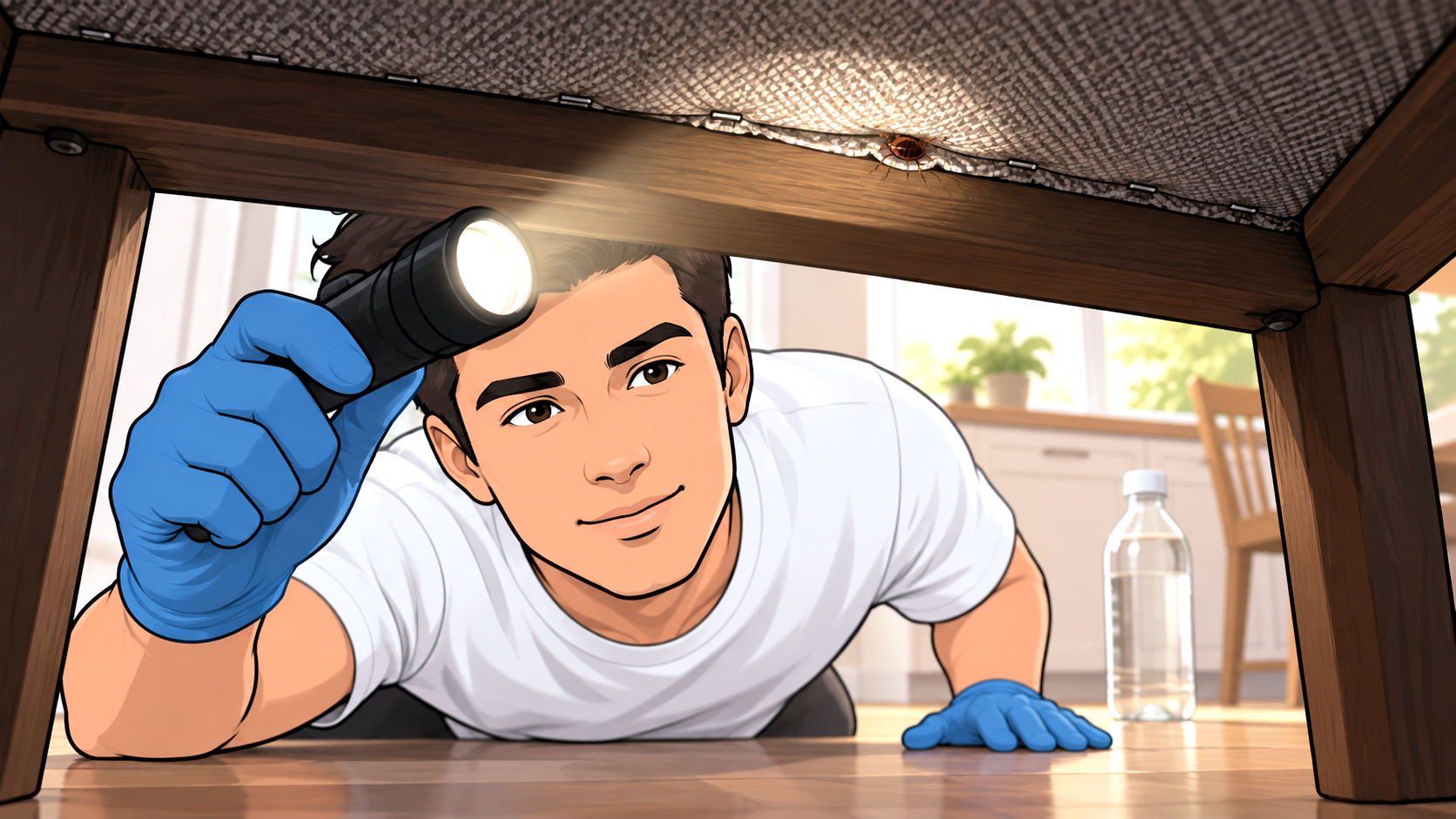
There isn’t reliable evidence showing that household vinegar is an effective bed bug treatment. Claims that vinegar’s acetic acid attacks a bed bug’s nervous system or breaks down its protective outer layer are repeated widely online, but we couldn’t trace those specific explanations to controlled bed bug research.
That doesn’t prove vinegar could never harm a bed bug that is directly soaked with it. It means there isn’t enough evidence to give vinegar a reliable kill rate, explain a confirmed mechanism against bed bugs, or recommend it for eliminating an infestation. More importantly, spraying exposed bugs would leave the much larger control problem untouched: bed bugs and eggs hidden inside seams, furniture joints, cracks and other protected harborages.
There Isn’t Good Evidence for the Claimed Killing Mechanism
One of the most common explanations online is that acetic acid disrupts a bed bug’s nervous system. Another says vinegar damages the insect’s protective outer coating and causes it to dehydrate. Neither should be presented as an established bed bug mechanism without research demonstrating that effect.
This distinction matters because known bed bug treatments have much stronger evidence behind their mechanisms. The EPA explains that registered desiccant pesticides damage the waxy protective coating of bed bugs, causing them to lose moisture and die. That doesn’t mean any acidic or drying household substance acts in the same way. A demonstrated mechanism for one material can’t simply be transferred to vinegar because the explanation sounds chemically plausible.
Ordinary white vinegar is primarily water containing dilute acetic acid, commonly around 5%. That tells us what vinegar contains, but not what a particular concentration does to Cimex lectularius. Without bed bug-specific efficacy testing, there isn’t a defensible basis for assigning household vinegar a particular insecticidal mechanism or promising that direct spraying will kill bed bugs consistently.
Can Vinegar Kill a Bed Bug on Contact?
There isn’t enough reliable bed bug-specific research to give household vinegar a dependable contact-kill rate.
It is possible for a household substance to injure or kill an individual insect under sufficiently direct exposure without being useful for pest control. A bed bug completely soaked during an informal experiment also isn’t representative of bugs concealed deep inside a bed frame, mattress seam, upholstered furniture or wall crevice.
EPA requires effectiveness data before allowing a registered pesticide to carry a bed bug claim. Its guidance on bed bug pesticide effectiveness also makes clear that killing bed bugs under testing doesn’t automatically mean a product will eliminate an infestation. Treatment success depends on factors such as application coverage, reaching the different life stages and finding the insects’ resting areas.
Vinegar lacks even that first level of established bed bug efficacy. Until suitable testing demonstrates otherwise, it makes more sense to describe its effect as unconfirmed than to promise that vinegar kills bed bugs on contact.
Vinegar Isn’t a Reliable Treatment for Bed Bug Eggs
There also isn’t good evidence showing that household vinegar reliably kills bed bug eggs.
Eggs are particularly important because they can remain attached inside protected locations that a casual spray never reaches. Even an effective contact pesticide may fail to eliminate an infestation when bugs or eggs escape treatment. The EPA specifically recommends inspecting repeatedly after initial bed bug control because bugs may have been missed or eggs may subsequently hatch.
Spraying visible areas with vinegar therefore provides no assurance that eggs concealed elsewhere have been affected. The same problem applies to hidden nymphs and adults.
Does Vinegar Repel Bed Bugs?
The smell of vinegar isn’t evidence that it is an effective bed bug repellent.
A substance can have a strong odor without producing a useful or sufficiently persistent behavioral response in bed bugs. Even temporary avoidance wouldn’t necessarily help. If bugs simply move around a treated surface and remain elsewhere in the room, the infestation hasn’t been controlled.
EPA evaluates products intended to repel, attract or kill bed bugs using efficacy data rather than assuming that an odor has a particular behavioral effect. Its bed bug pesticide registration guidance explains that products carrying bed bug claims must be supported by laboratory performance data.
Without comparable evidence for household vinegar, there isn’t a reliable basis for calling it a bed bug repellent.
Why Spraying Vinegar Around the Bedroom Isn’t Enough
Bed bugs spend much of their time hidden. They can occupy mattress seams, bed-frame joints, upholstered furniture, baseboards and cracks narrow enough to make complete treatment difficult. A substance with no demonstrated residual bed bug activity would have to reach the insect directly to have any plausible immediate effect.
This is one reason home remedies often perform poorly against established infestations. Even when a substance harms individual exposed bugs, killing the bugs you can see isn’t the same as reaching the population you can’t see. The limitations of other home remedies for bed bugs follow the same principle.
Vinegar also shouldn’t be used as a reason to postpone methods with established evidence. Bed bug populations can continue feeding and reproducing while an ineffective treatment is repeatedly applied.
What Should You Use Instead of Vinegar?
Bed bug control works better when several appropriate methods are combined rather than relying on one household spray. The EPA recommends an integrated pest management approach that can include inspection, monitoring, high dryer heat for suitable clothing and bedding, properly applied heat or steam, encasements and appropriately selected pesticides.
When a pesticide is needed, the EPA recommends choosing a product registered for bed bugs and following its label. There are more than 300 EPA-registered products for bed bug control, spread across several chemical classes and modes of action. Registration doesn’t mean every product will eliminate every infestation, but it does provide something vinegar lacks: evidence supporting a bed bug claim and instructions defining how the product can be used.
Nonchemical options can also have good evidence when used correctly. For example, diatomaceous earth can kill bed bugs when an appropriate registered product is used according to its label. A broader bed bug treatment plan is preferable to repeatedly spraying vinegar on visible surfaces.
Questions About Vinegar and Bed Bugs
Does white vinegar kill bed bugs instantly?
There isn’t reliable bed bug-specific research establishing an instant kill rate for household white vinegar. Claims that it immediately kills bed bugs shouldn’t be treated as established without controlled efficacy data.
Is apple cider vinegar better than white vinegar for bed bugs?
There isn’t good evidence showing that apple cider vinegar is an effective bed bug treatment or that it performs better than white vinegar.
Can you mix vinegar with other ingredients to kill bed bugs?
Don’t improvise chemical mixtures in an attempt to make vinegar more effective. Mixing household chemicals can create unnecessary exposure risks, and adding another ingredient doesn’t establish that the resulting mixture works against bed bugs.
Is rubbing alcohol better than vinegar for bed bugs?
Rubbing alcohol has its own serious limitations and safety problems. The EPA specifically warns against using unregistered rubbing alcohol for bed bug treatment because it evaporates quickly, is flammable and has caused house fires. The limitations and risks are covered separately in whether rubbing alcohol kills bed bugs.
Can you still clean with vinegar if you have bed bugs?
Using vinegar for ordinary household cleaning is different from treating an infestation with it. Routine cleaning doesn’t need to stop simply because bed bugs are present, but cleaning with vinegar shouldn’t be counted as a bed bug control treatment.
One thought on “Does Vinegar Kill Bed Bugs?”