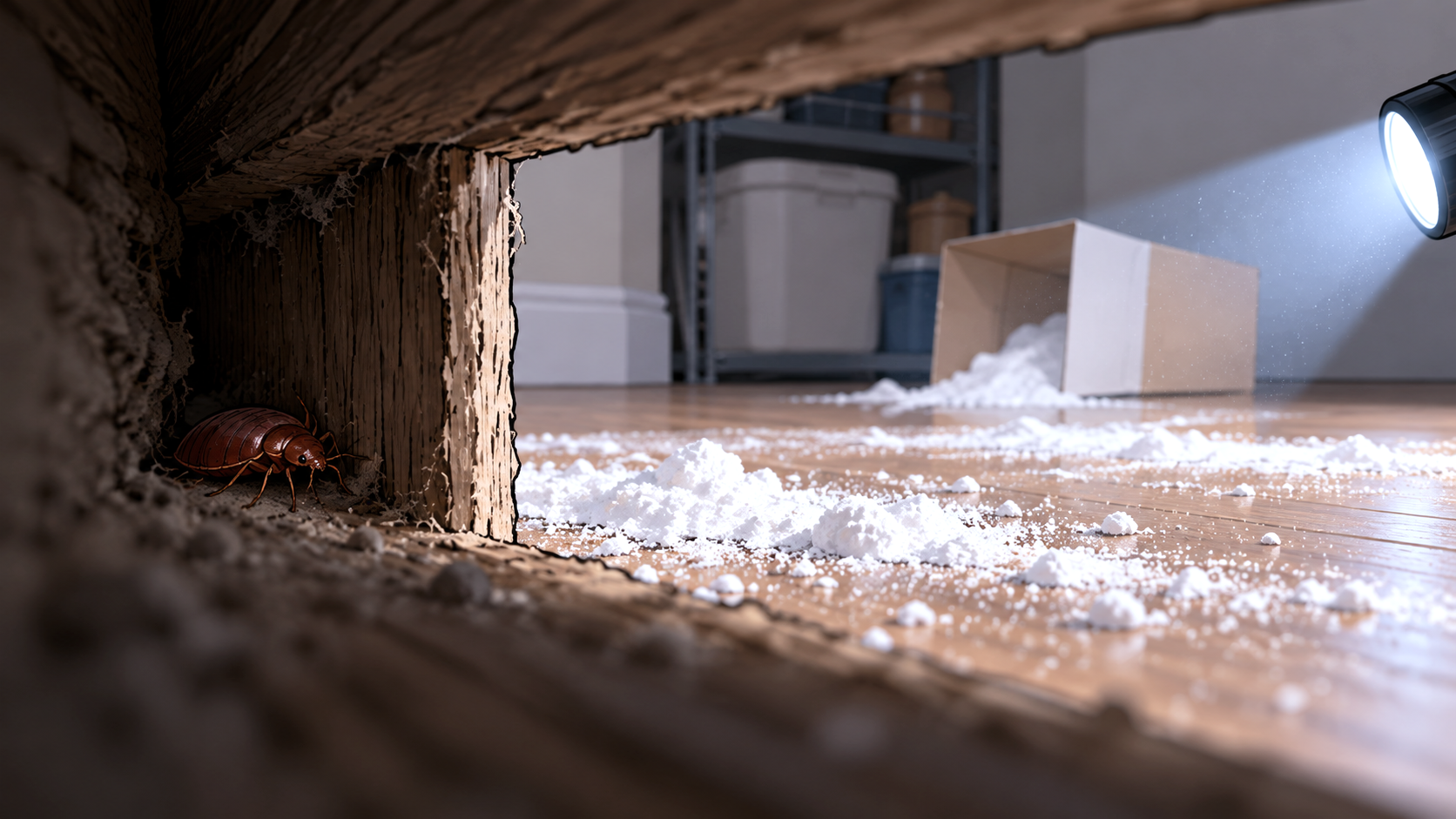
Baking soda isn’t an effective way to kill bed bugs. Unlike many home remedies that simply haven’t been studied directly, sodium bicarbonate has actually been tested against bed bugs in peer-reviewed research and performed poorly. That makes the answer unusually straightforward: sprinkling baking soda around a bed, mattress, or room shouldn’t be treated as a bed bug control method.
Baking Soda Has Been Tested Against Bed Bugs
A 2024 peer-reviewed study compared several dusts against two colonies of the common bed bug, Cimex lectularius. The researchers tested sodium bicarbonate, green clay, talc, several forms of diatomaceous earth, silicon dioxide, and Sommières earth.
They evaluated permanent exposure, short exposure, horizontal transfer, and repellency. Sodium bicarbonate was ineffective against the bed bugs under the conditions tested.
The study is particularly useful because baking soda wasn’t merely discussed theoretically. The researchers directly exposed bed bugs to it and measured the outcome.
Baking Soda Doesn’t Work Like an Effective Desiccant
Many claims about baking soda assume that because it can interact with moisture, it should dry out bed bugs. That doesn’t follow.
Effective insecticidal desiccants damage or remove components of the insect’s protective outer layer, increasing water loss until the insect dehydrates. The EPA describes desiccants as destroying the waxy protective coating on bed bugs, causing them to slowly dehydrate and die.
The 2024 dust study helps demonstrate why simply being a dry, absorbent powder isn’t enough. Sodium bicarbonate, talc, and green clay were ineffective, while some purpose-made desiccant dusts performed much better.
Not All Diatomaceous Earth Performs the Same Either
The same experiment produced another useful result: the name of a dust alone doesn’t guarantee good performance.
The professional pest-control diatomaceous earth tested was effective, while diatomaceous earth sold as litter conditioner and a supermarket diatomaceous earth product were ineffective under the study conditions. Sommières earth produced 75% to 100% mortality in permanent and short-exposure tests, depending on the experiment.
That doesn’t mean Sommières earth should automatically be used as a household bed bug pesticide. In the United States, the EPA recommends using pesticides registered for bed bugs and specifically warns against using non-pesticidal forms of diatomaceous earth for bed bug treatment because of inhalation concerns.
If you’re considering a desiccant, diatomaceous earth for bed bugs and silica gel for bed bugs require their own product-specific considerations.
Using More Baking Soda Doesn’t Solve the Problem
There is no established application rate at which ordinary baking soda becomes an effective bed bug treatment.
Covering floors, mattresses, or furniture with a thicker layer therefore isn’t supported by the research. It also creates unnecessary residue without addressing bed bugs concealed inside cracks, furniture joints, mattress seams, baseboards, and other harborages.
Likewise, there is no good evidence that mixing baking soda with another household ingredient turns it into an effective bed bug treatment.
Use Proven Bed Bug Control Methods Instead
Bed bug control usually requires more than one method because bugs and eggs can be distributed across numerous hiding places. Inspection, vacuuming, heat or steam where appropriate, monitoring, encasements, and properly selected pesticides can all have roles depending on the infestation.
If using a pesticide or desiccant in the United States, choose a product registered by the EPA and specifically labeled for bed bugs, then follow its label exactly. Don’t substitute household or food-grade powders simply because they appear chemically similar to a pesticide product.
Getting rid of bed bugs requires treating the infestation as a whole rather than relying on baking soda scattered around the room.
Questions About Baking Soda and Bed Bugs
Does baking soda kill bed bug eggs?
There is no reliable evidence that ordinary baking soda kills bed bug eggs. The direct dust research doesn’t support baking soda as an effective bed bug control treatment.
Will mixing baking soda with vinegar kill bed bugs?
There is no established bed bug treatment based on combining baking soda and vinegar. Vinegar isn’t a reliable bed bug treatment either.
Can you sprinkle baking soda around your mattress to prevent bed bugs?
There is no evidence that a baking soda barrier reliably prevents bed bugs from reaching a sleeping person. It shouldn’t replace proven monitoring or control methods.
One thought on “Does Baking Soda Kill Bed Bugs?”