Some essential-oil compounds genuinely cause bed bugs to avoid treated areas, but that doesn’t mean spraying essential oils around a bed creates a dependable barrier.
A peer-reviewed study designed specifically to measure bed bug avoidance found the strongest lasting responses to geraniol, eugenol, carvacrol and citronellic acid. Yet even these compounds couldn’t stop hungry bed bugs from crossing treated barriers to reach a warmed blood source. Other compounds commonly found in aromatic plant oils produced little useful avoidance, while 24-hour-old linalool residue produced the surprising opposite response: bed bugs aggregated on the treated areas.
These results provide much better evidence than simply assuming bed bugs dislike strong smells. They also show why smells that bed bugs appear to dislike shouldn’t automatically be treated as practical repellents.
Which Essential Oil Compounds Actually Repelled Bed Bugs?
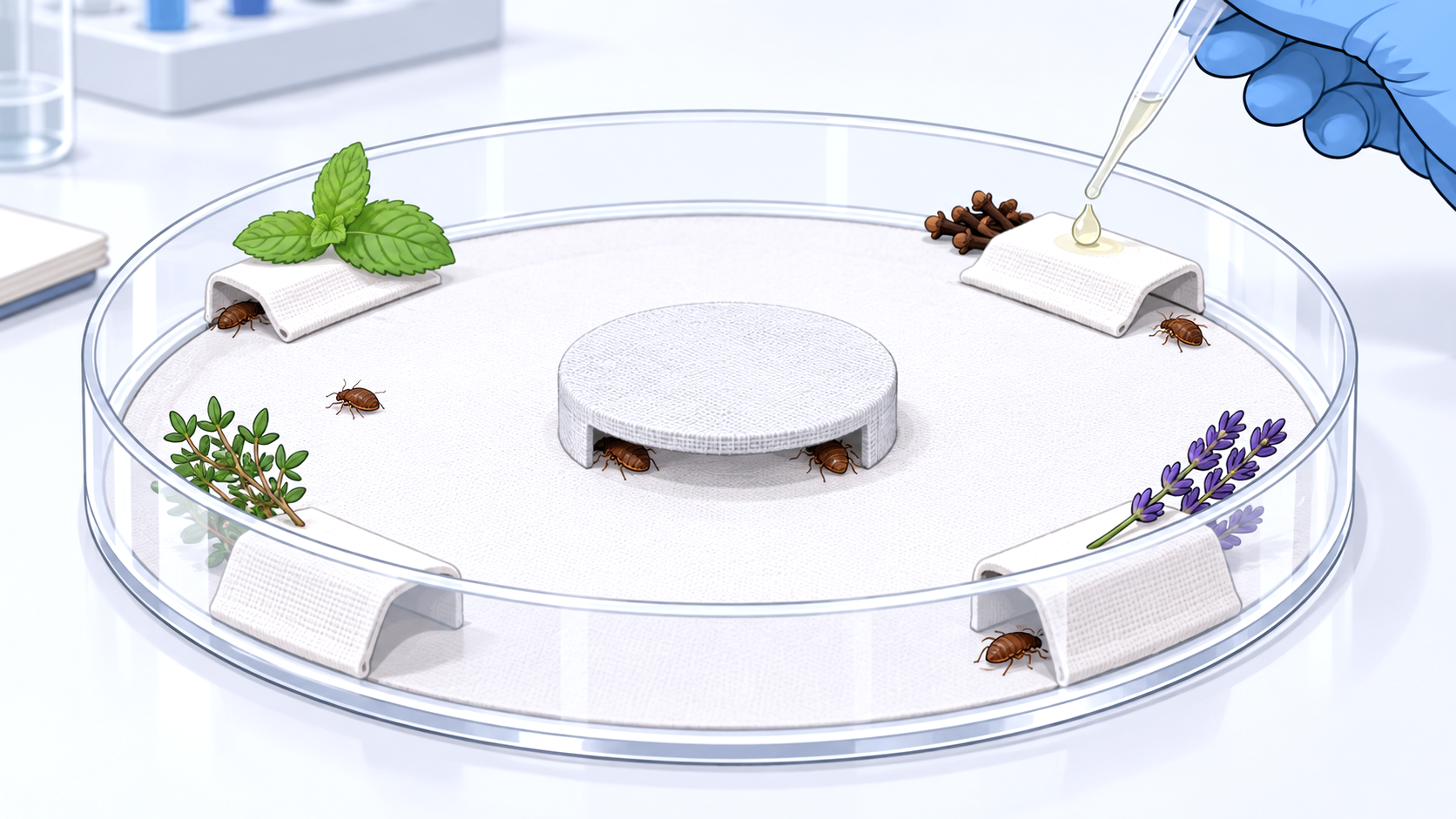
A 2021 peer-reviewed study published in Insects tested 11 essential-oil constituents against the common bed bug, Cimex lectularius. Researchers used video tracking to measure how individual bed bugs responded to fresh and 24-hour-old residues. They then used overnight choice experiments on the more promising compounds and tested whether treated barriers could stop bed bugs from reaching a warmed blood source.
The 11 compounds were geraniol, eugenol, carvacrol, thymol, citronellic acid, linalool, menthone, trans-cinnamaldehyde, alpha-pinene, beta-pinene and limonene. Importantly, these were purified chemical constituents diluted to 1% in acetone. The researchers weren’t spraying commercial bottles of lavender, peppermint, clove or other whole essential oils.
With fresh residues, geraniol, eugenol, carvacrol, thymol and trans-cinnamaldehyde caused bed bugs to avoid approaching and visiting treated areas. Citronellic acid and linalool reduced visits to treated areas but produced a weaker response.
The more demanding overnight experiments produced an especially useful result. Bed bugs avoided resting on areas treated with 24-hour-old residues of geraniol, eugenol, carvacrol and citronellic acid. Those four therefore have the clearest evidence from this study for a persistent avoidance effect.
Geraniol
Geraniol produced one of the strongest and most consistent responses in the study. Bed bugs avoided fresh geraniol residues, and the effect remained when researchers tested residue that had aged for 24 hours.
Geraniol occurs naturally in numerous aromatic plants and essential oils, including geranium, rose and citronella oils. However, the experiment used purified geraniol at a controlled concentration rather than a bottle of geranium or citronella essential oil.
That difference prevents a simple conclusion that any essential oil containing geraniol will perform the same way. Whole oils contain numerous constituents in varying concentrations, and their formulations can differ substantially. What the research directly supports is that geraniol itself caused measurable avoidance under the conditions tested.
Eugenol
Eugenol also produced consistent avoidance. Bed bugs avoided areas treated with fresh residue, and groups continued avoiding shelters treated with 24-hour-old eugenol during the overnight experiment.
Eugenol is strongly associated with clove oil and occurs in several other plants. That makes clove-derived products relevant when discussing botanical bed bug repellents, but once again the study tested purified eugenol rather than ordinary clove essential oil.
There is also an important distinction between repelling and killing. A compound that changes where a bed bug chooses to rest isn’t necessarily an effective insecticide. The researchers were measuring behavior here, not demonstrating that household applications of clove oil eliminate infestations.
Carvacrol
Carvacrol was another strong performer. Fresh residue caused avoidance during video tracking, and bed bugs continued avoiding carvacrol-treated shelters after the residue had aged for 24 hours.
Carvacrol is found prominently in oregano and some other aromatic plant oils. Laboratory research has also investigated its toxicity to bed bugs, but the repellency experiment provides a separate finding: bed bugs altered their behavior around carvacrol even when it wasn’t being evaluated simply as a lethal contact treatment.
Again, this doesn’t establish that applying oregano essential oil around a bedroom will keep bed bugs away. Concentration, formulation, evaporation and the presence of other constituents can all differ from a purified laboratory solution.
Citronellic Acid
Citronellic acid behaved somewhat differently. Its initial effect wasn’t as strong as the clearest fresh-residue performers, but it performed well in the overnight choice test.
When given treated and untreated shelters, bed bugs avoided resting on filter paper containing 24-hour-old citronellic acid residue. That placed it alongside geraniol, eugenol and carvacrol among the four compounds the researchers ultimately identified as having potential for development in repellent formulations.
That wording matters. The researchers discussed their potential in formulations. They didn’t conclude that consumers could use these individual chemicals or their corresponding essential oils as standalone home remedies.
What Happened With Thymol and Cinnamon-Related Compounds?
Thymol produced avoidance during the initial testing and was among the six compounds selected for the longer overnight choice experiment. However, it wasn’t among the four compounds the researchers ultimately identified as producing the strongest useful avoidance from 24-hour-aged residues.
Trans-cinnamaldehyde also produced clear avoidance during the initial video-tracking experiment. However, it wasn’t included among the six constituents selected for the subsequent overnight choice test. The study therefore doesn’t provide the same 14-hour group-choice evidence for aged trans-cinnamaldehyde residue that it provides for geraniol, eugenol, citronellic acid, thymol, carvacrol and linalool.
This makes it inappropriate to rank cinnamon-derived products alongside the four best-supported compounds based on this experiment alone.
What Happened With Linalool?
Linalool produced the study’s most unusual result.
Fresh linalool residue reduced the number of visits bed bugs made to treated areas during the initial video-tracking experiment. But when researchers conducted the longer choice experiment using 24-hour-old residue, bed bugs didn’t continue avoiding it. They aggregated in the linalool-treated shelters.
Linalool is an important constituent of lavender and numerous other aromatic plants, but this result shouldn’t be rewritten as “lavender oil attracts bed bugs.” The researchers tested purified linalool at a particular concentration and under controlled laboratory conditions, not commercial lavender essential oil.
It does, however, undermine the much broader assumption that a plant-derived aromatic compound will necessarily remain repellent simply because its fresh odor seems unpleasant or intense to humans. The behavioral response can change as residues age.
What About Menthone, Limonene and the Pinenes?
Menthone, alpha-pinene, beta-pinene and limonene didn’t produce the useful avoidance seen with the stronger compounds in the study.
These chemicals occur in various aromatic plants. Menthone is associated with mint oils, limonene is abundant in many citrus oils, and alpha- and beta-pinene occur in pine and numerous other plants. But the results shouldn’t be converted into blanket statements that peppermint, citrus or pine essential oils have been proven ineffective as bed bug repellents.
The experiment tested individual purified constituents, not complete oils. Whole essential oils are mixtures containing multiple compounds in proportions that vary by plant species, extraction method and product.
The safer conclusion is narrower: these particular constituents didn’t demonstrate meaningful avoidance in this experiment.
Why Even the Best Compounds Didn’t Create a Bed Bug Barrier
The most important experiment may have been the one in which repellency failed.
Researchers created treated barriers and placed a warmed blood source beyond them. If geraniol, eugenol, carvacrol or citronellic acid functioned as dependable barriers, bed bugs should have remained on the other side.
They didn’t.
Bed bugs crossed the treated areas and obtained blood meals. The researchers concluded that host-associated cues can interfere with the avoidance response produced by these compounds. In other words, a substance can make bed bugs prefer not to occupy a treated area without being strong enough to stop them when a host provides sufficient motivation to cross it.
That distinction is critical when considering home remedies for bed bugs. A laboratory avoidance response doesn’t mean you can spray an essential oil around a bed and create an invisible perimeter that hungry bed bugs won’t cross.
Repelling Bed Bugs Isn’t the Same as Getting Rid of Them
Even successful repellency presents another practical problem: the bed bugs remain alive.
Driving bugs away from one treated location doesn’t necessarily remove them from the room. They may occupy another harborage, wait for residues to weaken or cross the treated area when host cues become sufficiently strong.
That’s fundamentally different from a control method designed to reduce or eliminate the population. If an infestation is already established, a complete plan for getting rid of bed bugs should rely on proven physical, heat and appropriately selected pesticide controls rather than trying to redirect the insects with scent.
Essential oils can also create the impression that an area has been protected when bugs remain nearby. The research itself demonstrates why that confidence would be misplaced: even the four compounds with the clearest avoidance effects didn’t stop bed bugs from reaching blood.
Can You Use Essential Oils Around Your Bed?
The laboratory results don’t establish a DIY concentration, application rate or treatment schedule for applying these essential oils around beds.
The researchers used high-purity chemical constituents diluted to 1% in acetone and applied measured quantities to filter paper. A household bottle of essential oil is a chemically more complicated mixture, and putting drops into water, using a diffuser or spraying an improvised solution doesn’t reproduce the experiment.
Essential oils also aren’t automatically harmless because they’re plant-derived. Concentrated oils can irritate skin and eyes, pose risks if swallowed and may be unsuitable around some children or pets. Products should be used according to their intended directions rather than assuming that a laboratory result for one constituent makes an improvised pesticide mixture safe.
For people specifically interested in nonconventional approaches, natural methods for getting rid of bed bugs still need to be judged by evidence for actual control rather than by whether a substance has a strong smell or produces short-term avoidance.
Questions About Essential Oils and Bed Bugs
Which essential-oil compounds have the strongest evidence for repelling bed bugs?
In this study, geraniol, eugenol, carvacrol and citronellic acid produced the clearest lasting avoidance. Bed bugs avoided resting on areas containing their 24-hour-old residues during overnight choice experiments.
Does lavender oil repel bed bugs?
This study doesn’t answer that directly. It tested linalool rather than complete lavender oil. Fresh linalool produced some avoidance, but bed bugs aggregated on areas containing 24-hour-old linalool residue during the longer experiment. That finding shouldn’t be expanded into a claim that lavender oil itself attracts or repels bed bugs.
Does peppermint oil repel bed bugs?
The study tested menthone, not whole peppermint oil, so it can’t establish the effectiveness of peppermint essential oil as a finished product. Menthone didn’t produce meaningful avoidance under the experimental conditions.
Can essential oils stop bed bugs from reaching you at night?
The evidence here says not reliably. Even barriers made with the strongest avoidance compounds didn’t prevent bed bugs from crossing treated areas and feeding from a warmed blood source.
Would combining several repellent compounds work better?
This experiment doesn’t establish that. It tested the compounds individually, so it can’t tell us whether combining geraniol, eugenol, carvacrol and citronellic acid would strengthen, weaken or otherwise change their behavioral effects.
Does an essential-oil diffuser repel bed bugs?
This study doesn’t provide evidence for that use. Researchers tested measured residues applied to filter paper rather than essential oils dispersed through room air by a diffuser.