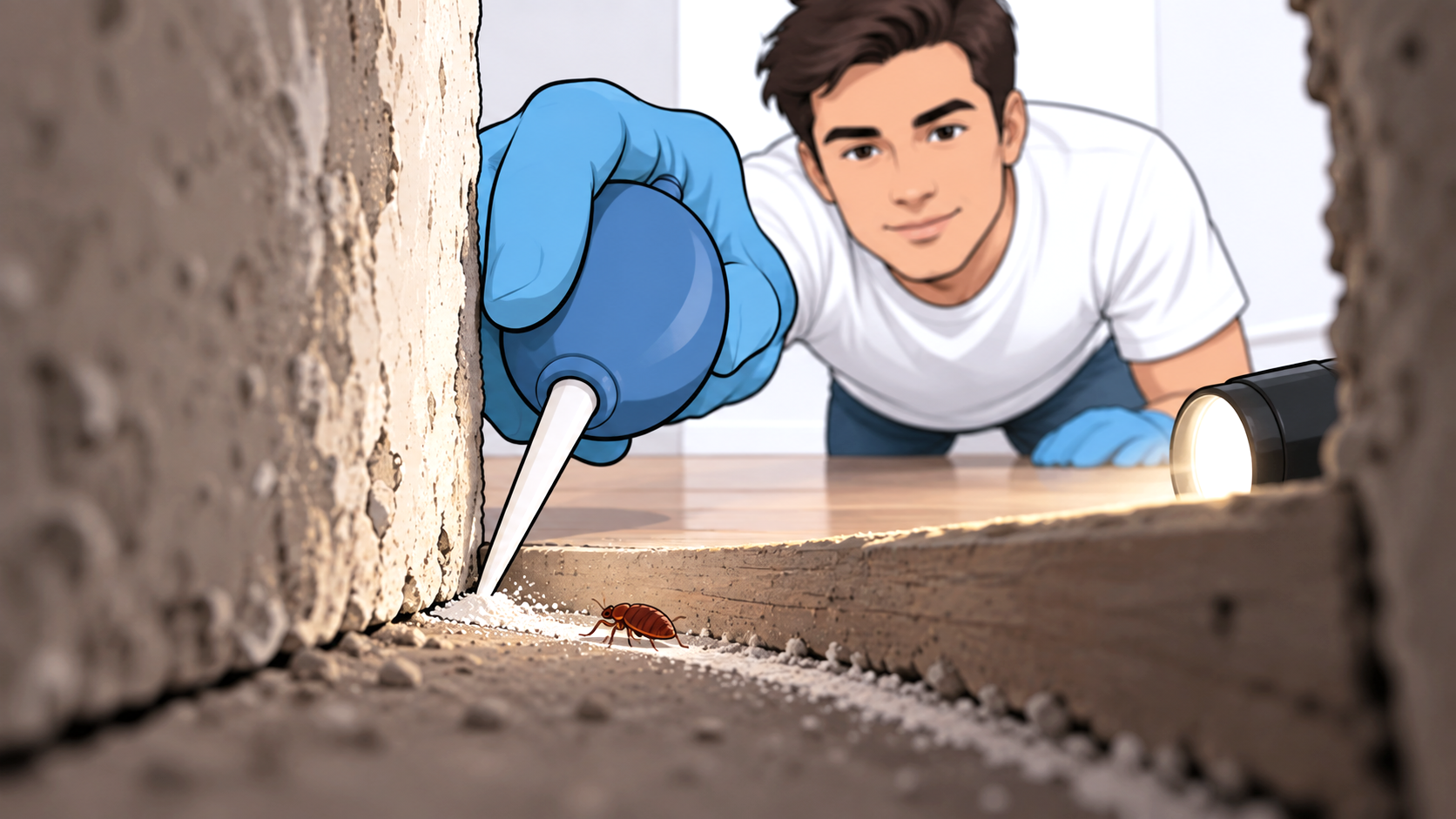
Diatomaceous earth can kill bed bugs, but the type of product and the way it is applied matter enormously. It is a slow-acting desiccant rather than an instant contact killer, and the EPA specifically recommends using only diatomaceous earth pesticide products that are registered and labeled for bed bug control. Food-grade and pool-grade products should not be substituted simply because they also contain diatomaceous earth.
When an effective diatomaceous earth dust contacts a bed bug, it damages the protective outer layer that helps the insect retain water. The bed bug gradually loses moisture and eventually dies from desiccation. This physical mode of action also makes properly labeled desiccant dusts useful against bed bugs that may be resistant to conventional insecticides.
Use Pesticide-Grade Diatomaceous Earth Labeled for Bed Bugs
The most important distinction isn’t simply whether the package says “food-grade.” The EPA specifically warns against using food-grade or swimming-pool-grade diatomaceous earth for bed bug control because products intended for those purposes can pose greater inhalation risks than pesticide formulations evaluated for bed bug use.
Pool-grade diatomaceous earth is particularly inappropriate for indoor pest control. The material is processed for filtration rather than pesticide use and can contain substantially more crystalline silica, which presents a serious respiratory hazard when respirable particles are repeatedly inhaled. Food-grade diatomaceous earth generally contains much less crystalline silica, but “food-grade” still doesn’t mean that a fine powder is safe to breathe or that it has been evaluated for application around bedrooms.
Instead, look for an EPA registration number and confirm that bed bugs appear on the pesticide label. The EPA maintains a searchable database of registered bed bug pesticide products, which can also help determine where a particular product is permitted to be applied. The label, rather than a generic recommendation for diatomaceous earth, determines how and where that specific product should be used.
How Does Diatomaceous Earth Kill Bed Bugs?
Diatomaceous earth is made from the fossilized remains of microscopic aquatic organisms called diatoms. Its insecticidal effect is physical rather than the nerve-targeting action associated with insecticides such as pyrethroids.
Cornell’s guidance on desiccant dusts explains an important difference between diatomaceous earth and silica gel. Diatomaceous earth abrades or scratches the protective cuticle, making the insect more vulnerable to water loss, while silica gel adheres to the insect and adsorbs its waxy protective layer. Both ultimately interfere with the bed bug’s ability to retain water, causing death through desiccation.
Because the mechanism is physical, conventional insecticide resistance doesn’t protect a bed bug in the same way it can against pesticides that attack particular biochemical targets. This is one reason the EPA considers desiccants valuable components of bed bug control.
How Long Does Diatomaceous Earth Take to Kill Bed Bugs?
Diatomaceous earth is slow. A bed bug that walks through an effective application may remain alive for days afterward while gradually losing water.
Laboratory studies have also found substantial performance differences between diatomaceous earth and silica gel. Silica gel has generally produced faster mortality in comparative testing, while different diatomaceous earth formulations haven’t necessarily performed identically. That makes it misleading to promise that every DE product will kill bed bugs within a fixed number of days.
The EPA goes even further when discussing desiccants in DIY treatment, noting that desiccants can take several months to work in some circumstances. Laboratory mortality under controlled exposure therefore shouldn’t be treated as a guaranteed timeline for eliminating an infestation inside a home, where bugs may remain inside untreated harborages and encounter much less dust.
A Thin Application Works Better Than Piles of Dust
Using more diatomaceous earth doesn’t necessarily improve treatment. Bed bugs have to contact the dust, so application location and technique matter more than covering large surfaces with visible powder.
Cornell recommends applying desiccant dust as a very thin coating, often barely perceptible, in label-approved cracks and crevices where bed bugs are likely to make close contact with treated surfaces. Heavy piles can be less effective because bed bugs may avoid them, while excessive dust also increases the amount of material that can become airborne.
Depending on the individual product label, appropriate treatment locations may include cracks around floor molding, portions of bed frames, furniture crevices, or other protected areas where bed bug activity has been found. Some registered products permit particular mattress or box-spring applications, while others may not. Don’t assume that an open mattress surface, carpet, electrical outlet, or piece of furniture can be treated simply because bed bugs could hide there.
Moisture Can Make Diatomaceous Earth Less Effective
Desiccant dust needs to remain dry and finely distributed to work properly. Cornell notes that excessive moisture can cause these materials to clump, preventing the particles from adhering effectively to insects. High humidity can also make desiccation more difficult because bed bugs lose water less readily under humid conditions.
That doesn’t mean there is a particular household humidity percentage at which diatomaceous earth suddenly stops working. It also doesn’t establish that running a dehumidifier will make DE treatment successful. The practical point is simpler: keep labeled applications dry and follow the manufacturer’s instructions if treated areas become wet, disturbed, or removed during cleaning.
This is also why repeatedly adding fresh powder on top of damp or heavily clumped material isn’t necessarily appropriate. If an application needs to be cleaned up or replaced, follow the product label rather than continuing to build up additional layers.
Diatomaceous Earth Can Still Irritate Your Lungs
Using a registered pesticide formulation doesn’t make inhaling the dust harmless. The EPA limits desiccant applications to appropriate locations to reduce inhalation exposure and specifically warns that using unregistered diatomaceous earth for bed bugs can be harmful when breathed in.
Avoid creating clouds of dust during application and follow the pesticide label’s instructions for protective equipment, ventilation, application methods, and re-entry. Don’t automatically assume that a particular respirator, mask, or other protective device is required unless the label calls for it. The required precautions depend on the actual registered product.
Children and pets also shouldn’t be allowed to disturb pesticide dust or enter areas contrary to label directions. A desiccant can have a relatively low toxicity profile while still creating unnecessary exposure when it is applied incorrectly.
Diatomaceous Earth Works Better as Part of a Larger Treatment
Even correctly applied diatomaceous earth can’t kill a bed bug that never contacts it. Bugs may remain inside untreated furniture, belongings, cracks, wall voids, and other protected harborages, while newly hatched nymphs can continue appearing after treatment begins.
For that reason, DE works better as one component of an integrated treatment plan rather than as powder spread around a room and left to solve the infestation alone. Depending on the situation, treatment can also include inspection, vacuuming, monitoring, encasements, steam, and dryer heat for suitable belongings. A complete approach to getting rid of bed bugs addresses those additional parts of the infestation rather than depending on a single product.
Diatomaceous earth’s slow action isn’t necessarily a disadvantage when it is used correctly. Dry desiccant dust can remain active for a long time in protected locations, allowing bed bugs that cross treated areas later to be exposed. The limitation is that every application still depends on correct placement and the bugs actually contacting the dust.
Questions About Diatomaceous Earth and Bed Bugs
Can you put diatomaceous earth directly on your mattress?
Only if the label of the specific EPA-registered product permits application to that part of the mattress. Don’t spread ordinary food-grade DE or another unlabeled powder across the surface where you sleep.
Is food-grade diatomaceous earth safe for bed bugs?
Food-grade isn’t the standard you should use when choosing a bed bug treatment. The EPA specifically recommends using an EPA-registered pesticide labeled for bed bugs and warns against substituting food-grade or pool-grade DE.
Does diatomaceous earth kill pesticide-resistant bed bugs?
Yes, properly labeled desiccant dust can kill bed bugs even when resistance reduces their susceptibility to conventional insecticides. Desiccants damage the insect’s ability to retain water through a physical mechanism rather than relying on the same biochemical targets as insecticides such as pyrethroids.
Is silica gel better than diatomaceous earth for bed bugs?
Silica gel has killed bed bugs faster than diatomaceous earth in comparative laboratory research. The two materials also interact with the insect’s protective outer layer differently. Whichever desiccant is used, choose a pesticide registered for bed bugs and follow its label.
4 thoughts on “Does Diatomaceous Earth Kill Bed Bugs? How to Use It Properly”