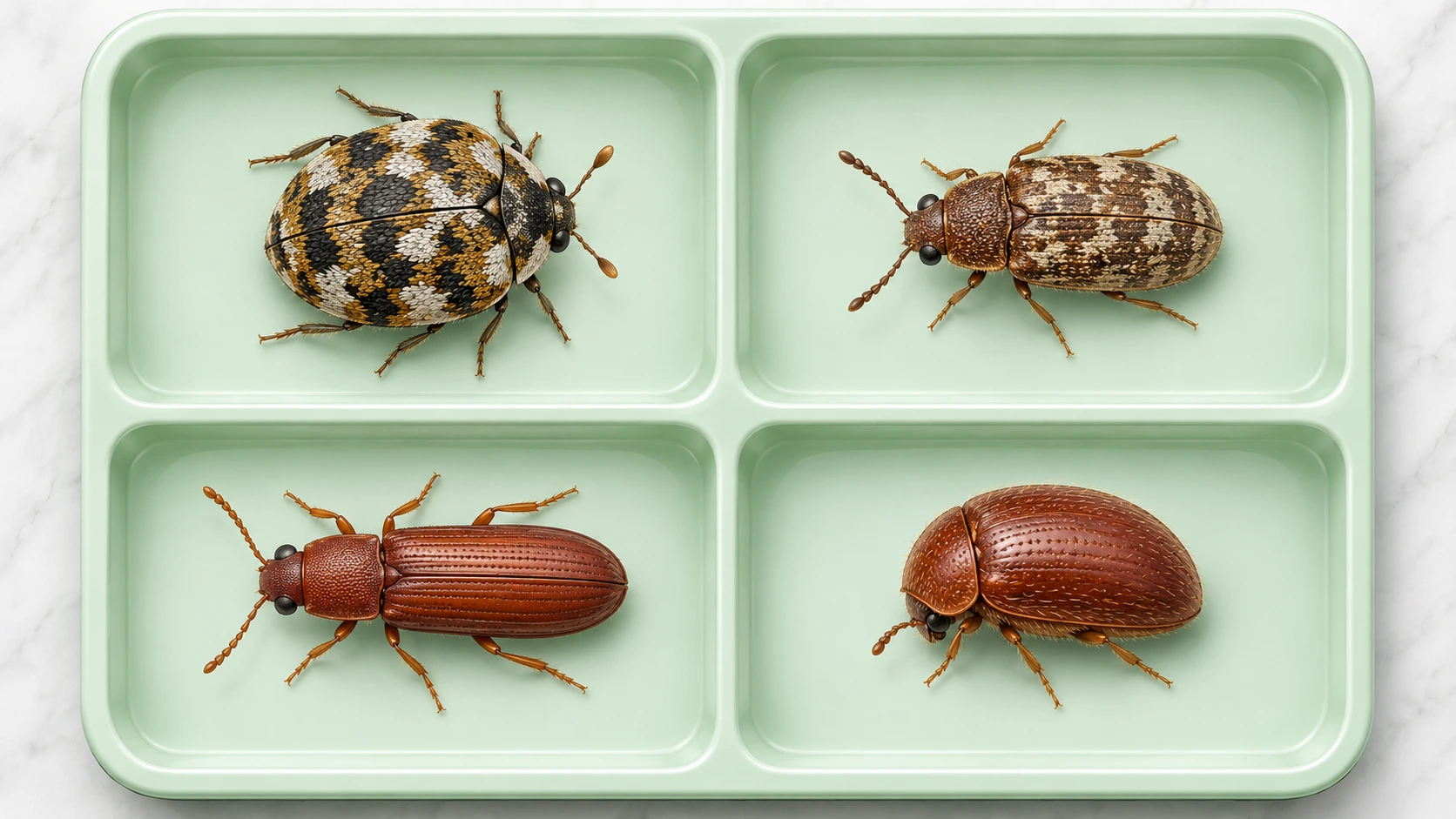
Carpet beetles can look like several common stored-food beetles, especially warehouse beetles, cigarette beetles, and other small brown insects found in pantries. The most useful differences are the beetle’s body shape, antennae, surface markings, and the material where its larvae are developing.
Finding a beetle in a kitchen does not automatically make it a pantry pest. Adult carpet beetles can wander into cupboards or gather near windows, while some carpet beetle species can actually infest dried food products. Black carpet beetles, for example, can feed on cereal products, bran, dried pet food, and other stored materials.
The name pantry beetle adds another complication because it describes a group of pests rather than one species. A cigarette beetle is not a flour beetle, and a warehouse beetle is not a sawtoothed grain beetle. They differ in appearance, larval development, and food associations.
The best approach is to identify the beetle first and then look for evidence that connects it to a particular stored product. A single adult on a shelf is not enough to establish which package, if any, contains an infestation.
Which Stored-Food Beetles Are Most Easily Confused With Carpet Beetles?
Several beetles that infest stored food are small enough to be mistaken for household carpet beetles. Some are rounded, some are flattened, and others have distinctive features that become visible only under magnification.
The comparison below covers the principal candidates.
| Beetle | Scientific name | Adult identification clue | Commonly associated material |
|---|---|---|---|
| Black carpet beetle | Attagenus unicolor | Dark, convex, elongated oval; short clubbed antennae | Wool, dried animal material, grain products, pet food |
| Varied carpet beetle | Anthrenus verbasci | Small, rounded, mottled with pale and dark scales | Animal-derived materials; adults often found near windows |
| Warehouse beetle | Trogoderma variabile | Oval, dark, usually with lighter reddish or brownish bands | Cereals, seeds, nuts, dried food, animal feed |
| Red flour beetle | Tribolium castaneum | Flattened, reddish brown, elongated; antennae end in an abrupt three-segmented club | Flour, meal, cereals, other processed foods |
| Confused flour beetle | Tribolium confusum | Similar to red flour beetle; antennae enlarge more gradually | Flour, cereals, processed grain products |
| Cigarette beetle | Lasioderma serricorne | Small, rounded, humpbacked, reddish brown; head largely hidden from above | Spices, tobacco, dried herbs, grains and other dried goods |
| Drugstore beetle | Stegobium paniceum | Humpbacked, reddish brown; wing covers have lengthwise grooves | Spices, dry foods, pet food and other stored products |
| Sawtoothed grain beetle | Oryzaephilus surinamensis | Very flat, elongated; six toothlike projections along each side of the thorax | Cereals, flour, nuts, dried fruit, processed foods |
| Merchant grain beetle | Oryzaephilus mercator | Similar sawtoothed body form | Nuts, dried fruit, cereal products and other dry foods |
| Spider beetles | Several species, including Ptinus and Gibbium | Often rounded with long legs, sometimes resembling tiny spiders | Dried foods, animal material, stored debris |
These names describe different species or, in the case of spider beetles, several related species. They should not be compressed into one generic identification.
The stored-food beetle comparison used in pantry pest management separates warehouse, flour, cigarette, drugstore, and sawtoothed grain beetles because each has recognizable identifying features.
One complication is that warehouse beetles and carpet beetles are more closely related than most of the other insects in the table. They belong to the same beetle family, Dermestidae.
Warehouse Beetles Look Particularly Similar to Carpet Beetles
The warehouse beetle, Trogoderma variabile, is one of the most important lookalikes in this comparison.
Adult warehouse beetles are small, oval insects, commonly around 2–4.6 millimetres long. Their wing covers are usually dark with contrasting lighter brown or reddish bands. The markings can vary, making some specimens appear more mottled than others.
That appearance can resemble a household carpet beetle, particularly when the specimen is photographed from above.
Warehouse beetle larvae create even greater confusion. They are elongated, hairy, and may have dense tufts of bristles toward the rear. Their discarded skins can resemble those of familiar carpet beetle larvae.
This similarity has a biological explanation. Warehouse beetles and carpet beetles are both dermestids.
The warehouse beetle’s adult and larval characteristics include variable banding, hairy larvae, and cast skins that can accumulate in infested products.
Their food associations also overlap. Warehouse beetles can develop in seeds, nuts, legumes, dried animal material, and numerous processed foods. They may be found in food warehouses, grain facilities, animal feed, and household stored goods.
Carpet beetle larvae can likewise exploit certain dried animal materials, while some species also use stored plant products.
Finding a hairy dermestid larva in pet food therefore does not establish whether it is a warehouse beetle or a carpet beetle.
A close examination of adult or larval structures may be necessary. Where species-level identification matters, a qualified entomologist can separate the insects more reliably than an ordinary phone photograph.
The key household question remains whether the food or material contains developing larvae, rather than merely one wandering adult.
Warehouse Beetles and Carpet Beetles Can Leave Similar Shed Skins
Shed skins are useful evidence of beetle development, but they are not always sufficient for species identification.
Carpet beetle larvae molt repeatedly as they grow. The discarded coverings can preserve their segmented shape and characteristic bristles.
Warehouse beetle larvae also molt, leaving hairy cast skins among the materials they infest.
Those skins may accumulate in dried food, animal feed, or sheltered storage areas. Their presence supports previous larval development, but does not automatically identify which dermestid species produced them.
Warehouse beetle larvae also bear specialized hairs that can become a contamination concern in stored food. These hairs may irritate the mouth, throat, or digestive tract if contaminated material is consumed.
That risk is recognized in warehouse beetle food-contamination guidance.
When hairy larvae or cast skins are found inside food, the correct response is to treat the material as potentially infested rather than assume that it is safe because the insect resembles a familiar carpet beetle.
The detailed separation of Trogoderma species belongs to specialist identification. A warehouse beetle may also be confused with other dermestids, including regulated species whose identification has greater consequences.
Carpet Beetle vs. Red and Confused Flour Beetles
Red flour beetles and confused flour beetles are among the most familiar insects associated with processed grain products.
Their scientific names are Tribolium castaneum and Tribolium confusum, respectively. Both are small, reddish-brown beetles with elongated bodies.
They look different from the rounder, more convex forms of many carpet beetles.
A flour beetle has a relatively flattened outline, with the head visible from above. Its body looks longer and more parallel-sided than that of a varied carpet beetle.
A black carpet beetle may be elongated too, but it retains a more convex beetle profile and usually lacks the same uniformly reddish-brown appearance.
The two Tribolium species are difficult to separate from one another without a close view of the antennae.
The red flour beetle has a distinct club formed by the final three antennal segments. In the confused flour beetle, the segments enlarge more gradually toward the tip.
The red and confused flour beetle identification reference also describes differences in the shape of the thorax, although these can be subtle in ordinary photographs.
Both flour beetles are associated with flour, meal, cereal products, and other processed foods. Their larvae are pale, slender, and much less hairy than typical carpet beetle larvae.
A reddish-brown adult beetle repeatedly appearing inside a container of flour is therefore worth comparing with Tribolium.
A dark adult found on the kitchen windowsill without any associated food infestation could be something else entirely.
Does the Type of Flour Damage Identify the Beetle?
Finding insects in flour supports a stored-product infestation, but the flour’s appearance usually cannot identify the species on its own.
Flour beetles can develop among milled grain products and accumulations of broken kernels. Their activity may leave insects, larvae, shed skins, and other contamination in the material.
Some carpet beetles can also use stored grain products, particularly black carpet beetles.
The stored-product profile of the black carpet beetle specifically includes cereal products, bran, ground maize, dried pet food, and other stored commodities.
The difference is often clearer in the specimens than in the food.
A reddish-brown, flattened adult with a visible head suggests a flour beetle. A darker, convex adult with short, clubbed antennae may be a carpet beetle.
Their larvae also differ. Flour beetle larvae are slender, pale, and have small pointed projections at the rear. Carpet beetle larvae are generally more bristly and may have pronounced hair tufts.
A container may contain only one insect species, but mixed infestations can occur. Do not assume every larva and adult belongs to the same species until their forms are consistent.
Carpet Beetle vs. Cigarette Beetle
The cigarette beetle, Lasioderma serricorne, is a small reddish-brown beetle with a rounded, strongly convex body.
Its shape can resemble that of a tiny carpet beetle, especially when the insect is viewed from above.
One useful feature is the cigarette beetle’s humpbacked appearance. The head is often largely concealed beneath the front of the thorax when viewed from above.
Its antennae have a serrated, or sawlike, appearance rather than the typical compact club of a carpet beetle.
The wing covers also tend to look relatively smooth, without the conspicuous lengthwise rows of grooves seen on drugstore beetles.
Cigarette beetles are associated with tobacco, spices, dried herbs, seeds, cereal products, dried leaves, and many other stored materials. The name does not mean that they only infest cigarettes.
The cigarette beetle identification and commodity record documents its reddish-brown color, small size, serrated antennae, and broad range of stored-product foods.
A tiny humpbacked beetle emerging repeatedly from dried spices therefore deserves closer comparison with cigarette beetles than with a varied carpet beetle found near a sunny window.
Their larvae can also be pale and hairy, so the presence of hairs alone is not enough to identify carpet beetles.
The adults’ head position, antennae, and wing-cover texture provide better evidence.
Carpet Beetle vs. Drugstore Beetle
Drugstore beetles, Stegobium paniceum, closely resemble cigarette beetles.
Both are small, reddish-brown, rounded insects whose heads may be difficult to see from above. Both are associated with numerous dried stored products.
Drugstore beetles differ in two useful ways.
Their wing covers have distinct lengthwise grooves, and their antennae end in a three-segmented club rather than the serrated arrangement typical of cigarette beetles.
These details usually require magnification.
The drugstore beetle’s characteristic wing grooves and antennae are particularly useful when separating it from other rounded brown stored-food beetles.
A carpet beetle may be distinguished by its broader body form, different antennal arrangement, and, for some species, conspicuous mottled scales.
However, a dark or worn carpet beetle and a plain brown drugstore beetle may remain difficult to separate in an unfocused photograph.
The dedicated carpet beetle versus drugstore beetle comparison covers that pairing in more detail. For this roundup, the main practical clue is the combination of a humpbacked body, a largely concealed head, and grooved wing covers.
Sawtoothed and Merchant Grain Beetles Have a Flatter Shape
Sawtoothed grain beetles and merchant grain beetles are less similar to carpet beetles once their body structure is visible.
The sawtoothed grain beetle, Oryzaephilus surinamensis, is a narrow, flattened, brown beetle. It has six small toothlike projections along each side of the thorax, immediately behind the head.
The merchant grain beetle, Oryzaephilus mercator, has a similar overall appearance.
The two species are difficult to distinguish reliably without close examination. Both can be associated with dried stored foods, including grain products, nuts, and other processed materials.
Their flattened bodies differ from the more convex shape of carpet beetles.
The thoracic teeth also provide a strong clue. Adult carpet beetles do not have the distinctive sawtoothed outline along the sides of the thorax.
These insects can hide among food particles and inside narrow package folds. A specimen removed from a cupboard may appear to be nothing more than a thin brown line until magnified.
The pantry beetle identification guide describes sawtoothed and merchant grain beetles among the common species associated with stored products.
A flattened beetle with visible thoracic teeth is more consistent with Oryzaephilus than with a rounded carpet beetle.
Could the Insect Be a Spider Beetle?
Spider beetles are another group that may be mistaken for small carpet beetles.
Several household species have rounded bodies and relatively long legs. Some look like tiny spiders when viewed from above, particularly when their legs and antennae extend outward.
They are still beetles, not spiders.
Spider beetles can develop in a range of stored materials, including dried food, animal-derived debris, and accumulated organic matter. Their appearance varies considerably among species.
A smooth spider beetle may look like a shiny reddish-brown bead with long legs. Other species have a more elongated body and visible hairs.
The household stored-food pest guide includes spider beetles among pantry insects and describes their rounded bodies and long-legged appearance.
Carpet beetles are generally more compact-legged and do not usually have the same spiderlike outline.
A rounded beetle with unusually long legs, particularly one found in stored dry material, deserves consideration as a spider beetle rather than being identified automatically as a carpet beetle.
Larder Beetles Are Related to Carpet Beetles
Larder beetles, Dermestes lardarius, also belong to Dermestidae.
They are usually larger than the small household carpet beetles discussed here. Adults commonly have a distinctive pale buff band across the front portion of their otherwise dark wing covers, with dark spots in the band.
Their larvae are hairy and can be associated with dried animal materials, meat products, hides, and other organic matter.
This makes larder beetles another example of a stored-product insect that is closely related to carpet beetles but not identical to the familiar wool-associated household species.
A large, dark beetle with a broad pale band is more consistent with a larder beetle than a tiny varied carpet beetle.
The overlap in animal-derived food also makes the discovery context less decisive than it first appears.
A beetle found near dried meat or animal remains should not automatically be identified as a carpet beetle merely because it belongs to the same family.
The full carpet beetle versus larder beetle comparison addresses that specific pairing without requiring this stored-food overview to become a separate larder beetle guide.
What About Khapra Beetles and Other Trogoderma Species?
The khapra beetle, Trogoderma granarium, is another dermestid associated with stored products.
Its importance goes beyond ordinary household pest identification because it is a serious regulated stored-grain pest in certain jurisdictions.
Khapra beetles can resemble warehouse beetles and other Trogoderma species. Their larvae may also resemble the hairy larvae of familiar carpet beetles.
This similarity makes identification from an ordinary photograph unreliable.
It would be inappropriate to call a specimen a khapra beetle simply because it has a dark oval body or was found in imported grain.
Official identification may require specialist examination, particularly where quarantine or reporting requirements apply.
The separate carpet beetle versus khapra and other dermestid beetles guide addresses those identification limits.
For this article, the useful point is that Trogoderma includes more than the warehouse beetle. Species within the group can be difficult to distinguish, and a suspected regulated pest requires a different level of confirmation from an ordinary household carpet beetle.
What Does the Food Tell You About the Beetle?
A specimen’s appearance should lead the identification, but the food can help narrow the candidates.
Some stored-product beetles specialize in particular forms of food. Others feed on a much broader range of dry materials.
Here is how the discovery context can help.
| Where the beetle is found | Candidates worth examining | Best supporting evidence |
|---|---|---|
| Flour, meal, or broken grain products | Red flour beetle, confused flour beetle, other stored-food beetles | Flattened reddish adults and pale larvae within food |
| Spices, dried herbs, or tobacco | Cigarette beetle, drugstore beetle | Small humpbacked adults and signs of development within the product |
| Cereals, pet food, seeds, nuts | Warehouse beetle, flour beetles, other stored-product pests | Adults, larvae, cast skins, and direct food infestation |
| Wool or animal-derived materials near a pantry | Carpet beetles, warehouse beetles, larder beetles | Hairy larvae and evidence of feeding in the material |
| Cracks containing spilled grain and debris | Several stored-product beetles, including black carpet beetles | Live immature stages associated with accumulated food |
| Windowsill near a kitchen | Carpet beetles or wandering adults of several pantry species | Species identification; window location alone is inconclusive |
Food associations overlap. Cigarette beetles can infest more than tobacco, and warehouse beetles can use both plant and animal materials.
Black carpet beetles are especially important to remember because they are not confined to textiles. Their established stored-product associations include dried pet food, cereal products, and grain debris.
An insect’s presence inside a package is stronger evidence of an infestation than its presence on a nearby shelf.
The carpet beetles in kitchens and pantries article deals with the possible sources in that room. For identification, the relevant question is whether the beetle’s anatomy agrees with the affected food.
Why Larvae Can Be More Useful Than Adult Beetles
Adult stored-food beetles often move away from the materials where they developed.
Some fly toward light. Others crawl along pantry shelves, walls, and windowsills. Finding one adult away from food may provide little information about the breeding source.
Larvae found directly within a stored product offer stronger evidence.
Their appearance can also narrow the identification.
Flour beetle larvae are pale and slender, with small pointed projections at the rear. Cigarette and drugstore beetle larvae are pale, curved, and may be hairy. Warehouse beetle and carpet beetle larvae are typically more elongated and conspicuously bristled.
The overlap among hairy larvae is particularly important.
A warehouse beetle larva cannot reliably be distinguished from every carpet beetle larva merely by noticing that both have rear hair tufts.
The same caution applies to cast skins. A bristly shed skin in a food package can identify the broader dermestid type of insect without establishing the precise species.
Where food contamination is involved, it is more important to establish that the product contains insects than to force a species name from incomplete evidence.
Do Small Holes in Packages Identify the Pest?
Small holes in dry-food packaging can suggest insect activity, but they are not unique to one beetle.
Different insects may chew packaging, exploit existing openings, or develop inside products before adults emerge.
Drugstore and cigarette beetles can be associated with damage to food packaging and dry commodities. Other stored-product pests can also appear in packages that seem closed.
A package hole cannot establish whether a carpet beetle, cigarette beetle, drugstore beetle, or another insect caused it.
The same applies to fine powder or debris at the bottom of a container. It may reflect feeding, broken food, frass, shed skins, or other contamination.
For more reliable identification, examine the adult beetles and any larvae present. Pay attention to body shape, antennae, markings, and whether the insects are developing directly in the food.
A clear specimen is usually more informative than a single unexplained hole.
How to Identify a Tiny Pantry Beetle More Reliably
A good identification photograph should show the insect from above and, if possible, from the side.
The overhead view reveals body shape, markings, and the structure of the thorax. The side view can show a humpbacked profile or a head that is concealed beneath the thorax.
For a flour beetle, examine the exposed head and the antennal tip. For a cigarette or drugstore beetle, look at the antennae and wing-cover texture. For a warehouse beetle or carpet beetle, examine the overall oval shape and any contrasting bands or scales.
A small ruler beside the specimen can establish approximate size, but size should not decide the identification by itself. Several stored-food beetles overlap within the 2–5 millimetre range.
If larvae are present, photograph them separately. Their structures may provide evidence that the adult photograph does not.
Keep the discovery location with the record. A specimen from inside a bag of flour has a more direct food association than one collected from a bathroom windowsill.
The Canadian Grain Commission also publishes a visual identification key covering stored-product beetles. It includes black carpet beetles, warehouse beetles, flour beetles, cigarette beetles, drugstore beetles, and many other relevant species.
A key can narrow the possibilities, but it requires the necessary anatomical details to be visible. Where those details are missing, a qualified insect-identification service may be needed.
What If Several Beetle Species Are Present?
More than one stored-product beetle species can occur in a pantry, food warehouse, or other storage area.
Different foods may support different pests. A container of flour could contain one species, while neglected pet food or dried animal material supports another.
Mixed evidence should not be forced into a single identification.
For example, a reddish-brown, flattened adult in flour and a dark, banded dermestid larva in pet food may represent two separate infestations.
Even where the insects occur in the same cabinet, their breeding materials may differ.
A sound assessment identifies each distinct beetle form, connects it to the material where development is occurring, and avoids assigning every insect sighting to the first species noticed.
This matters because one infested package does not necessarily explain all the activity in a room.
Why a Correct Identification Matters Before Treatment
The safest and most effective response begins with identifying the infested material.
A pantry beetle developing inside dried food cannot be eliminated reliably by spraying a nearby wall while leaving the contaminated package untouched.
Stored-food insect management generally emphasizes removing infested products, cleaning spilled material, and keeping suitable foods in secure containers.
The integrated management guidance for pantry pests advises against using insecticides as the normal solution around stored food because pesticide contamination can create additional risks.
Food containing insects, cast skins, or other evidence of infestation should not be treated with household pesticides and then used for consumption.
For a confirmed carpet beetle infestation in animal-derived materials, identifying the feeding source remains important, but that source may be outside the pantry.
One spray treatment should not be assumed suitable for both situations. Product labels, permitted surfaces, and exposure risks differ.
The purpose of identifying the beetle is to locate the material supporting its development, not simply to choose a pesticide.
The Bottom Line
Carpet beetles are only one of several small beetles that can appear around stored food. Warehouse beetles, flour beetles, cigarette beetles, drugstore beetles, sawtoothed grain beetles, and spider beetles have their own distinguishing features and food associations.
Warehouse beetles are among the closest lookalikes because they belong to the same family as carpet beetles. Their hairy larvae and cast skins can be difficult to distinguish without careful examination. Flour beetles have flatter, reddish-brown bodies. Cigarette and drugstore beetles are typically humpbacked, while sawtoothed grain beetles have a distinctive flattened shape and toothlike projections along the thorax.
The food helps narrow the possibilities, but it does not provide a final identification. Black carpet beetles can infest stored products, and several other beetles feed on overlapping categories of dried food.
Look at the specimen, examine any larvae, and connect the evidence to the material where insects are actually developing. That is more reliable than calling every small brown insect in a cupboard a pantry beetle.