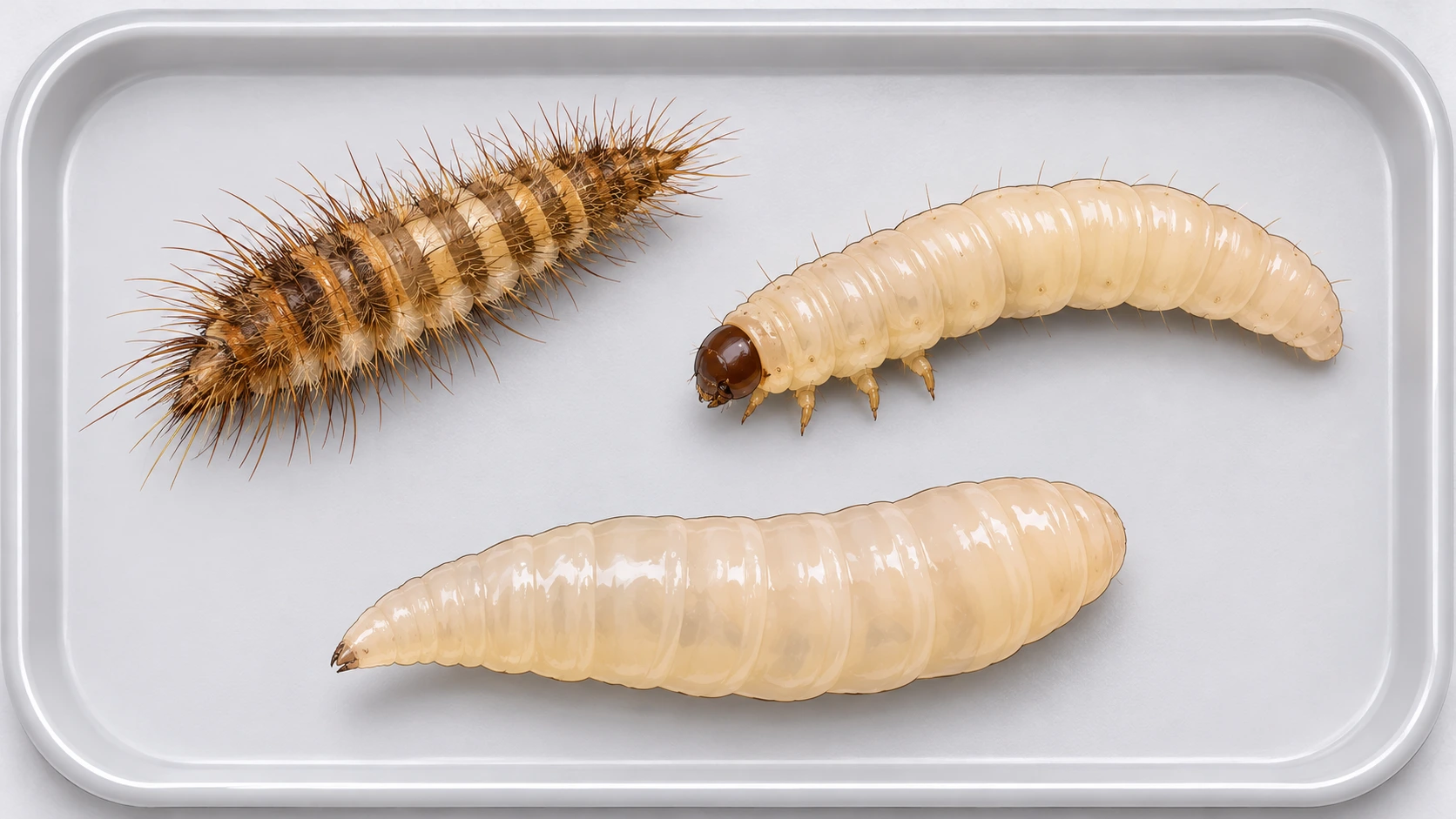
Carpet beetle larvae are usually brown and bristly, clothes moth larvae look like small cream-colored caterpillars with distinct heads, and typical fly maggots are pale, legless, and lack an obvious head capsule. Looking at their legs and the material around them is more reliable than judging by color or size alone.
These three kinds of immature insects can be confused because all may appear as small, segmented creatures crawling through a home. A carpet beetle larva found beside a baseboard may be called a maggot simply because of its shape. A clothes moth caterpillar may be mistaken for a pale beetle larva, especially when only part of its body is visible.
The confusion matters when the insects are found around clothing or furniture. Carpet beetle larvae and clothes moth larvae can both damage wool and other animal-derived materials, but they leave different physical clues. Ordinary housefly and blowfly maggots are usually associated with moist, decomposing material instead.
A magnifying glass and a close inspection of the front and underside of the insect can often separate the three groups.
Carpet Beetle Larvae, Moth Larvae, and Maggots Compared
<text color=”secondary” size=”sm”>The comparison below focuses on carpet beetle larvae, common household clothes moth larvae, and typical housefly or blowfly maggots. Other moth and fly species can look different.</text>
| Feature | Carpet beetle larva | Clothes moth larva | Typical fly maggot |
|---|---|---|---|
| Body surface | Usually covered in visible hairs or bristles | Generally smooth-looking, with sparse tiny hairs | Usually smooth-looking, sometimes with minute spines |
| Typical color | Tan, golden brown, reddish brown, or dark brown | Cream or whitish | White, cream, or pale yellow |
| Head | Distinct, hardened head capsule | Distinct, usually darker head capsule | No obvious external head capsule in common housefly and blowfly maggots |
| True legs | Three pairs near the head | Three pairs near the head | None |
| Abdominal prolegs | None | Present | None |
| Silk | Does not spin feeding silk | Makes feeding webbing or a portable case, depending on species | Does not produce caterpillar-style feeding silk |
| Common discovery location | Carpet edges, lint, stored natural fibers, dead insects | Wool clothing, rugs, fur, feather-filled materials | Garbage, decaying food, animal remains, other suitable organic matter |
The most dependable differences are anatomical. Color can vary, hairs may be difficult to see on very young larvae, and discovery location is only supporting evidence.
A pale worm with no obvious legs deserves closer inspection before it is identified. Small moth caterpillars can hide their legs against fabric, while a maggot may appear similar until its head and underside are examined.
The Fastest Identification Test: Count the Legs
Carpet beetle larvae are beetle larvae. Like other insects, they have three thoracic body segments behind the head, and each bears a pair of jointed legs. That gives a typical carpet beetle larva six true legs concentrated toward the front of its body.
Clothes moth larvae are caterpillars, the immature stage of moths. They also have three pairs of true legs near the head, but they possess additional fleshy structures farther along the abdomen. These are called prolegs.
Prolegs differ from true legs in their structure and attachment. They help a caterpillar grip and move across its food, including fabric fibers. They can be difficult to see without magnification, especially when a small moth larva is curled up or partly hidden in silk.
Typical housefly and blowfly maggots have no true legs and no caterpillar-style prolegs. Their movement comes from muscular contractions and contact with the surrounding surface.
The UC Integrated Pest Management guide to distinguishing larval forms uses these leg arrangements to separate caterpillars from beetle and fly larvae.
For a small specimen, place it in a clear, secure container and observe the underside with a magnifying glass. There is no need to handle it with bare fingers or press it against a surface.
A larva with only six legs near its head may be a carpet beetle or another beetle larva. Six true legs plus abdominal prolegs point toward a caterpillar. No legs, combined with a reduced-looking head, favors a typical fly maggot.
Leg counts identify the broader insect group before finer features are considered.
Carpet Beetle Larvae Have Bristles That Moth Larvae Usually Lack
The hair covering is often the most visible feature of a carpet beetle larva.
Varied carpet beetle larvae, Anthrenus verbasci, commonly have a broad, segmented body covered in noticeable hairs, including specialized tufts toward the rear. Their brown coloration may include lighter and darker bands.
Black carpet beetle larvae, Attagenus unicolor, have a more elongated, tapering form with shorter body hairs and a conspicuous tuft of longer hairs at the tail end.
These examples show why not every carpet beetle larva looks equally fluffy. A black carpet beetle larva may appear relatively sleek from a distance, while an Anthrenus larva can look densely bristled.
The University of Maryland’s carpet beetle identification guide describes these differences and notes that larvae frequently occur in sheltered locations such as carpet edges, furniture spaces, and stored materials.
Clothes moth caterpillars usually have a much smoother appearance. Their small body hairs do not form the dense, conspicuous bristle covering associated with household carpet beetle larvae.
An exposed clothes moth larva tends to look like a tiny pale caterpillar. Its dark head contrasts with the cream-colored body, and the abdominal segments appear softer than the armored-looking segments of many carpet beetle larvae.
Typical housefly maggots lack the long body hairs seen on carpet beetle larvae. Their surfaces can have tiny spines, but these are not equivalent to a carpet beetle’s projecting bristles.
A brown, visibly bristly larva found among wool or lint strongly suggests a carpet beetle. If the specimen is pale and smooth-looking, head structure and legs become more useful than color.
The Head Looks Different in Each Group
Head structure is another strong identification feature, particularly when hairs or legs are obscured.
Carpet beetle larvae have a defined head capsule. The head can be small relative to the body and partly hidden from above, but it is an identifiable structure containing the mouthparts and the front attachments of the body.
Clothes moth larvae also have a hardened head capsule. In both the webbing clothes moth and casemaking clothes moth, it usually appears brown or darker than the pale body.
That dark, rounded head is often the first feature visible when a moth caterpillar emerges from a silken case or feeding tunnel.
Common housefly and blowfly maggots are different. Their front end tapers, and they lack the distinct external head capsule characteristic of a clothes moth caterpillar.
The housefly larval description from Virginia Tech identifies an elongated, pale, legless larva with a tapered front and blunt rear. It also describes small body spines that assist movement.
The word maggot is sometimes used broadly for fly larvae, and not every fly larva has exactly the same appearance. Some fly larvae possess a visibly distinct head, while others are armored, flattened, or unusually dark.
For the familiar pale maggots associated with household garbage or decaying animal material, though, the absence of an obvious head capsule is a useful clue.
A small brown head combined with visible legs makes a clothes moth caterpillar much more likely than an ordinary housefly maggot.
Silk Is the Best Clue for Clothes Moth Larvae
Carpet beetle larvae and clothes moth larvae can feed on many of the same materials, including wool, fur, and feathers. Their silk-producing behavior is one of the clearest differences.
Carpet beetle larvae do not spin feeding webs or carry portable silken cases. They may leave shed skins and small fecal particles among the damaged fibers, but those materials are not woven into silk feeding structures.
Clothes moth larvae produce silk, and the form of that silk depends on the moth species.
The webbing clothes moth, Tineola bisselliella, makes temporary silken feeding tubes or patches over the affected material. These structures may incorporate fabric fibers and droppings. The larva can feed beneath the silk and leave webbing behind as it moves.
The casemaking clothes moth, Tinea pellionella, constructs a protective tube from silk and material taken from its surroundings. It carries this case while moving and feeding, extending its head and front legs from an opening.
These behaviors are documented in the UC IPM clothes moth identification reference.
Imagine finding a cream-colored larva projecting its brown head from a narrow tube covered in wool fibers. That strongly supports a casemaking clothes moth identification.
A similar pale caterpillar feeding beneath a sheet of fine silk attached to a wool sweater points toward a webbing clothes moth.
A bristly brown larva crawling freely beside a cluster of dry, hairy shed skins is more consistent with carpet beetles.
Silk can be absent or difficult to see around an individual moth larva that has wandered away from its feeding site. Use the insect’s head and legs as confirmation rather than excluding moths solely because no silk is immediately visible.
Not All Moth Larvae Are Clothes Moth Larvae
The phrase moth larva can also refer to pantry moth caterpillars and many other species. The location of the discovery helps narrow the group.
Clothes moth larvae are associated with susceptible textiles and other animal-derived materials. Webbing clothes moths and casemaking clothes moths are particularly relevant when larvae are found in wool garments, rugs, fur, or feather-filled furnishings.
Pantry moth caterpillars are often pale with a brownish head, so they can resemble clothes moth larvae. But their feeding environment is usually different.
The Indianmeal moth, Plodia interpunctella, develops in stored foods such as cereal products, nuts, seeds, dried fruit, and pet food. Its larvae produce silk among the food particles and may leave the feeding source to find a place to pupate.
That is why finding a pale caterpillar high on a kitchen wall or ceiling can point toward a pantry moth infestation in a cupboard rather than a clothes moth infestation in nearby fabrics.
The Cornell pantry moth identification guidance describes larvae leaving food and collecting near wall-ceiling junctions.
The same general anatomy still applies. Pantry moth larvae have a distinct head, six thoracic legs, and abdominal prolegs. They are caterpillars, not fly maggots.
If the insect was found in stored food, the more relevant comparison is Indian meal moth larvae versus maggots.
A location alone cannot establish which moth species is present, but it helps determine which nearby food materials deserve inspection.
Why Maggots Are Usually Found in Different Materials
A typical housefly or blowfly maggot is associated with a very different feeding environment from a carpet beetle or clothes moth larva.
Housefly larvae commonly develop in moist, decomposing organic materials, including garbage, manure, and certain food wastes. Blowfly larvae often develop in animal remains or other decaying animal tissues.
Carpet beetle larvae, by comparison, can develop on dry animal-derived materials such as wool, feathers, hair, and dead insects. Clothes moth larvae commonly develop in sheltered textile materials.
That makes the condition of the material an important clue.
A group of pale, legless larvae emerging from a leaking garbage bag suggests fly maggots. A hairy brown larva beside a dusty baseboard, where pet hair and dead insects have accumulated, suggests a carpet beetle. A cream-colored caterpillar inside a wool coat, surrounded by silk, suggests a clothes moth.
There is an important overlap involving dead animals.
Carpet beetle larvae may feed on dried animal remains, while certain flies can breed in decaying remains. An animal carcass inside a wall, attic, or chimney can therefore attract different insects at different stages of decomposition.
Finding larvae near a vent does not establish their identity without examining them.
The University of Maryland’s household insect identification guide identifies fly maggots as possible signs of animal remains in a fireplace or building void. It also distinguishes pale pantry moth larvae by their brown heads and tendency to climb walls.
Discovery context is strongest when it agrees with the insect’s anatomy.
Why Size and Color Alone Often Lead to Mistakes
Young carpet beetle larvae can be much smaller and lighter than mature examples shown in pest photographs. Some moth larvae are nearly translucent when young, while older ones may take on a yellowish or pinkish cast depending on the species and food.
Fly maggots are not always pure white, either. Their appearance can change with development and the materials around them.
Size ranges also overlap.
Common carpet beetle larvae are often only a few millimetres long, although some species grow larger. Mature clothes moth caterpillars can reach around 10 to 13 millimetres, while housefly maggots can be similar in length.
That makes length alone a weak way to separate the groups.
A small cream-colored larva might be a young moth caterpillar or a fly maggot. A brown larva might be a carpet beetle or an unusual fly species.
The complete carpet beetle larval appearance guide deals with variations among beetle species and developmental stages. For this three-way comparison, legs, head structure, body hairs, and silk give a more useful identification sequence.
A Practical Three-Way Identification Check
For the clearest view, observe a live specimen through a transparent container or examine a sharply focused photograph. A side view may show the head and body hairs, while a view from underneath is better for distinguishing six true legs from abdominal prolegs.There is no need to crush a specimen to determine what it is.
If the insect has a portable fabric-covered case, examine its exposed head and legs before assigning it to a clothes moth. A case by itself may remain after the larva has moved or died.
If a specimen has no visible legs but clearly appears hairy and segmented, magnification may reveal carpet beetle legs tucked beneath the body.
Shed Skins Can Look Like Living Carpet Beetle Larvae
Carpet beetle larvae repeatedly shed their outer coverings as they grow. The discarded skins can preserve the segmented shape and many of the hairs of the original larva.
That creates a common identification error.
A brown, bristly structure sitting motionless in a carpet seam may be an empty shed skin rather than a living larva. It can look strikingly similar to the insect that produced it.
Clothes moth caterpillars also molt, but their discarded skins do not usually resemble the hairy, bristled casings typical of carpet beetles.
Fly maggots undergo their own development and produce pupal structures, which may appear as compact brown cases rather than hairy larval skins.
Finding several carpet beetle skins near a wool garment suggests previous larval activity, but it cannot establish that live larvae remain there today.
The characteristics of carpet beetle shed skins and casings provide additional confirmation when the original insect is no longer visible.
Fresh feeding activity or a live specimen is more informative than counting old skins alone.
What If You Find Larvae on a Mattress or Bedding?
The location may be alarming, but it does not automatically establish that the insect feeds on people or that the mattress itself is the food source.
Carpet beetle larvae can wander away from where they developed. Their body hairs may irritate sensitive skin, but carpet beetle larvae do not feed on living human tissue.
Clothes moth larvae may be associated with animal-derived bedding materials such as wool blankets or feather-filled items. Their feeding does not make them human parasites.
Typical housefly maggots appearing in or around a bed are unusual and warrant an inspection for an appropriate organic breeding source nearby. An identification should be confirmed rather than assumed from the word maggot.
For a specimen found on a sheet, inspect its anatomy before drawing conclusions from the room. A fuzzy brown beetle larva and a pale legless fly maggot imply different possibilities.
If larvae appear repeatedly in one area, examine the surrounding materials and document where each specimen was found. A precise discovery location can be useful when an entomologist or pest-identification service reviews photographs.
Can You Identify the Pest From Fabric Damage Alone?
Not reliably.
Carpet beetle larvae and clothes moth caterpillars can damage many of the same animal-derived materials. Holes in wool, damaged fur, or worn sections of a rug can be associated with either group.
Their associated evidence is often more revealing.
Carpet beetle larvae leave bristly cast skins, while clothes moths produce recognizable silken webbing or cases. Their droppings can both be small and difficult to distinguish from debris, so these should not be treated as a unique identification feature.
The UC IPM carpet beetle guidance notes that damage patterns alone may not identify the responsible pest. Shed skins and the absence of webbing can provide useful additional clues.
Fly maggots found near fabric are generally more likely to be associated with a separate organic food source than with feeding holes in clean wool. The material should still be examined rather than assuming the insect is responsible for every defect nearby.
For an investigation involving moths or beetles, use the whole set of evidence: a specimen, its anatomical features, its immediate surroundings, and any characteristic silk or shed skins.
An isolated hole, without an insect or related evidence, is insufficient for a confident diagnosis.
What to Do When You Still Cannot Tell Them Apart
A clear photograph can often resolve a confusing identification. Take one image from above, another from the side, and, where possible, an image showing the underside. Include a small ruler or another known scale.
Keep the specimen associated with its original location in your notes. A larva collected from a food cabinet has a different discovery context from one recovered from an old wool coat.
Avoid applying an insecticide based only on a vague description such as tiny white worms. Fly maggots in decomposing material and clothes moth caterpillars in wool require attention to different sources.
When larvae are found near spoiled food or animal remains, protect food and avoid bare-handed handling of contaminated material. If the source is inaccessible or involves a dead animal in a wall cavity, professional assessment may be appropriate.
For repeated textile pests, identify the affected material and obtain a specimen if practical. A university extension service or qualified insect-identification professional may be able to examine it.
Once the insect group is established, the relevant source becomes much easier to locate. The guide to removing carpet beetle larvae addresses confirmed beetle infestations, but that approach should not be applied automatically to moth caterpillars or fly maggots.
Final Identification Verdict
Carpet beetle larvae, clothes moth larvae, and typical fly maggots can usually be separated by examining their legs, head, and body covering.
Carpet beetle larvae have six true legs, a distinct head capsule, and usually obvious bristles or tail hairs. Clothes moth larvae are caterpillars with six true legs plus abdominal prolegs; their pale bodies, brown heads, and silk structures provide further evidence. Common housefly and blowfly maggots have no legs or conspicuous external head capsule.
The surroundings help confirm the identification. Bristly larvae among dry hair or wool favor carpet beetles, pale caterpillars in silken fabric tunnels favor clothes moths, and legless larvae in wet decomposing material favor flies.
When those clues conflict, inspect the specimen more closely instead of guessing from color or location. The correct identification begins with the insect itself.