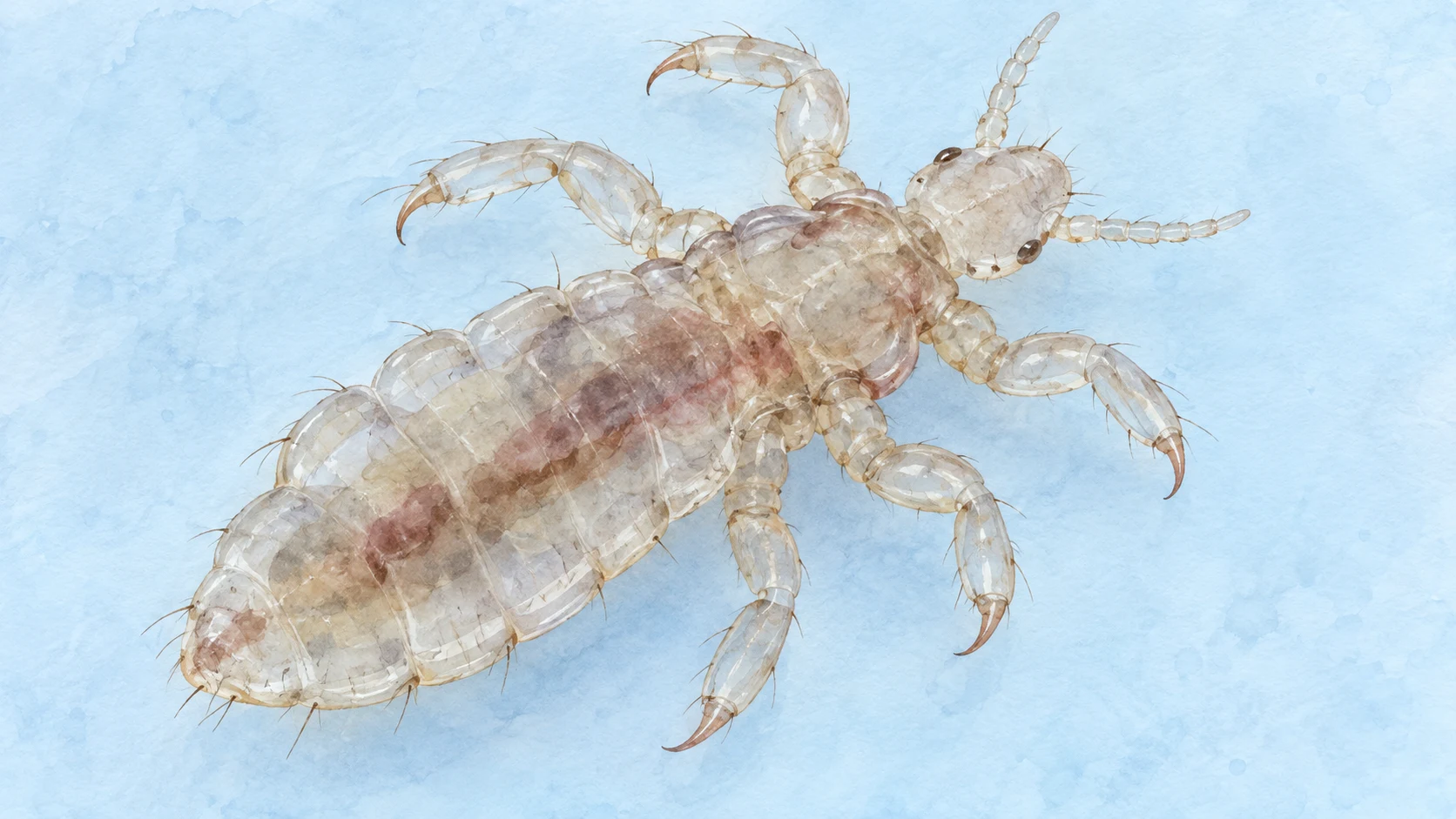
Head lice are tiny, wingless insects with flattened, elongated bodies, six short legs, and claws that grip human hair. Adult head lice are approximately the size of a sesame seed, usually measuring 2 to 3 millimeters long. Their bodies can appear tan, beige, grayish-white, or brown, making them surprisingly difficult to recognize against the scalp and hair.
An adult head louse has a narrow head, a slightly broader middle section where its legs attach, and an elongated abdomen. Its overall appearance is quite different from the round, plump insect shape people sometimes imagine. The physical characteristics of adult head lice are easier to recognize under magnification, although a fully grown louse can be seen without one.
What Is the Body Shape of an Adult Head Louse?
An adult head louse has a long, narrow body that is flattened from top to bottom. Viewed from above, its outline is somewhat oval, although the body is not uniformly rounded. The head is noticeably narrower than the abdomen, giving the insect a tapered appearance toward the front.
The abdomen occupies much of the insect’s length. It is divided into visible segments, which can give its edges a slightly scalloped appearance under magnification. The abdomen is generally broader than the head and thorax, although its exact outline varies between individual lice.
This flattened shape is particularly noticeable in close-up photographs. A head louse does not have the tall, rounded body of an insect that stands prominently above a surface. Its relatively low profile allows it to remain close to the scalp while moving among individual hairs.
The flattened body and narrower head are useful anatomical features when examining a suspected adult louse. However, photographs taken from different angles can make the same insect appear broader, narrower, or more rounded than expected.
What Do the Legs of Head Lice Look Like?
Adult head lice have six legs, arranged in three pairs along the thorax, the middle section of the body. The legs are relatively short, sturdy, and positioned to help the insect move through hair rather than travel across open surfaces.
Each leg ends in a specialized claw. These claws are curved and work with opposing structures on the legs to grasp individual hair shafts. Under magnification, the claws resemble tiny hooks or pincers wrapped around a strand of hair.
The clawed legs of head lice explain why the insects can maintain a firm grip while a person moves their head or brushes against surrounding hair. Their feet are adapted for holding onto cylindrical hair shafts, allowing them to crawl from one strand to another.
When viewed directly on the scalp, the legs may be difficult to distinguish. They are small and can blend into the surrounding hair. A louse may appear to be a narrow, moving body until a closer view reveals the legs extending from its sides.
Do Head Lice Have Wings?
Head lice do not have wings. Their bodies lack the structures needed for flight, and they cannot jump between people.
Instead, they move by crawling. Their movement through human hair depends on the same gripping legs that help them remain attached to individual strands.
An adult louse may move quickly enough to disappear into nearby hair before someone gets a clear look at it. This movement can make visual recognition difficult, particularly when the insect is close to the scalp.
The absence of wings is a consistent feature of adult head lice. A close-up photograph of a genuine head louse should show six legs and a wingless body, not folded wings or wing covers.
How Big Do Adult Head Lice Look?
A fully grown head louse is approximately the length of a sesame seed. Most adults measure around 2 to 3 millimeters, or roughly 1/12 to 1/8 inch, although measurements vary slightly between individuals and reference sources.
At this size, an adult louse is large enough to see with the naked eye. However, being visible does not necessarily mean its anatomical features are easy to distinguish. Its legs, body segments, and head shape are much clearer under magnification.
The actual size of head lice becomes particularly important when someone expects to find an insect as large as an ant or a small beetle. An adult head louse is considerably smaller than many familiar household insects.
A person looking through thick hair may notice only a tiny moving speck. Even when the insect is fully grown, its size and position can prevent the observer from immediately recognizing its shape.
What Color Are Adult Head Lice?
Adult head lice commonly appear tan, beige, grayish-white, or light brown. Some look darker, particularly against dark hair or after feeding on blood. Their coloration is not always uniform, and the abdomen can appear different from the head and legs.
The body may have a somewhat translucent appearance, allowing darker internal contents to influence its visible color. Recently fed lice can look darker or reddish-brown because blood is visible through parts of the abdomen.
The color of adult head lice can also be influenced by the surrounding hair and the conditions under which the insect is viewed. A pale louse against dark hair may stand out, while a similarly colored insect can be harder to notice.
Color alone is not a reliable identification feature. The different colors head lice can appear are best considered alongside their body shape, six legs, and characteristic movement through hair.
What Does an Adult Head Louse Look Like in Human Hair?
On a person’s head, an adult louse usually looks like a very small, elongated insect crawling among the hair shafts. Its body may be visible for only a moment before it moves closer to the scalp or becomes concealed behind surrounding strands.
Head lice are commonly found in hair close to the scalp, including areas behind the ears and near the back of the neck. These locations provide opportunities to observe the insects, although lice can occur elsewhere on the head.
An adult louse may appear to cling to a single hair with its legs extending around the shaft. As it moves, it can transfer its grip between neighboring hairs. The insect’s movement is generally more noticeable than the fine details of its anatomy.
Because adult lice can move quickly and avoid light, a brief glance at the hair may not reveal one even when it is present. A clear view often depends on separating the surrounding strands and observing the insect against a contrasting background. The places head lice commonly occupy on the head help explain why they can remain unnoticed despite being visible insects.
Why Do Head Lice Look Different in Close-Up Photographs?
Magnified photographs reveal details that are difficult to see on a person’s head. The segmented abdomen, individual legs, curved claws, and narrow head become much more obvious when the insect fills a large portion of an image.
Lighting can also change the appearance of the body. Strong illumination may make pale sections look almost white, while shadows can emphasize darker markings or make the abdomen appear more opaque.
The viewing angle is another factor. From above, the elongated body and paired legs are usually easier to recognize. A side view may make the insect look thinner and obscure some of its legs.
Photographs also differ in magnification. A louse shown beside a strand of hair provides a different sense of scale from one photographed through a microscope without any familiar reference object.
For a more realistic understanding of its appearance, compare close-up photographs with the visibility of head lice without magnification. The same insect can look anatomically detailed in one image and resemble a tiny moving speck in another.
Which Physical Features Are Most Useful for Recognizing Adult Head Lice?
The most useful visual characteristics are the combination of a small, elongated body, a narrow head, six clawed legs, and the absence of wings. An adult louse also moves by crawling while gripping hair rather than flying or jumping.
No single feature should be considered in isolation. A tiny brown object in the hair is not automatically a head louse, and an insect’s apparent color can change with lighting, hair color, and feeding.
The strongest visual impression comes from observing several features together. A sesame-seed-sized insect with a flattened abdomen, short legs, and a firm grip on individual hairs is consistent with the appearance of an adult head louse.
Finding a living louse is also important when determining whether an infestation is active. The signs of a head lice infestation involve more than simply noticing an unfamiliar speck in the hair. If the insect’s features cannot be seen clearly enough for identification, a closer examination or assessment by a healthcare professional is preferable to making a decision based on color or size alone.
Common Questions About the Appearance of Adult Head Lice
Are adult head lice round or long?
Adult head lice are elongated rather than round. Their bodies are flattened, with a narrow head and a broader, segmented abdomen. They can appear more oval in photographs taken directly from above.
Can you see the legs of a head louse?
Yes, although the legs are difficult to distinguish without magnification. Adult head lice have six short legs, each ending in a claw designed to grip hair.
Are adult head lice always brown?
No. They can appear tan, beige, grayish-white, light brown, or darker depending on their individual appearance, recent feeding, and viewing conditions.
Do adult head lice look the same in every photograph?
No. Magnification, lighting, viewing angle, and the position of the insect can make its body look different. The basic anatomical features remain the same.
Are head lice easier to recognize when they are moving?
Movement can help reveal an adult louse among the hair, particularly when it crawls between strands. However, its small size and tendency to move away from light can make it difficult to observe long enough to identify confidently.
5 thoughts on “What Do Head Lice Look Like?”