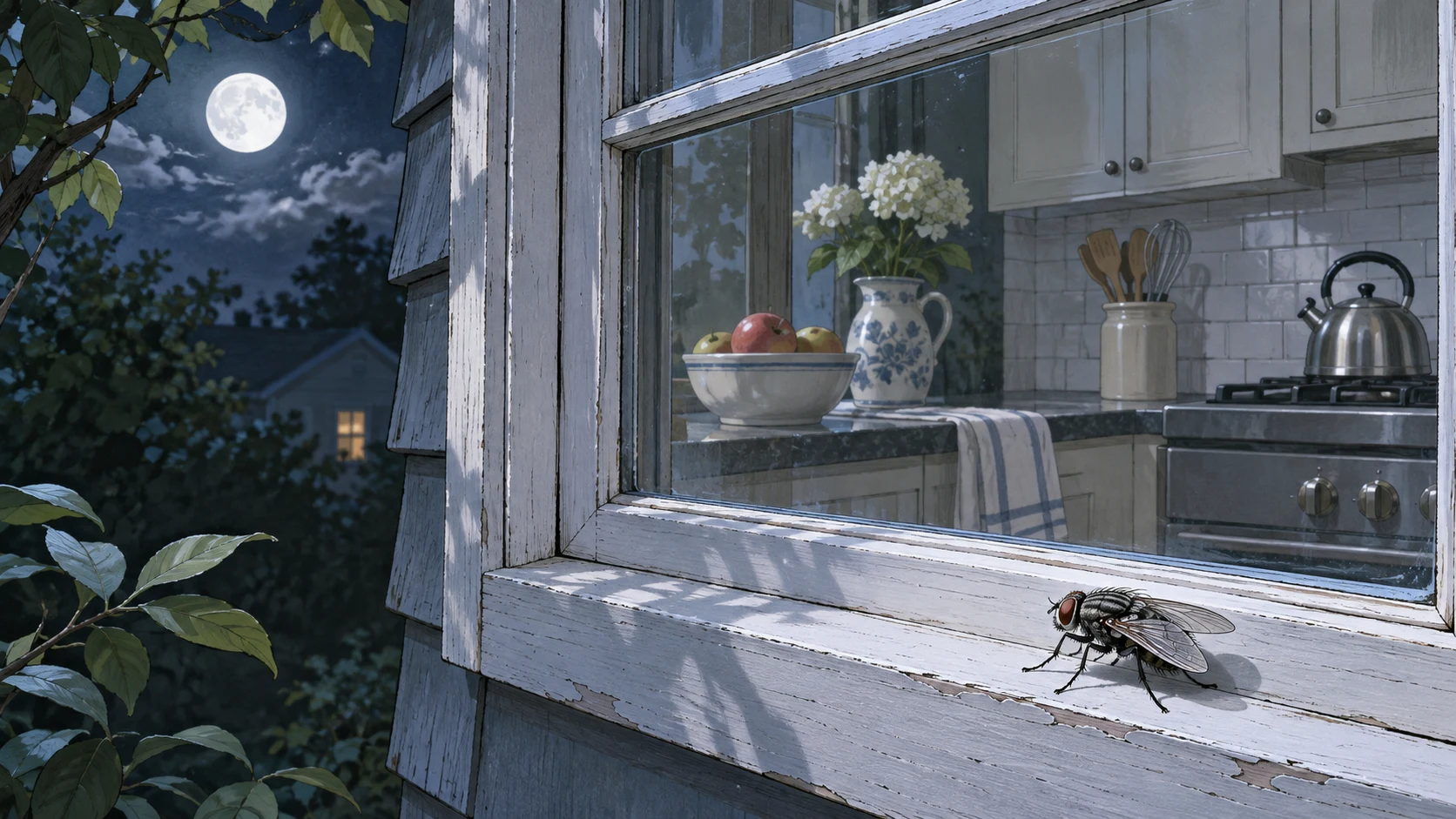
A house fly can spend the afternoon moving between kitchen counters, windows, and other surfaces, then seem to disappear once evening arrives. It may still be inside the room, resting somewhere you would not normally think to look.
The common house fly, Musca domestica, usually spends the night on a stationary surface rather than flying continuously or retreating into a nest. Indoors, its preferred nighttime resting places include ceilings, upper walls, corners, overhead wires, and other elevated structures. Outdoors, house flies commonly settle on fences, vegetation, tree branches, and sheltered parts of buildings.
These locations are not random. House flies often choose elevated surfaces protected from wind and close to places where they were active during the day.mKnowing their preferred nighttime resting sites can make it much easier to spot flies that seem to have vanished.
Where Do House Flies Rest Inside a House at Night?
Inside buildings, house flies commonly settle on ceilings and other overhead surfaces when they become inactive for the night.
They may also rest on upper walls, ceiling edges, exposed beams, electrical cords, and similar structures.
The Centers for Disease Control and Prevention’s historical house fly control guidance describes nighttime resting sites indoors as primarily ceilings, light cords, and electrical wires.
This preference explains why a fly that was clearly visible during the afternoon may be difficult to locate later. Instead of remaining on a kitchen counter or another easily observed surface, it may have moved overhead.
A house fly resting on a ceiling can be especially difficult to notice when the ceiling is high, unevenly illuminated, or interrupted by fixtures and structural details.
The insect may remain in place for an extended period, making little movement that would otherwise draw attention.
Ceilings and Upper Walls
Ceilings are among the most characteristic indoor nighttime resting sites for house flies.
The flies may settle on broad ceiling surfaces or near the edges where ceilings meet walls.
Upper portions of vertical walls can also provide suitable resting surfaces, particularly where illumination is relatively low.
Oregon State University’s Flies in School Kitchens describes house flies moving to ceilings or less brightly illuminated vertical surfaces for nighttime rest. Although this guidance addresses school kitchens, the resting behavior described applies to the common house fly more broadly.
A fly that remains on an upper wall may be less noticeable than one resting at eye level.
Wall color, shadows, and the fly’s position can all influence how easily it can be seen.
Ceiling Corners and Structural Edges
House flies may settle along corners and edges rather than on the middle of a large, uninterrupted surface.
These locations include the junction between a wall and ceiling, the edges of overhead beams, and narrow structural projections.
Corners and edges provide defined surfaces where the insects can remain stationary.
In some buildings, these areas are also relatively sheltered from moving air.
A fly resting along a ceiling edge can be difficult to see from directly below, particularly if the surface is shadowed.
However, not every house fly selects a corner. Some rest on exposed ceilings or flat walls.
The preference for edges is a useful observation, not an absolute rule.
Light Cords, Wires, and Overhead Fixtures
Thin overhead objects can also serve as nighttime resting sites.
Historical public-health descriptions specifically mention light cords and electrical wires as surfaces used by house flies.
A suspended cord or wire offers a narrow, elevated place where a fly can remain attached.
Exposed beams and the edges of overhead fixtures may provide similar resting opportunities.
The fly is resting on the object as a physical surface. Its presence does not necessarily mean that the fixture attracted it through illumination.
For a person looking around a room at night, these thin structures are easy to overlook.
A fly attached to a cord may be visible only from certain angles, especially when the object is near the ceiling.
Do House Flies Stay in the Same Room Overnight?
A house fly may remain in the room where it was active earlier, but it does not necessarily choose the exact surface on which it last landed.
Researchers have observed house flies using nighttime resting sites near their daytime activity areas.
That means a fly active in a kitchen may settle on an overhead surface in that room rather than traveling to a distant part of the building.
However, the insect may also move into an adjoining space before becoming inactive.
Open doorways, connected rooms, and differences in environmental conditions can influence where it eventually settles.
The fact that a fly was last seen in one room does not establish that it is still there.
A useful distinction is between the area where the fly was observed during the day and the surface where it ultimately rests at night.
Those locations may be close together without being identical.
Where Do House Flies Spend the Night Outdoors?
Outdoors, house flies commonly rest on fences, wires, vegetation, tree branches, and sheltered building surfaces.
The CDC’s house fly guidance describes nighttime resting places on fences, electrical wires, building edges, weeds, and tree branches.
These locations share two common characteristics: they are often elevated above the ground and relatively protected from wind.
A house fly resting outdoors is not necessarily concealed inside vegetation or another enclosed space.
It may remain exposed on a fence wire or the underside of a branch.
The surface provides a place to settle while the surrounding environment determines how suitable that location is.
Fences and Outdoor Wires
Fences are well-documented nighttime resting sites.
House flies may settle along fence rails, posts, and wires, particularly in areas where they have been active during the day.
Thin wires and fence edges offer elevated resting surfaces.
On farms and other properties with extensive fencing, these structures can provide numerous potential resting locations.
An individual fly may be difficult to notice against a long fence line, but several resting flies may become apparent when the surface is examined closely.
Their presence on a fence at night does not necessarily indicate that they developed or fed directly beneath it.
Resting sites and feeding areas can be separate locations.
Weeds, Grass, Shrubs, and Tree Branches
Vegetation provides another common group of outdoor resting surfaces.
House flies may settle on grass stems, weeds, shrubs, hedges, or tree branches.
The exact surface depends partly on what is available in the surrounding environment.
A property with tall vegetation offers different resting opportunities from one dominated by bare ground and buildings.
The CDC’s historical descriptions include weeds and tree branches among the typical outdoor nighttime sites.
Vegetation can also provide some shelter from moving air, particularly when the insects settle within protected portions of a plant.
However, a fly resting on a plant should not automatically be assumed to be feeding or reproducing there.
The plant may simply be serving as an overnight perch.
Building Edges and Roof Overhangs
Outdoor portions of buildings can provide suitable resting surfaces, especially when they offer some protection from wind.
These may include walls, roof overhangs, projecting beams, and other structural edges.
The University of Maryland Extension’s poultry pest-management guidance identifies walls, fences, vegetation, and areas beneath roof overhangs as resting locations around poultry buildings.
Similar structural features occur around houses, sheds, garages, and other buildings.
A roof overhang may offer a more sheltered resting surface than an exposed wall.
The insect does not need to enter the building to use these locations.
How High Above the Ground Do House Flies Rest at Night?
House flies frequently choose elevated nighttime resting places, although the height varies.
The CDC’s historical house fly control manual reports that outdoor resting sites are generally above ground level but seldom higher than approximately 15 feet.
That is about 4.6 meters.
This observation is useful because it directs attention toward fences, overhead structures, and vegetation rather than exclusively toward ground-level surfaces.
It is not a strict height limit.
A house fly may rest lower than this range, and the height of available structures can influence its choice.
Indoors, ceilings naturally provide elevated surfaces, even when the room is relatively small.
In a building with unusually high ceilings or exposed roof framing, the insects may have more overhead surfaces available.
The practical implication is that searching only at eye level can miss resting flies.
Why House Flies Often Choose Sheltered Nighttime Surfaces
Protection from wind is an important characteristic of many outdoor resting sites.
A fly attached to an exposed surface may encounter stronger air movement than one resting near a building edge or within sheltered vegetation.
Historical observations describe nighttime resting places as commonly protected from wind.
This helps explain why flies may use structural edges, fences near buildings, and vegetation rather than settling indiscriminately across open ground.
Shelter is not the only influence.
Temperature, moisture, and the availability of suitable surfaces may also affect where an individual settles.
A fly does not necessarily choose the same resting place every night.
Environmental conditions can change, and different locations may become more or less suitable.
It would therefore be inaccurate to describe one particular surface as the universal nighttime destination for house flies.
Do House Flies Return to the Same Resting Spot Every Night?
House flies may repeatedly use the same general resting areas, but that does not mean an individual returns to one exact position every night.
A ceiling corner or overhead beam may be used by several flies over time because it offers suitable conditions.
The repeated appearance of flies on that surface may reflect the attractiveness of the location rather than a demonstrated habit of individual flies returning to a specific point.
Observations of resting sites generally describe where groups of house flies are found.
They do not necessarily establish the movements of individually identified flies across consecutive nights.
Without tracking individual insects, it is difficult to determine whether the same fly has returned or another fly has selected the location.
For household observations, it is more accurate to describe a repeatedly used resting area than to assume that every fly has a permanent overnight spot.
Do House Flies Rest Near Their Feeding Areas?
Often, yes.
House flies commonly use nighttime resting sites near places where they were active during the day.
The CDC’s historical guidance describes outdoor resting sites as generally located near favored daytime feeding and breeding areas.
This does not mean that every resting fly is immediately beside a food source.
A fly can travel between locations, and the resting surface itself may provide no food.
For example, a fly may feed around organic waste during the day and later settle on a nearby fence or building wall.
The fence is a resting surface, not necessarily the source of the fly population.
Likewise, flies resting on a kitchen ceiling may have entered from outdoors rather than developing somewhere inside the kitchen.
Resting location alone cannot establish where the insects originated.
Can You Find House Flies More Easily at Night?
Nighttime can provide an opportunity to observe house flies while they are relatively stationary.
Instead of following a moving insect through a room, you may be able to see it resting on a ceiling, upper wall, or overhead fixture.
However, finding a motionless fly is not always easier than noticing one in flight.
Its small size, coloration, and position may make it blend into the surrounding surface.
An overhead fly may also be hidden from view by a beam, fixture, or other object.
The most useful approach is to examine surfaces associated with documented nighttime resting behavior rather than searching every possible gap or enclosed space.
Where to Look Indoors
Begin with the ceiling of the room where the fly was last observed.
Pay attention to the junctions between ceilings and walls, especially near corners.
Upper wall surfaces, exposed beams, and suspended cords are other reasonable places to inspect.
A fly resting on a pale ceiling may appear as a small dark mark.
However, an isolated mark is not necessarily an insect, so closer observation may be needed.
Avoid touching electrical wiring or climbing onto unstable furniture simply to inspect a possible resting site.
A visual inspection from a safe position is usually sufficient.
Where to Look Outdoors
Outdoor observations are more practical when focused on nearby structures.
Fence rails, wires, sheltered building edges, and vegetation are all documented resting surfaces.
Look at surfaces near areas where house flies were active earlier, while remembering that a resting site does not necessarily identify the source of the flies.
The underside of a roof overhang may be more difficult to see than an exposed fence rail.
Lighting and viewing angle can affect whether a resting fly is visible.
There is no guarantee that every fly on a property can be located at night, even when its general resting preferences are known.
Can Fly Specks Reveal Where House Flies Rest?
Repeatedly used resting surfaces may accumulate small deposits commonly called fly specks.
These marks can include dark fecal spots and lighter deposits associated with regurgitated material.
The University of California Integrated Pest Management Program notes that house flies leave fecal and regurgitation spots on surfaces where they rest.
Accumulations can become noticeable where numerous flies repeatedly use the same area.
For example, speckling on a ceiling beam or upper wall may suggest that flies have spent time there.
The marks do not necessarily establish that the insects were present only at night.
House flies can also rest on surfaces during daylight.
Furthermore, not every small dark spot on a wall or ceiling is produced by a house fly.
The appearance and location of the deposits should be considered together with actual observations of flies.
Fly specks are useful supporting evidence of repeated use, not proof of a specific overnight population.
Why House Flies May Be Difficult to Spot Despite Being Nearby
A resting house fly occupies very little space.
Its body may be clearly visible against a smooth, pale surface but much harder to distinguish against wood grain, dark paint, or irregular structural materials.
Viewing angle also matters.
A fly attached to a ceiling may be visible from directly below, while one resting on the upper side of a beam may be completely obscured.
Outdoor vegetation presents an additional challenge because leaves, stems, and branches create numerous overlapping surfaces.
A person may walk past several resting flies without noticing them.
This is one reason that the disappearance of visible flies after sunset should not be interpreted as evidence that they have left the property.
They may simply have settled in places where their movement no longer draws attention.
Do All House Flies Choose the Same Type of Nighttime Resting Site?
No. House flies use a range of indoor and outdoor surfaces.
A fly inside a house may settle on a ceiling, while one outdoors may rest on a fence or plant stem.
The available surfaces and local environmental conditions influence the choices.
Even within the same building, different flies may occupy different locations.
A large open room with exposed beams provides different resting opportunities from a small room with a smooth ceiling.
Similarly, a property surrounded by shrubs and fences offers different outdoor surfaces from one with little vegetation.
The species has recognizable resting preferences, but those preferences do not produce a single identical resting arrangement everywhere.
Questions About Where House Flies Spend the Night
Do house flies go into walls at night?
House flies commonly rest on exposed ceilings, upper walls, corners, and overhead structures. They do not need to enter wall cavities to spend the night, although a fly may occupy other sheltered spaces under particular circumstances.
Why do house flies sit on the ceiling at night?
Ceilings are well-documented nighttime resting surfaces. Their elevated position and relatively undisturbed conditions can provide a suitable place for flies to remain stationary.
Do house flies sleep in trees?
House flies may rest on tree branches and other vegetation outdoors. The behavior is best described as nighttime resting rather than assuming a particular physiological sleep state.
Can house flies spend the night outside?
Yes. House flies can remain outdoors overnight, resting on fences, wires, vegetation, and sheltered building surfaces. They do not necessarily enter a house when evening arrives.
One thought on “Where Do House Flies Go at Night?”