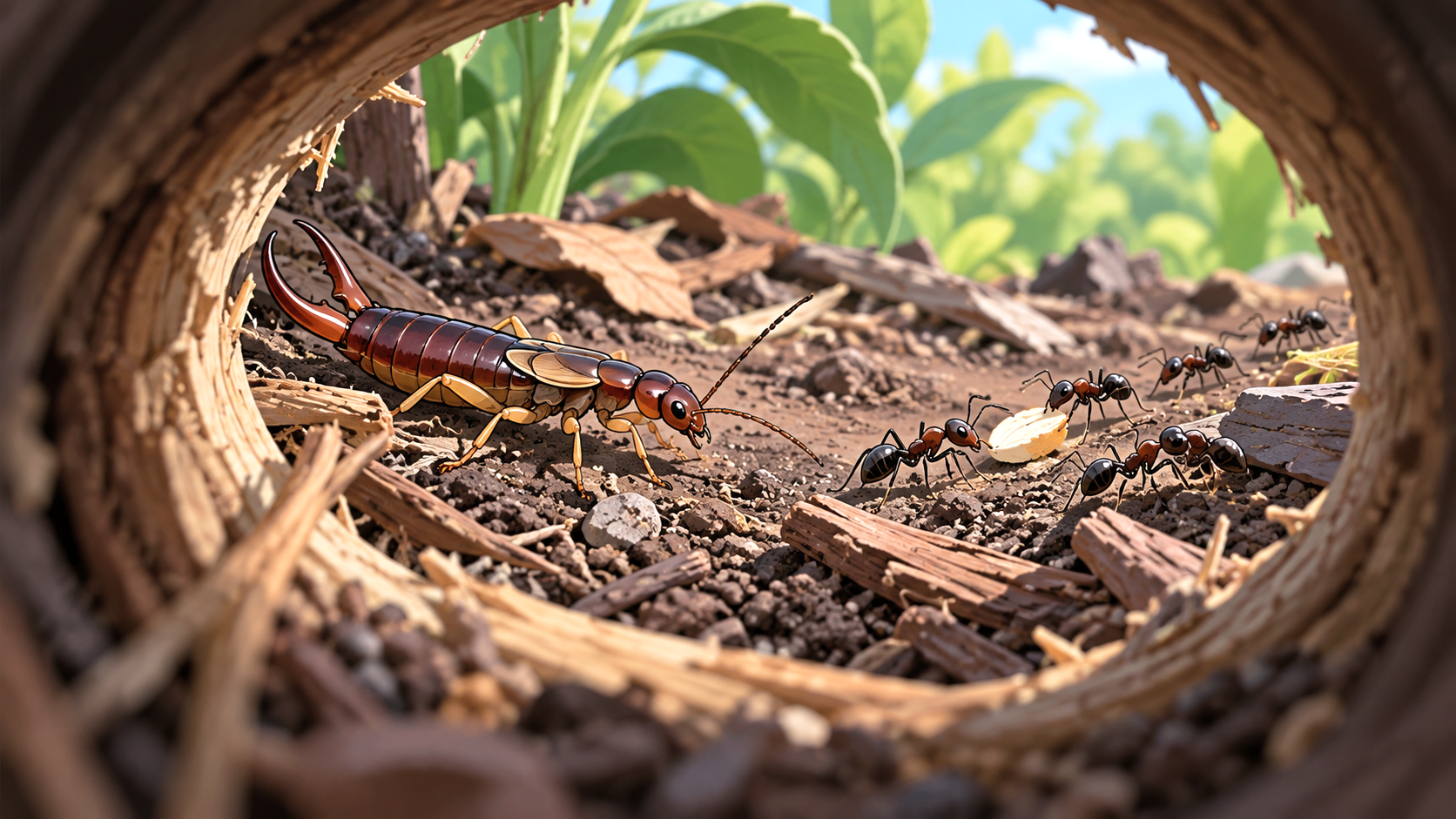
An earwig can look surprisingly ant-like from a distance, especially when a small earwig is moving quickly across the ground. Up close, though, the resemblance falls apart. Earwigs have an elongated body with a pair of forceps at the rear. Ants have elbowed antennae and a distinctly narrowed waist between the main sections of the body.
Those differences are more reliable than color. Both groups include brown and dark-colored insects, so trying to identify one from its shade alone can send you in the wrong direction.
Earwig vs. Ant: Start at the Rear of the Body
The quickest place to look is the back end. Earwigs have a pair of conspicuous appendages called cerci at the tip of the abdomen. On an adult European earwig, these form the familiar pincers that make the insect so recognizable.
The shape varies between the sexes. Male European earwigs generally have stout, strongly curved cerci, while females have straighter, more slender ones. That variation is why we would not use “curved pincers” as the identification rule. The more reliable feature is the presence of the paired rear forceps themselves.
Ants do not have those earwig-style forceps. Instead, one of their most useful identifying features is at the opposite end of the insect. Ants have distinctly elbowed antennae, meaning each antenna bends rather than extending from the head in a simple straight line.
For a clear specimen, those two observations can settle the comparison quickly. Pincers projecting from the rear point toward an earwig. Elbowed antennae with no rear forceps point toward an ant.
The Ant’s Narrow Waist Is an Even Better Clue
There is another feature we like for this comparison because you can often see it without getting extremely close. Ants have a constricted section between the thorax and the larger portion of the abdomen. This narrow connection is the petiole, and it has one or two nodes depending on the ant.
That construction gives an ant its familiar pinched-waist silhouette. It is particularly noticeable when you view a larger ant from above.
An earwig has a very different outline. Its body is elongated and flattened, without the dramatically narrowed waist that defines an ant. The abdomen continues backward toward the forceps rather than narrowing into the ant’s characteristic petiole.
This is especially useful when the pincers are difficult to see. A photograph taken from the side or an insect partly hidden beneath an object may obscure the rear of the body. In that situation, the waist and antennae give you two other features to check.
Size Alone Will Not Separate Every Ant From an Earwig
Adult European earwigs are about 5/8 inch long. That makes them considerably larger than many of the tiny ants people commonly notice around kitchens, patios and sidewalks.
However, size is a poor universal test because ants vary enormously. Ant workers can range from about 1/20 inch to 1/2 inch, and some ant queens are larger still. Carpenter ant workers, for example, can reach about 1/2 inch in length. That puts the larger workers much closer to an earwig’s scale.
The same problem applies to color. Ants can be yellowish, reddish, brown or black, while the European earwig is reddish brown. A dark insect of roughly the expected size could therefore fit several possibilities.
We would use size to narrow the field, not to make the final identification. Body shape gives you much stronger evidence. Check for the ant’s pinched waist and bent antennae or the earwig’s elongated abdomen and rear pincers.
A Line of Insects Strongly Changes the Identification
Sometimes you can identify the problem before you get a close look at an individual insect. Ants are social insects that live in colonies. Workers leave the nest to forage, which is why homeowners commonly encounter multiple ants moving through the same area.
Repeated activity along the same route therefore fits ants far better than earwigs. You might notice workers traveling along a countertop edge, baseboard, foundation or another route between a food source and their nesting area.
Earwigs can also gather in favorable hiding places, sometimes in substantial numbers. However, their social organization is not the same as an ant colony. A group of earwigs sheltering beneath a damp board should not be interpreted as an ant-style trail simply because several insects occupy the same spot. We cover that distinction more closely in our guide to whether earwigs live in colonies.
This behavioral clue is particularly helpful when the insects are too small or fast-moving to examine easily. A defined stream of small, narrow-waisted insects deserves an ant identification check before you assume that several earwigs have entered together.
Winged Ants and Winged Earwigs Look Very Different
Wings can make this comparison more confusing because both ants and earwigs can have them. Most ants you encounter are wingless workers, but reproductive males and queens can develop wings and leave their colonies during swarming events.
A winged ant still retains the features that identify it as an ant. It has a narrow waist and elbowed antennae. In addition, the front wings are longer than the hind wings.
Earwig wings are built very differently. European earwigs have short, hardened forewings that cover folded hind wings. The wings can be easy to overlook when the insect is simply crawling around, which is one reason someone may assume an earwig is completely wingless. Our guide to whether earwigs have wings explains that unusual arrangement in more detail.
Even so, wings should remain a secondary clue. The rear forceps, waist and antennae are easier features to use when you simply want to decide whether the insect in front of you is an earwig or an ant.
Finding Them Indoors Can Mean Different Things
A single earwig wandering across a floor does not automatically indicate that earwigs are reproducing somewhere inside the building. European earwigs commonly enter homes from outdoors, particularly when conditions favor movement into sheltered areas. Indoors, they are considered nuisance invaders and do not reproduce inside buildings.
Ants require a different interpretation because the species matters. Some ants nest outdoors and enter buildings while foraging. Others can establish nests within or around structures. Consequently, identifying the ant becomes important before choosing a control strategy because nesting sites, food preferences and appropriate control methods differ among species.
This distinction prevents a common mistake. Seeing several insects indoors does not tell you that both pests should be handled in the same way. A recurring ant trail may lead you toward locating and addressing a colony, while recurring earwigs are more likely to make you investigate how they are getting into the house.
What to Check Before You Treat Them
Before using any control method, get one specimen into good light and look at its overall shape. An ant should show the characteristic narrow waist and elbowed antennae. An earwig should have the elongated body and rear forceps that distinguish the group.
That identification matters because ant control is species-dependent. The food an ant accepts, where it nests and how its colony is organized can affect the appropriate approach. Treating an unidentified crawling insect simply because it appears “ant-like” can therefore waste time.
For an occasional earwig indoors, physical removal is usually enough. If they keep appearing, focus on entry points and favorable conditions around the building. Our guide to keeping earwigs out of the house covers that problem separately.
With ants, repeated indoor activity deserves a closer identification before treatment. If the insects are difficult to identify, preserve a specimen or take a sharp close-up photograph rather than relying on color or size alone.
Other Questions About Earwigs and Ants
Can earwigs eat ants?
Earwigs are omnivorous and can feed on other small insects and arthropods. Their forceps can also help them grab and hold prey. What an individual earwig eats depends on the available food and circumstances, so finding earwigs near ants does not by itself show that they are hunting them.
Can ants and earwigs be found under the same object?
Yes. Both can occur outdoors beneath objects that provide shelter. Earwigs particularly favor dark, confined and damp hiding places, while various ant species nest or forage in soil and around landscaping. Finding both beneath a stone, board or similar object is therefore possible.
Is a winged ant still an ant?
Yes. Ant colonies produce winged reproductive forms, including males and queens. The wings do not turn them into a different kind of insect. Their elbowed antennae and constricted waist remain useful identification features.
Are all ants smaller than earwigs?
No. Ant size varies considerably among species and castes. Some ant workers approach the size of an adult European earwig, while queens of certain species can be larger. Size is therefore useful as an initial clue but not a dependable way to separate every ant from an earwig.
Why does an earwig sometimes look like an ant from a distance?
Both are six-legged insects with antennae, and some share similar brown or dark coloration. At a distance, those broad similarities can dominate what you see. A closer view reveals the structural differences, particularly the ant’s narrow waist and the earwig’s rear forceps.