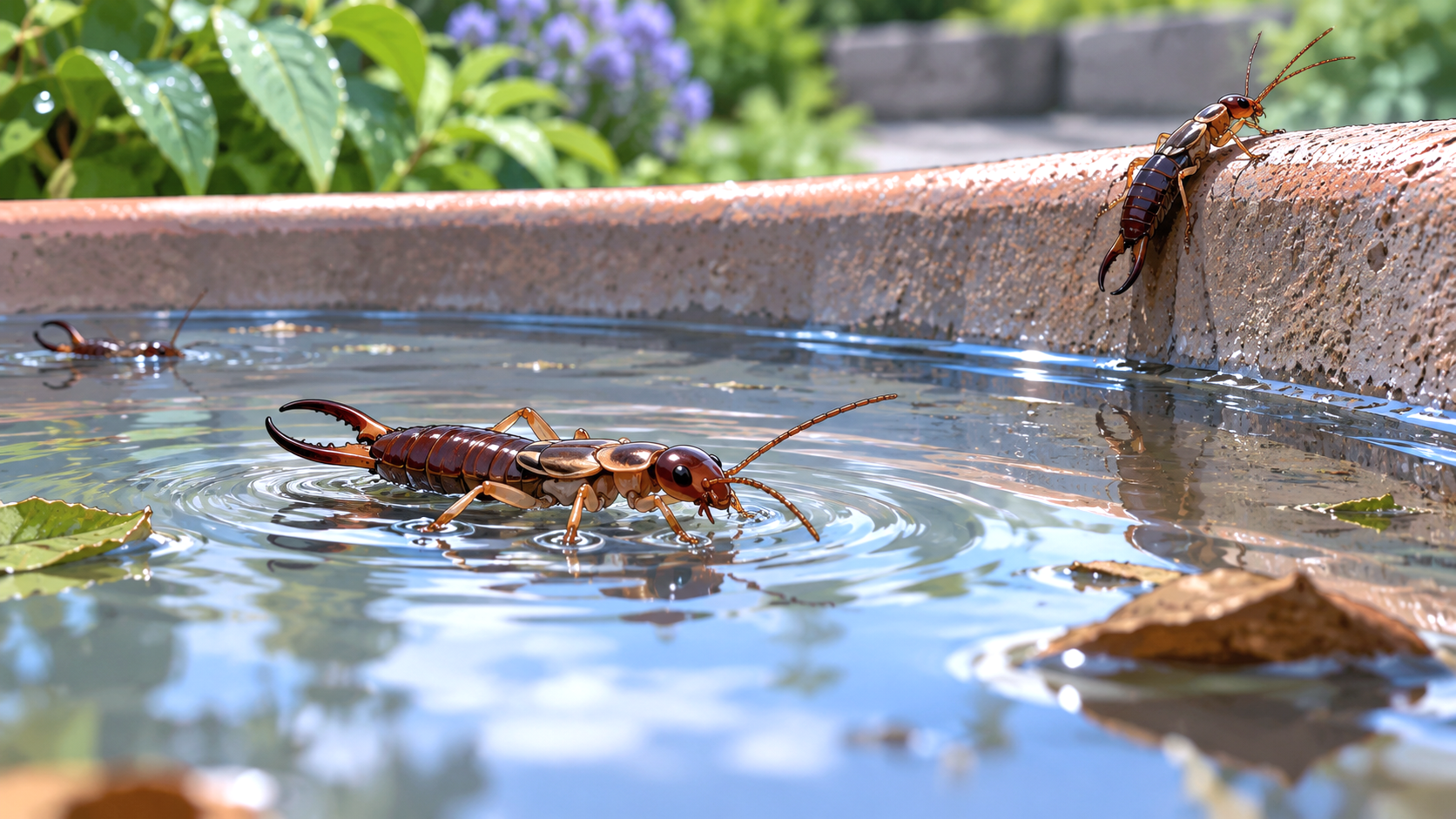
Seeing an earwig moving in a sink, bucket or puddle can make it look surprisingly capable around water. That does not make it an aquatic insect. Earwigs are terrestrial insects that favor moist environments, and water deep enough to trap and submerge them can kill them.
Earwigs are not true swimmers. They may struggle, paddle or remain mobile for a time after falling into water, but they are not adapted to live underwater. If an earwig cannot escape and remains trapped in water, it will eventually drown. This is why water and liquid-filled traps can be used to kill captured earwigs.
Earwigs Can Move in Water Without Being Good Swimmers
There is an important difference between an insect moving its legs in water and an insect being adapted for swimming. Earwigs spend their lives on land. They normally move by crawling and spend daylight hours hiding in dark, tight and moist places, rather than living in ponds, streams or other bodies of water.
An earwig that falls into water can continue moving its legs, so you may see it struggling across the surface or attempting to reach the edge. That movement can easily be interpreted as swimming. However, it is better understood as an attempt to escape an environment the insect is not specialized to occupy.
This distinction matters because earwigs are strongly associated with moisture. Their preference for damp conditions can make it seem logical that they would also be comfortable in water, but those are two different things. Excess moisture attracts earwigs because it helps create the humid, protected habitats they use. It does not turn them into aquatic insects.
An Earwig Trapped in Water Can Drown
Water becomes lethal when an earwig cannot get back onto a dry surface. Earwigs trapped in liquid can die, and pest-management guidance specifically uses this vulnerability as a nonchemical way to dispose of them.
For example, earwigs collected from rolled newspaper or other shelter traps can be shaken into a container of soapy water to kill them. Another extension guide recommends transferring live earwigs caught in traps into soapy water for disposal.
That gives us a much firmer answer than simply watching an earwig struggle in a puddle. An earwig may remain active when it first encounters water, but prolonged entrapment is another matter. It needs a way out.
Oil Traps Show the Same Limitation Even More Clearly
Some of the most established earwig traps use liquid rather than a conventional enclosed trap. A shallow container is placed at soil level and baited with an attractive odor, commonly fish oil or vegetable oil combined with fish oil or bacon grease.
Once earwigs enter, they become trapped in the liquid. In agricultural pest-management guidance, earwigs attracted into oil-filled containers are specifically described as drowning. Similar oil traps are recommended for gardens because earwigs are attracted to the bait and cannot simply treat the container as a tiny swimming pool.
Oil and plain water should not be treated as identical liquids, though. Oil can coat an insect and interfere with its ability to function normally, while soap changes the properties of water. Therefore, an oil trap proves that earwigs can die in liquid, but it should not be used to claim that an earwig dropped into clean water will die at exactly the same rate.
That is also why we would not give a precise countdown for how long an earwig lives after submersion. The conditions matter, including the liquid involved and whether the insect can climb out.
Why Do Earwigs Like Damp Places If Water Can Kill Them?
This is where the apparent contradiction disappears. Earwigs like moisture, not submersion.
During the day, earwigs seek protected locations that are dark and moist. Mulch, plant debris and other ground-level shelters can provide those conditions. Reducing excess landscape moisture is consequently one of the standard ways to make an area less favorable to them.
A damp layer beneath a flowerpot gives an earwig humidity plus a solid surface to stand on. Saturated mulch can provide protected crevices. Neither situation requires the insect to breathe and move underwater.
That difference also helps explain what attracts earwigs to a property. Moist soil and sheltered crevices can support earwig activity without exposing the insects to the very different conditions created by prolonged submersion.
Heavy Rain Does Not Mean Every Earwig Drowns
A downpour can soak the exact places where earwigs normally shelter, yet that does not mean the local population simply disappears underwater.
Earwigs are mobile insects. They can crawl away from unfavorable conditions and seek new shelter. Their normal hiding places are also not necessarily sealed chambers that fill completely with water whenever it rains. Some remain protected, while others become unsuitable and force the insects to move.
That movement is one reason earwigs can become more noticeable after heavy rain. The important point is not that rain makes earwigs aquatic or that rain automatically kills them. Changing moisture conditions can alter where they hide and where people encounter them.
This is a useful distinction around homes as well. An earwig appearing somewhere wet does not mean it traveled there by swimming. Earwigs primarily disperse by crawling, and they are weak fliers. A wet location can simply provide the moisture or shelter that brought the insect there.
An Earwig in a Sink or Bathtub Probably Did Not Swim Up the Drain
Finding an earwig beside water creates another misleading impression. A homeowner may see one in a bathtub, shower or sink and assume it swam through the plumbing.
The location alone does not establish that route. Earwigs can enter buildings through exterior openings and then wander into humid rooms. Bathrooms are particularly noticeable because smooth tubs and sinks can leave a wandering insect exposed and unable to hide easily.
This matters when dealing with earwigs appearing in a bathroom or apparent earwigs coming from drains. The presence of an insect beside a drain is not proof that it traveled through water-filled plumbing.
Instead, look at the surrounding room and exterior of the building for plausible entry points and favorable moisture conditions. Earwigs found indoors are nuisance invaders, and they do not reproduce indoors. Repeated sightings are therefore more useful as a reason to investigate entry and outdoor habitat than as evidence of an underwater route into the house.
What to Do With an Earwig You Find in Water
An earwig floating or struggling in water should not automatically be assumed dead. If the goal is simply to remove a stray insect from the home, physical removal is straightforward. Earwigs indoors can be swept up or vacuumed rather than relying on water to kill them.
For outdoor populations, water is not a particularly useful standalone control strategy either. Earwigs actively favor moist habitats, so repeatedly soaking an area is the opposite of what you normally want to do. Reducing unnecessary surface moisture, removing hiding places and using appropriate traps makes more sense. Our broader guide to getting rid of earwigs covers those control options separately.
The simple rule is to stop treating “likes moisture” and “can live in water” as the same biological trait. Earwigs benefit from damp surroundings, but when liquid becomes an inescapable environment rather than moisture around a shelter, it can kill them.
Other Questions About Earwigs and Water
Can earwigs survive being flushed down a toilet?
Flushing an earwig removes it from sight, but the act of flushing alone is not a reliable way to determine whether the insect died. Physical removal and disposal are more straightforward when dealing with an earwig indoors.
Can earwigs live in a swimming pool?
A swimming pool is not normal earwig habitat. Earwigs are terrestrial insects associated with protected, moist places on land. An earwig found in a pool should be treated as an insect that fell or wandered into the water, not as one living there.
Why do I find earwigs near water?
Moisture can make an area favorable to earwigs, especially when dark shelter is available nearby. That can put them around damp gardens and other humid locations without requiring them to enter the water itself.
Can earwigs walk on the surface of water?
An earwig that falls into water may remain at the surface and continue moving while trying to escape. Seeing that movement should not be taken as evidence that earwigs are specialized water-walking or swimming insects.
Will rain wash earwigs away?
Heavy rain can disrupt earwig hiding places and change where the insects appear, but it is not a dependable control method. Earwigs can move into alternative shelter, which is why habitat management is more useful than waiting for rainfall to eliminate them.
One thought on “Can Earwigs Swim or Will They Drown?”