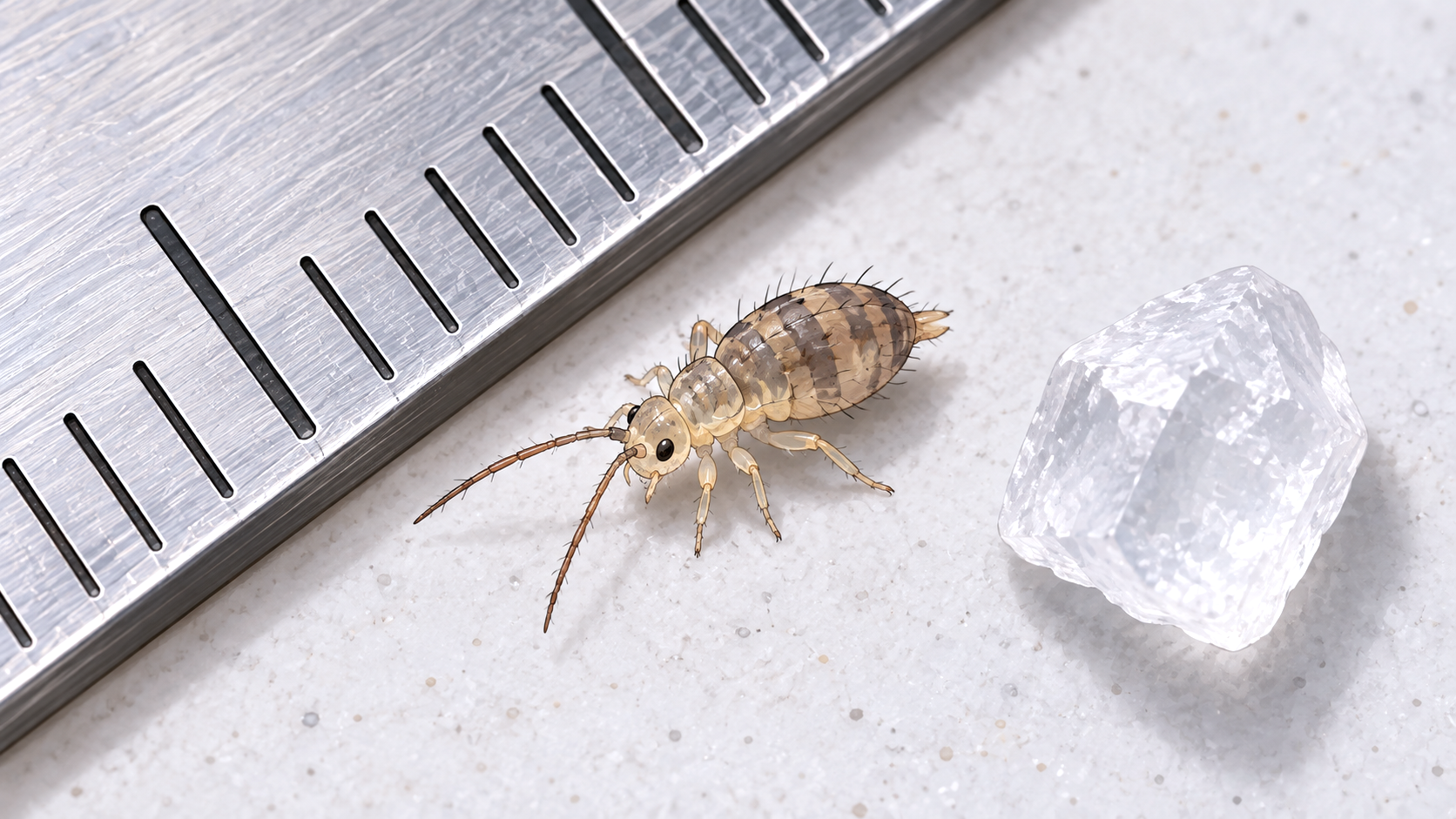
Most springtails commonly encountered around homes are about 1 to 2 millimeters long, or approximately 0.04 to 0.08 inches. Across the much larger group of springtail species, body length can range from about 0.2 millimeters to 10 millimeters. So the springtail on your windowsill is probably much closer to 1 millimeter than 10. That difference matters. The 10-millimeter figure describes the upper end of a diverse group, not the size you should expect from a typical springtail in your bathroom, basement, or plant pot.
Most Household Springtails Are 1 to 2 Millimeters Long
For practical identification, 1 to 2 millimeters is the most useful range to remember. Springtails that occasionally enter homes are commonly within this size range, even though the order Collembola contains both smaller and larger species.
One millimeter is only 0.039 inches. Two millimeters is about 0.079 inches. That makes a typical household springtail considerably shorter than the width of an ordinary pencil eraser and small enough to be mistaken for dirt on a surface.
Another useful comparison is a U.S. dime. A dime is 17.91 millimeters across, so a 1-millimeter springtail is only about one-eighteenth of its diameter. Even a 2-millimeter individual is only about one-ninth as long as the coin is wide.
This explains why springtail appearance can be difficult to judge with unaided vision. At this scale, you may notice a moving dot before you can distinguish antennae, legs, or individual body segments.
Springtails Can Range From 0.2 to 10 Millimeters
The full springtail size range is much wider than the household average. Across different species, springtails range from approximately 0.2 to 10 millimeters long. Another extension reference gives the same 0.2-to-10-millimeter range while noting that most are between 1 and 2 millimeters. (agrilifeextension.tamu.edu)
At the lower extreme, a 0.2-millimeter springtail is only one-fifth of a millimeter long. You could easily overlook an animal that size without magnification.
A 10-millimeter springtail sits at the opposite extreme. Ten millimeters equals 1 centimeter, or about 0.39 inches. However, using that maximum as the expected size of a household springtail would give you a distorted picture of the group.
We think that distinction is more useful than simply publishing “0.2 to 10 mm” and leaving it there. A reader trying to identify tiny jumping dots indoors needs the typical household range first. The biological extremes come second.
What Does a 1-Millimeter Springtail Look Like in Real Life?
Millimeters are difficult to visualize without something familiar beside them. A standard credit card is about 0.76 millimeters thick. Therefore, a 1-millimeter springtail is only a little longer than the thickness of the card.
At that size, the animal can look like a grain, fleck, or tiny line depending on its body shape and the surface beneath it. A dark springtail against a white bathtub may be obvious. The same individual against soil, mulch, or a dark countertop can disappear surprisingly well.
A 2-millimeter springtail is easier to notice, but it is still tiny. An adult springtail photographed at 1.5 millimeters gives a useful representation of the scale commonly encountered around homes.
For identification, this is also why macro photographs need context. A springtail filling an entire photograph may still be only 1 or 2 millimeters long in reality.
Some Springtails Are Smaller Than 1 Millimeter
Springtails do not have a 1-millimeter minimum. Some species reach only about 0.2 millimeters, making them five times shorter than a 1-millimeter individual.
Underground forms can also be exceptionally small. Some soil-dwelling springtails measure less than 1 millimeter, which helps explain why enormous springtail populations can exist in soil without attracting much attention.
Size alone can therefore make certain springtails effectively invisible during a casual inspection. You may see larger individuals while overlooking smaller ones occupying the same general environment.
Young springtails also begin smaller than mature individuals. Instead of undergoing a dramatic transformation into a completely different-looking adult, they retain the basic springtail form as they develop. The separate springtail life cycle explains those developmental stages in detail.
How Big Are the Largest Springtails?
A useful general upper limit for springtails is about 10 millimeters, or 1 centimeter. Multiple extension references place the overall range up to this point, including the 0.2-to-10-millimeter range documented for Collembola.
Ten millimeters sounds small until you compare it with the springtails normally noticed indoors. A 10-millimeter specimen would be five times the length of a 2-millimeter household springtail and ten times the length of a 1-millimeter one.
However, that does not mean a large unidentified arthropod in your home becomes a springtail simply because it measures close to 10 millimeters. Size establishes what is possible, not what the animal is. Body shape, antennae, legs, movement, and other features still matter.
For an unidentified animal that seems much larger than the usual 1-to-2-millimeter springtail, our guide to bugs that look like springtails is the better next step.
Springtail Size Can Make a Jump Look Much Bigger Than It Is
Springtails have another trait that makes their tiny size easy to underestimate. Many species can propel themselves surprisingly far relative to their body length.
A springtail only 1 or 2 millimeters long can suddenly disappear from the spot where you were watching it. One extension reference describes springtails of that size moving 3 to 4 inches in a single springing motion. That distance is enormous compared with the animal itself.
The jump can create the impression that you are dealing with a larger or more powerful insect. In reality, the movement comes from a specialized forked structure beneath the abdomen called the furcula.
Size and jumping ability are therefore separate identification clues. Our article on whether springtails jump covers the movement itself without turning this size guide into a behavior article.
Springtails Are Much Smaller Than Fleas
Fleas are a useful comparison because people often notice both animals only after they jump. However, size ranges overlap enough that measurements alone cannot reliably separate them.
Adult cat fleas, for example, are commonly around 1.5 to 3.2 millimeters long. A household springtail at 1 to 2 millimeters can therefore occupy part of the same general size range. Simply deciding that an animal is “tiny” does not resolve the identification.
Their bodies provide better clues. Springtails have a different overall shape and use a furcula to launch themselves, while fleas have the laterally compressed body and enlarged hind legs characteristic of their own jumping mechanism.
If the animal is small enough to fit either possibility, use our springtails versus fleas guide rather than treating size as the deciding feature.
Measure a Springtail Instead of Guessing Its Size
Trying to estimate a 1-millimeter animal by eye is difficult, especially when it is moving. A photograph with a scale reference can give you a much better estimate.
Place a ruler beside the animal if you can do so without losing it. A clear macro photograph beside millimeter markings makes the comparison straightforward. You do not need to identify every anatomical feature to determine whether the animal is 1 millimeter, 3 millimeters, or something substantially larger.
That measurement can immediately narrow the possibilities. An animal around 1 to 2 millimeters remains consistent with the springtails commonly found indoors. Something substantially larger deserves closer inspection rather than being identified from jumping behavior alone.
Once the measurement fits, combine size with the physical traits covered in our springtail identification guide. That is much more reliable than judging an enlarged photograph without knowing its scale.
Other Questions About Springtail Size
Are baby springtails microscopic?
Young springtails can be extremely small, but “microscopic” should not be used as a fixed description for every immature springtail. Their size changes as they develop, and the dimensions also vary among species. The earliest stages can be much harder to notice than mature individuals.
Are globular springtails smaller than elongated springtails?
Body shape does not create one universal size rule. Globular springtails are commonly tiny, but springtail dimensions vary considerably among species. Shape and measured body length should therefore be treated as separate identification characteristics.
Can springtails be smaller than a flea?
Yes. Springtails can measure below 1 millimeter, while the common household range extends around 1 to 2 millimeters. However, the two groups can overlap in size, so measurement alone should not be used to distinguish them.
Can you see a 1-millimeter springtail without a microscope?
Yes. A 1-millimeter springtail is visible to the naked eye, although it may look like little more than a moving speck. Magnification becomes useful when you want to examine its antennae, legs, body segmentation, or other identification features.
Does a springtail get bigger after it jumps?
No. Jumping can make a springtail seem more substantial because it suddenly covers a distance far greater than its own body length. Its physical size does not change. The jump simply makes an otherwise tiny animal much easier to notice.
7 thoughts on “How Big Are Springtails?”