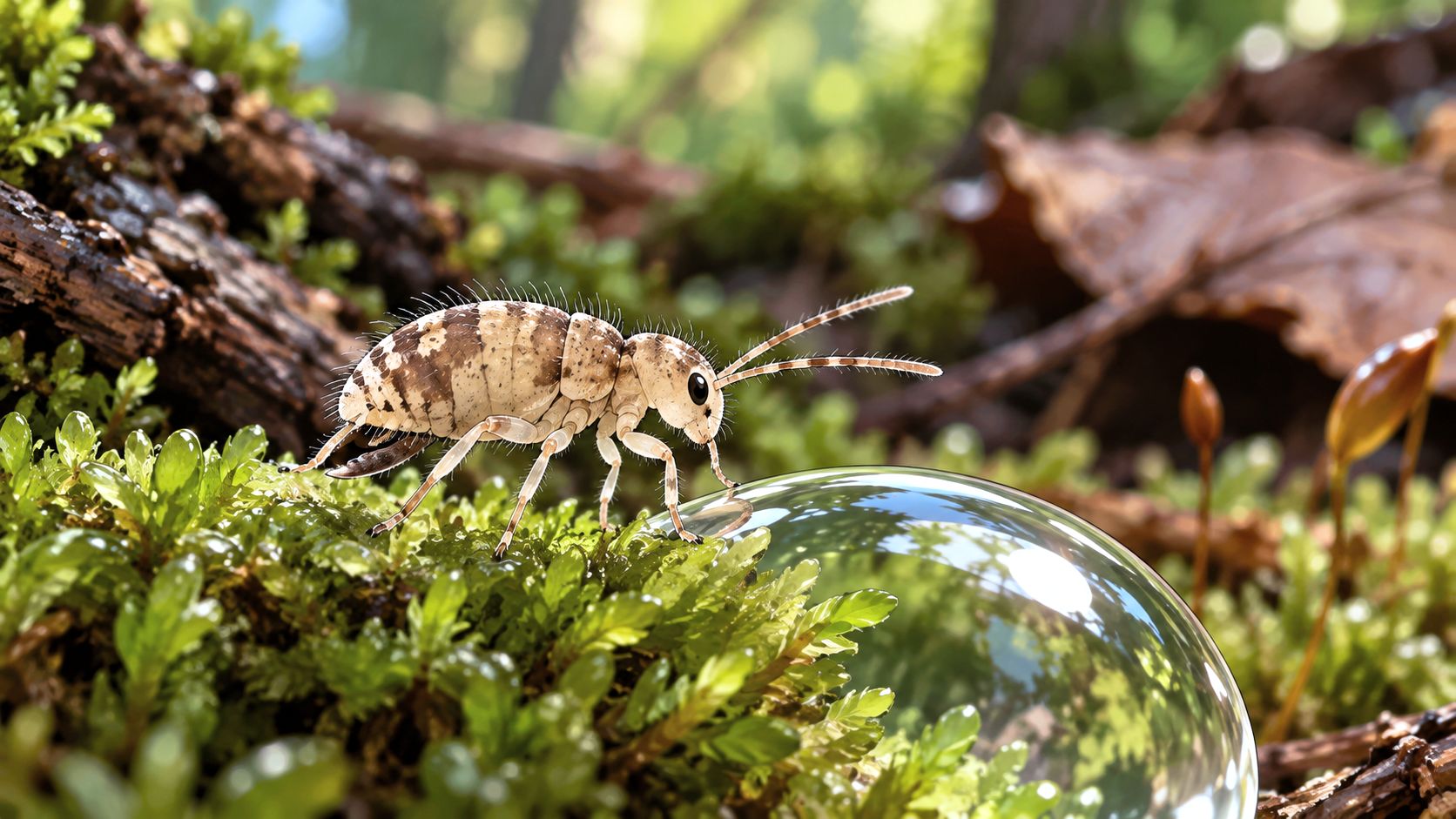
A speck on the bathroom floor suddenly launches itself several inches away. Another disappears from the rim of a damp plant pot the moment you get close. That combination of tiny size, moisture, and jumping is a strong reason to suspect it is a springtail. A springtail is a tiny, wingless, six-legged arthropod belonging to the order Collembola. Most live in damp soil, leaf litter, mulch, and other moist places rich in organic material. They commonly feed on fungi, algae, bacteria, and decaying plant matter. Indoors, springtails are primarily nuisance pests, and their presence often points to excess moisture rather than a dangerous infestation.
The name makes them sound like insects with literal spring-loaded tails. Neither part of that description is quite right. Springtails are no longer generally classified as true insects, and the structure responsible for their famous jump is tucked underneath the abdomen rather than trailing behind them like a tail.
Springtails Are Collembola, Not True Insects
Springtails are members of Collembola, a large group of small hexapods found in moist environments around the world. They have six legs and antennae, so it is easy to see why they were historically grouped with insects. Modern classification places them among the entognathous hexapods rather than within the true insects. One important distinction is that their mouthparts are enclosed within the head.
That distinction matters because “springtail” does not refer to one species. It refers to the members of an entire order containing many different species. Consequently, two springtails can look surprisingly different while still belonging to the same broader group. The scientific name and classification of springtails explains that taxonomy in more detail.
Most springtails you encounter around a home are extremely small. Household species are commonly only about 1 to 2 millimeters long, although size varies considerably across Collembola. You can see the differences more clearly in how big springtails are.
The “Spring” Is Under the Springtail
The feature that gave springtails their common name is called the furcula. In springtails that possess one, this forked appendage folds underneath the abdomen and is held in position until released. When it snaps downward against a surface, it can propel the animal through the air.
That is why a springtail may seem to vanish when you disturb it. It has not flown away. Springtails are wingless and cannot fly, but the sudden jump happens so quickly that it can be difficult to follow with your eyes.
Not every springtail has the same body form or equally developed jumping equipment, so the jump should not be treated as the only identification feature. Still, watching several tiny specks suddenly leap from damp soil or a wet surface is a useful clue. The mechanics are covered separately in how springtails jump.
What Does a Springtail Actually Look Like?
There is no single springtail color or silhouette. Many species have elongated bodies, while others are noticeably rounder or almost globular. Colors can include white, cream, gray, brown, black, purple, red, orange, yellow, and mottled combinations.
They have six legs and antennae, but their tiny size means those features may be difficult to see without magnification. The furcula is also underneath the body, so you should not expect to see an obvious “tail” sticking out behind every living specimen.
This variation is one reason a photograph is often more useful than trying to identify a springtail by color alone. The springtail appearance guide goes deeper into body shapes and identification features, while springtail colors covers the surprisingly wide color range.
Springtails can also be confused with other tiny household arthropods. Fleas are a particularly understandable mistake because both can be small, dark, and capable of jumping. The difference becomes much clearer once you compare their body structures and behavior rather than relying on the jump alone.
Springtails Belong in Damp Places
To understand why springtails appear in a home, it helps to forget the bathroom or windowsill for a moment and think about their normal habitat.
Springtails are extremely abundant in environments such as soil, leaf litter, compost, mulch, and decaying vegetation. Many feed on fungi, algae, bacteria, pollen, and decomposing organic material. In that setting, they form part of the community involved in decomposition and nutrient cycling.
Moisture is the connecting factor. Springtails require humid conditions, which is why populations can become especially noticeable in damp soil and other moisture-rich habitats. Outdoors, you may find them beneath leaves, mulch, logs, or other material that protects the ground from drying.
Indoors, the same moisture dependence explains why sightings often cluster around bathrooms, basements, kitchens, plumbing leaks, damp building materials, and overwatered houseplant soil. A springtail crawling across a dry bedroom wall may seem random, but a large recurring population deserves a closer look at where moisture is coming from.
Finding Springtails Indoors Does Not Mean They Are Living on You
Their jumping behavior creates some unfortunate comparisons with fleas, but springtails are fundamentally different household visitors.
Springtails do not bite or sting people. They also do not damage clothing, furniture, stored food, or the structure of a home. This makes them primarily a nuisance indoors rather than a pest that feeds on people or household materials.
Large numbers can still be unpleasant. Hundreds of tiny animals gathering around a bathtub, sink, window, foundation wall, or basement floor can look like a serious infestation. However, simply killing the springtails you can see misses the more useful question: why can so many of them survive there?
Usually, the answer leads back to moisture. Plumbing leaks, condensation, damp building materials, excessive irrigation, wet mulch near a foundation, poor drainage, and overly wet potting soil can all create suitable conditions. That makes a recurring springtail problem useful information about the environment, even though the animals themselves are generally harmless.
Why Springtails Can Suddenly Appear in Huge Numbers
Springtails can occur at very high densities in suitable outdoor habitats. As a result, a population that was practically invisible can become impossible to miss when environmental conditions change.
Extended wet conditions can support large populations. Later, when outdoor habitat dries, springtails may move in search of moisture and enter buildings through small gaps and openings. Periods of prolonged rainfall can also coincide with nuisance invasions. That helps explain why a homeowner may see almost none one week and then find large numbers around the house soon afterward.
Their size makes the invasion look even stranger. Instead of a few obvious insects walking through a doorway, you may see what resembles scattered pepper, dirt, or soot until the individual specks begin moving or jumping.
So a sudden appearance does not necessarily mean springtails have been secretly multiplying throughout the house. The population may originate outdoors and move inside when surrounding conditions change. The possible entry routes are covered in how springtails get into a house.
A Springtail Problem Is Often a Moisture Problem First
This is the distinction we would keep in mind before reaching for a pesticide.
When springtails persist indoors, removing visible individuals may make the surface look better without changing the conditions supporting them. Moisture control is the central management strategy. That can mean repairing a leak, drying a persistently damp area, correcting drainage, reducing excessive irrigation, or allowing overly wet potting soil to dry appropriately between waterings.
A vacuum can remove springtails that have already entered. Sealing cracks and other potential entry points can also reduce movement from outside. However, neither measure replaces correcting a moisture source when one is present.
This is where springtails can actually be informative. A few outdoors are normal. A recurring concentration inside gives you a reason to inspect the environment instead of treating the animal itself as the whole problem. If numbers keep returning, the signs of a springtail infestation can help you judge what you are seeing before moving on to springtail control.
Other Questions About Springtails
Are springtails bugs?
In casual conversation, calling a springtail a “bug” is understandable because the word is often used for almost any tiny crawling arthropod. Taxonomically, however, springtails belong to Collembola and are not true bugs, which are insects in the order Hemiptera. They are also generally classified separately from true insects.
Why are some springtails called snow fleas?
Some cold-active springtails can become conspicuous on the surface of snow, where masses of tiny dark individuals stand out against the white background. The “flea” part of the name refers to their small size and jumping behavior. They are springtails, not actual fleas.
Can springtails live in water?
Some springtails can occur on the surface of standing water, which is why they sometimes appear in pools and other wet locations. Their association with water does not mean a typical household springtail is an aquatic insect. Moisture-rich terrestrial habitats remain important environments for many species.
Are springtails always a bad sign in soil?
No. Springtails are normal inhabitants of soil and organic debris, and many feed on decomposing material, fungi, algae, and microorganisms. Their presence outdoors does not automatically indicate a problem. The situation becomes more relevant to a homeowner when unusually large numbers occur indoors or when persistently wet conditions are supporting them where they are unwanted.
Can springtails damage plants?
Most springtails associated with homes and gardens feed on fungi and decaying organic material rather than healthy plants. However, some species can feed on living plant tissue, particularly tender young plants. Plant damage from springtails is generally uncommon, so finding springtails in potting soil does not by itself prove that they are harming the plant.