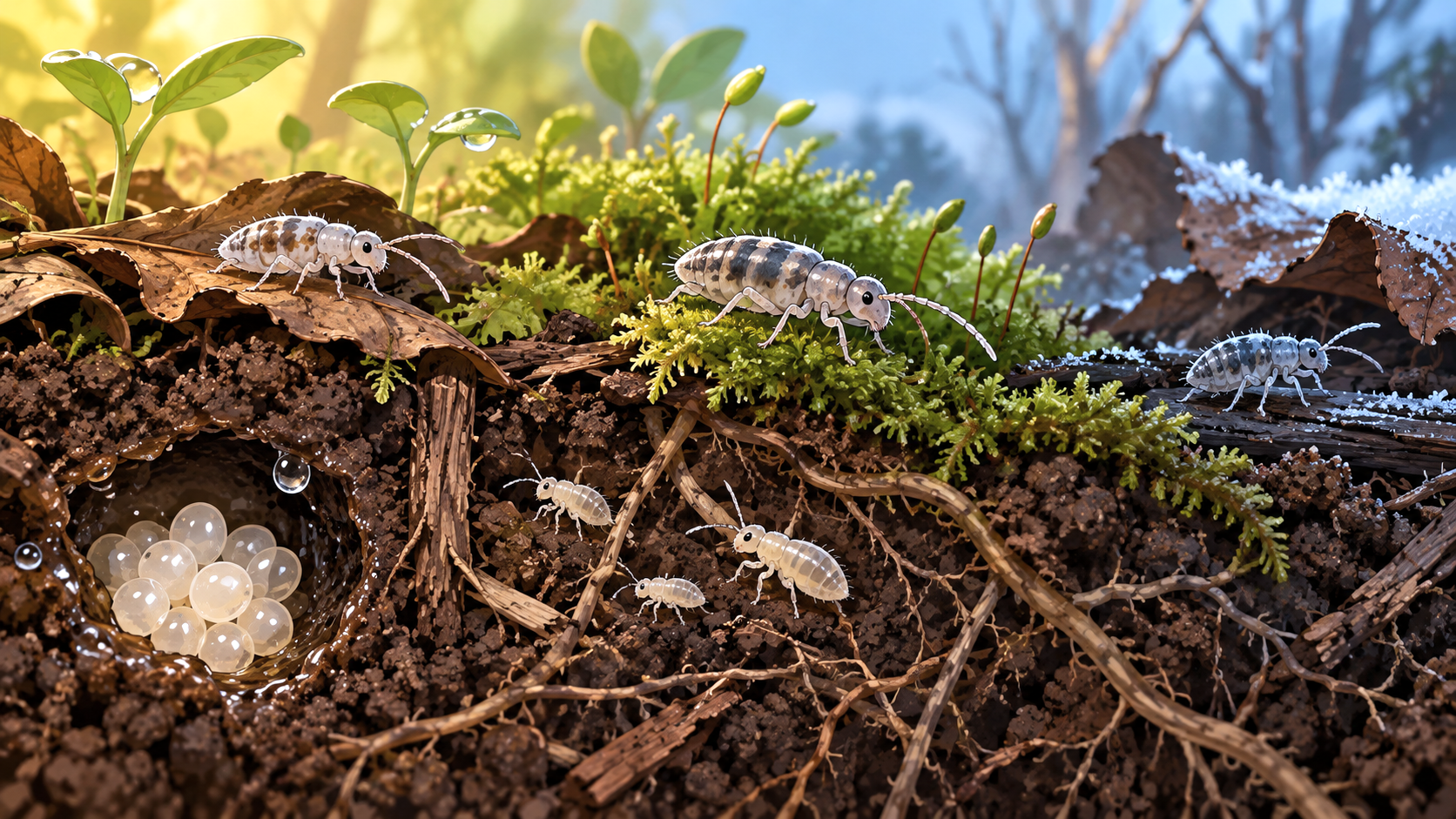
For something small enough to look like a moving speck, a springtail can live surprisingly long. There is no single lifespan that applies to the thousands of springtail species, though. Some complete their lives within weeks or months, while certain species can survive for more than a year under favorable conditions. Springtails can live from several weeks to more than a year, depending on the species and conditions. Some long-lived springtails survive beyond one year, while laboratory studies of particular species have recorded much shorter lifespans. Temperature, moisture, food, genetics, species, and other environmental conditions can all influence how long an individual survives.
There Is No Single Springtail Lifespan
Giving springtails one fixed lifespan would be misleading because Collembola is a large and diverse group. Lifespan differs substantially between species, and environmental conditions can change longevity even among individuals of the same species.
Some springtails are comparatively short-lived. Research on Arrhopalites caecus, for example, estimated a lifespan of roughly 30 to 50 days under the laboratory culture conditions studied. The researchers also noted that lifespan information remains poorly characterized for many springtail species.
At the other end of the range, some springtails can live considerably longer. A University of Minnesota resource notes that some springtails can live for more than one year, while University of Connecticut guidance states that adult springtails may live through the year.
This means a springtail found in a flowerpot, basement, or bathroom cannot be assigned an age simply from its presence. Even identifying the species would not tell you exactly how long that particular individual will survive because its surroundings also influence longevity.
Some Springtails Can Live for More Than a Year
The possibility of a springtail surviving beyond one year is not based only on general pest guides. Controlled research on Folsomia candida, a springtail widely used in laboratory studies, has documented remarkably long-lived individuals.
One study following different F. candida lineages recorded lifespans ranging from 17 to 571 days, with longevity varying substantially among genetic lineages and food conditions. Another experiment involving two F. candida lineages recorded median lifespans of 224 and 266 days under the conditions used in that study.
Those numbers should not be interpreted as the normal lifespan of every springtail living in a house or garden. They come from particular springtail populations under controlled conditions. What they demonstrate is how wide the possible lifespan range can be and why statements such as “springtails live for six months” are too broad to be reliable.
A Springtail in a Dry House Faces a Very Different Life
Where a springtail ends up can matter enormously. Springtails are strongly associated with moist environments such as soil, leaf litter, compost, decaying organic matter, and other humid habitats, where conditions are much more suitable for their survival.
A springtail that wanders onto a dry bedroom windowsill therefore faces a very different environment from one living inside moist potting soil. Springtails entering homes generally die fairly quickly when adequate moisture and food are unavailable. However, they can persist indoors when sufficiently humid conditions and suitable habitat remain available.
That makes the location of repeated sightings more useful to a homeowner than knowing the maximum lifespan ever recorded for a springtail. One individual wandering across a dry floor does not mean it can necessarily survive there for months. Springtails repeatedly appearing around the same damp location, on the other hand, give you a reason to investigate why that area remains suitable.
Persistent indoor activity can therefore act as a moisture clue. Our guide to what attracts springtails explains the environmental conditions that can make one part of a property considerably more favorable to them than another.
Adulthood Does Not Stop a Springtail From Molting
Springtail adulthood differs from what many people expect after watching familiar insects such as butterflies, beetles, or flies. Springtails continue to molt after reaching reproductive maturity, so becoming an adult does not mean the animal has completed its final molt.
A long-lived springtail may molt many times during its life. Some springtails can experience dozens of molts, with the total varying by species and conditions. Adulthood can therefore occupy a substantial portion of the animal’s life rather than representing a short final stage immediately before death.
This is also why lifespan should not be confused with development time. Our springtail life cycle guide follows development from the egg through the juvenile stages and into reproductive adulthood. Lifespan covers that entire journey and continues for however long the adult survives afterward.
Moisture Helps Springtails Survive, but It Does Not Set a Lifespan
Springtails and moisture are so closely connected that it is tempting to create a simple equation in which wetter conditions always produce a longer-lived springtail. Their longevity is more complicated than that.
Suitable humidity can be crucial for survival, but species, temperature, food availability, genetics, and other environmental conditions also influence longevity. Controlled research on Folsomia candida, for example, found substantial differences in lifespan among genetic lineages and feeding conditions.
For someone dealing with springtails at home, the practical lesson is much simpler. A dry indoor environment is generally inhospitable to them, while persistently damp locations can allow them to remain. If springtails repeatedly appear in one part of the house, investigating moisture will usually tell you more about the problem than trying to estimate the age of the insects you see.
Repeated sightings can also help reveal whether you are dealing with occasional wanderers or a more persistent problem. Our guide to the signs of a springtail infestation explains the patterns worth paying attention to.
Hundreds of Springtails Do Not Mean They Have Been Accumulating for Years
A sudden mass of springtails can make it look as though the same insects have been quietly building up for an extremely long time. Population growth provides a much better explanation.
Springtails can complete their life cycles relatively quickly when temperatures and other conditions are favorable. Suitable moisture, food, and habitat can support very large populations, and some common springtails can produce several generations during a year.
A huge gathering can therefore develop because springtails are reproducing successfully in favorable habitat, not because individual insects have been surviving and accumulating for years. This becomes especially relevant when large numbers suddenly appear around foundations, patios, pools, bathrooms, or houseplants.
If the population is suddenly appearing indoors, figuring out how springtails are getting into the house and whether favorable moisture exists nearby will usually be more useful than concentrating on their maximum possible lifespan.
Other Questions About How Long Springtails Live
Can a springtail live for several years?
Most springtails should not be assumed to live for several years. Lifespan varies substantially among species, and documented research shows that certain springtails can survive beyond one year. Exceptional laboratory longevity does not mean the average springtail encountered in a bathroom, garden, or flowerpot will live anywhere near that long.
Does a springtail die after reproducing?
Not necessarily. Adult springtails can continue living, reproducing, and molting after reaching sexual maturity. Reproduction therefore should not be treated as the automatic end of an adult springtail’s life.
Can springtails survive in an empty house?
Whether people occupy the building is not the deciding factor. The conditions inside it matter much more. Damp basements, plumbing leaks, wet building materials, or other humid areas can provide suitable habitat even in an unoccupied property. Our guide to springtails in new-construction homes shows another situation in which building moisture can influence where springtails appear.
Do springtails live longer indoors or outdoors?
Neither location automatically gives a springtail a longer life. Survival depends on the immediate habitat, including moisture, temperature, food, and species. A springtail stranded in a dry indoor room may die relatively quickly, while one living in moist indoor potting soil can encounter much more favorable conditions.
Will springtails eventually disappear if an area dries out?
Drying an indoor area can make it unsuitable for springtails because they depend heavily on moisture. Continued sightings after an area has dried may indicate that another moist habitat remains or that new springtails are entering from elsewhere. Our guide to preventing springtails from coming back covers the broader changes that can reduce recurring populations.