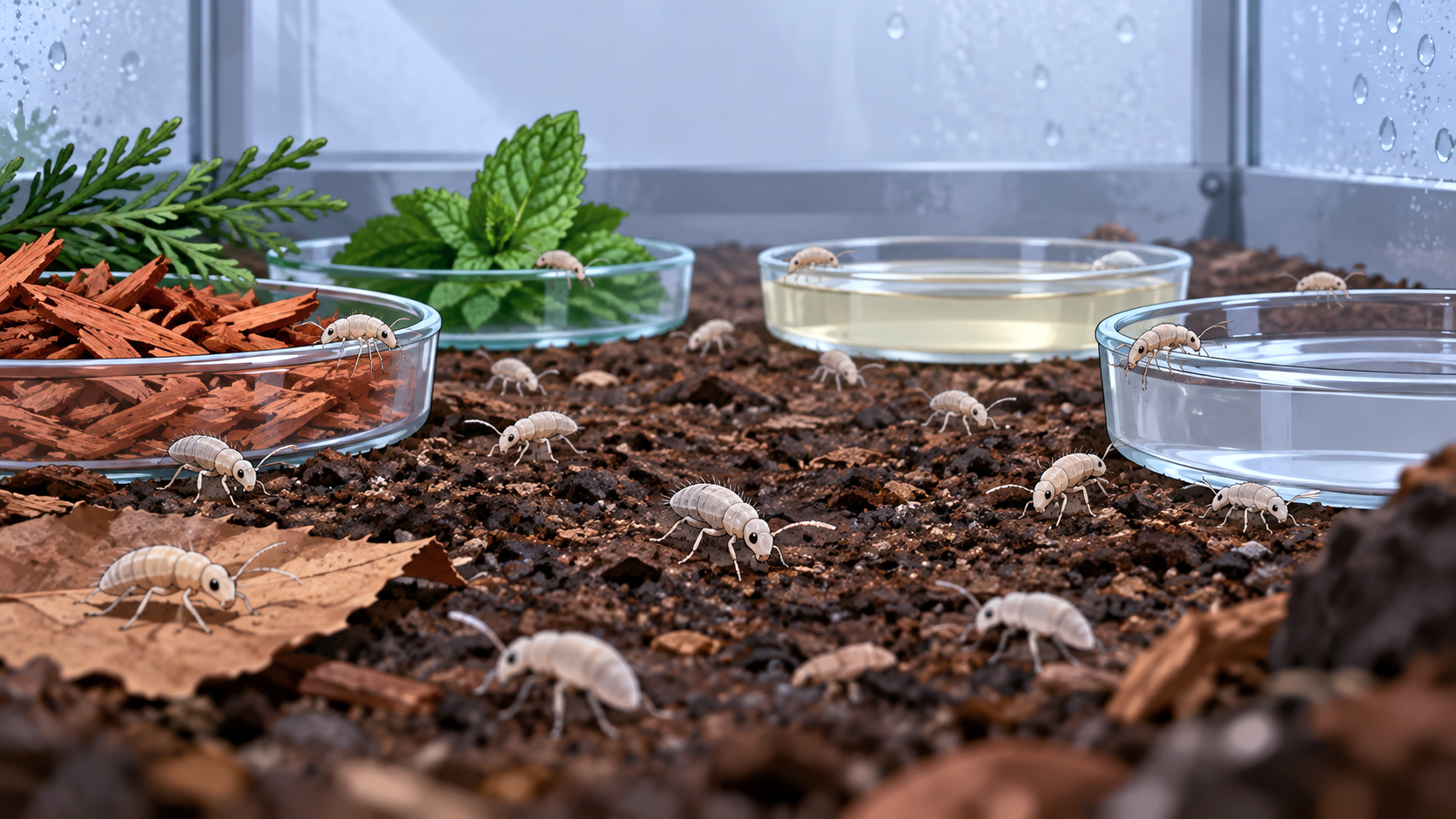
The obvious answer would be peppermint, cedar, eucalyptus, lavender, or another sharp scent people commonly use against household pests. Springtails do not give us such a convenient answer. Their response to odor is far more selective than “strong smells are bad,” and some scents actually draw them closer. No specific household smell has been established as a reliable springtail repellent. Springtails can detect and respond to airborne chemicals, and research has identified certain fungal compounds that discourage them. However, that does not establish peppermint, cedar, vinegar, citrus, lavender, or another familiar household scent as something springtails consistently hate.
Springtails Have a Sense of Smell That Can Lead Them in Either Direction
A springtail moving through soil lives in a world full of chemical signals. Fungi and bacteria release volatile compounds into the surrounding environment, and springtails can use some of those chemicals while deciding where to go.
One striking example involves geosmin and 2-methylisoborneol, two compounds associated with the earthy smell of soil. Experiments with the springtail Folsomia candida found that its antennae responded to both compounds and that the springtails were attracted to them. Field experiments also showed springtails moving toward odors released by Streptomyces bacterial colonies.
So smell matters to a springtail, but not in the simple way a DIY repellent list might suggest. Something noticeable to our nose could attract one, repel one, or have no useful effect at all. That is why we would not judge a supposed springtail repellent by how unpleasant or powerful it smells to a person.
There Are Compounds Springtails Avoid
Research on Folsomia candida has found evidence of avoidance associated with fungal sesquiterpenes. In choice experiments, springtails preferred a mutant strain of the fungus Trichoderma virens that produced far fewer sesquiterpenes over the normal fungus that produced them. The results supported a repellent role for these fungal compounds.
That gives us something much stronger than the vague statement that springtails dislike odors. Certain volatile chemicals really can alter where springtails choose to go.
But “sesquiterpenes” describes a broad class of chemical compounds, not a bottle of springtail repellent you can place beside the bathtub. The experiment involved a particular fungus, particular chemical emissions, and F. candida. It does not establish a universal scent that every springtail species avoids.
There is another useful example in α-pinene, a volatile compound associated with many coniferous plants. Controlled exposure produced direct biological effects in F. candida at sufficiently high experimental concentrations. However, the research investigated toxicity and stress responses rather than demonstrating that α-pinene works as a household springtail repellent.
Those differences are important. Detection, avoidance, repellency, and toxicity are not interchangeable.
So What About Peppermint, Cedar, Lavender, Citrus, and Eucalyptus?
None belongs on a trustworthy list of smells guaranteed to repel springtails.
Peppermint is especially easy to overstate because it has such a strong reputation as a natural pest remedy. Our separate look at peppermint oil for springtails deals with that remedy specifically. The same caution applies when extending claims from other pests to springtails.
Cedar presents a similar problem. A cedar scent may have useful applications involving certain other arthropods, but that does not establish cedar as a springtail repellent. The same leap should not be made for lavender, eucalyptus, citrus, tea tree oil, cinnamon, cloves, or other aromatic substances simply because they appear on homemade pest-control lists.
Springtail chemical ecology gives us a good reason not to make those leaps. Their response depends on the actual chemical cue, and attraction is possible as well as avoidance.
This is one area where a long list of “10 smells springtails hate” would make the article more useful-looking and less accurate. We would rather leave that list unwritten.
The Smell Test Can Distract You From a Better Clue
There is a strange mismatch between what homeowners usually notice and what springtails care about most inside a building. You notice the insects and where they are gathering, so the natural response might be to put something unpleasant in their path. Peppermint goes along the windowsill, cedar goes near the door, or another scented product gets sprayed around the bathroom.
But recurring springtails indoors are closely associated with moisture. They can occur around sinks, bathtubs, damp basements, crawl spaces, wall voids, and other moist locations. Their continued presence inside is an indicator that moisture deserves attention.
That changes what the springtails themselves can tell you. Ten springtails repeatedly appearing along one bathroom baseboard are more useful as a clue than as targets for a scented barrier. Check what is happening around that baseboard. Persistent dampness, a plumbing problem, condensation, or another moisture source can explain why that particular area remains favorable.
Our guide to what attracts springtails goes further into those conditions. When the animals are coming from outdoors instead, how springtails get into a house becomes the more useful question.
A Repellent Would Only Move Them Anyway
Suppose someone eventually identifies a household scent that makes a particular springtail turn around every time it encounters it. There would still be a limitation. Repelling is not the same as controlling.
Moving springtails away from one edge of a bathroom does not dry the wet material supporting them. Redirecting them from one windowsill does not close the opening they are using. Making one section of a flowerpot unattractive does not correct consistently wet potting soil.
For household springtails, reducing excessive moisture remains the more useful approach. Drying wet areas, repairing water leaks, improving problematic drainage, and reducing excessive moisture around foundations address the conditions that support recurring activity. Small numbers indoors can simply be vacuumed or otherwise physically removed.
Houseplants deserve their own approach. Springtails commonly inhabit damp potting soil, and reducing excessive watering is more useful than trying to perfume the soil. We cover that situation separately in our guide to springtails in potted plants.
Let the Springtails Tell You Where to Look
Instead of asking what smell to put where the springtails are, watch where they keep returning.
A recurring cluster beside a tub sends you toward the moisture conditions in the bathroom. Activity concentrated around plants sends you toward the potting soil. Large numbers appearing along exterior walls call for an inspection of mulch, moist leaves, drainage, irrigation, and possible entry points around the structure. Reducing moisture and excessive organic material around foundations is a core part of exterior springtail management.
A fan or dehumidifier may also help with springtails when an indoor area stays excessively humid or damp. Fixing a leak matters more when a leak is responsible.
For a larger infestation, the broader springtail control guide brings those different situations together.
That may be less satisfying than discovering one odor springtails cannot stand. It is considerably more useful, though. You do not need to make your house smell unpleasant to springtails. You need to make the problem area a poor place for them to remain.
A Few Smell Questions That Still Come Up
Can springtails smell with their antennae?
At least in Folsomia candida, the antennae can detect particular airborne chemical compounds. Researchers recorded antennal responses to geosmin and 2-methylisoborneol, and the springtails were attracted to both substances.
Can a smell attract springtails instead of repelling them?
Yes. The earthy-smelling compounds geosmin and 2-methylisoborneol can attract Folsomia candida. That is one reason assuming every powerful odor acts as a deterrent is unreliable.
Does mold smell attract springtails?
A musty room and springtails can occur together because damp conditions favor both fungi and springtail activity. Springtails also commonly feed on fungi. However, a household “mold smell” should not be treated as a single proven springtail attractant because it can represent a complex mixture of volatile compounds.
Could springtails eventually cross an area that smells unpleasant to them?
Avoidance observed under controlled experimental conditions does not establish a permanent household barrier. For prevention, correcting favorable habitat and limiting entry provides a much stronger strategy. Our guide to keeping springtails away covers that longer-term approach.
2 thoughts on “What Smell Do Springtails Actually Hate?”