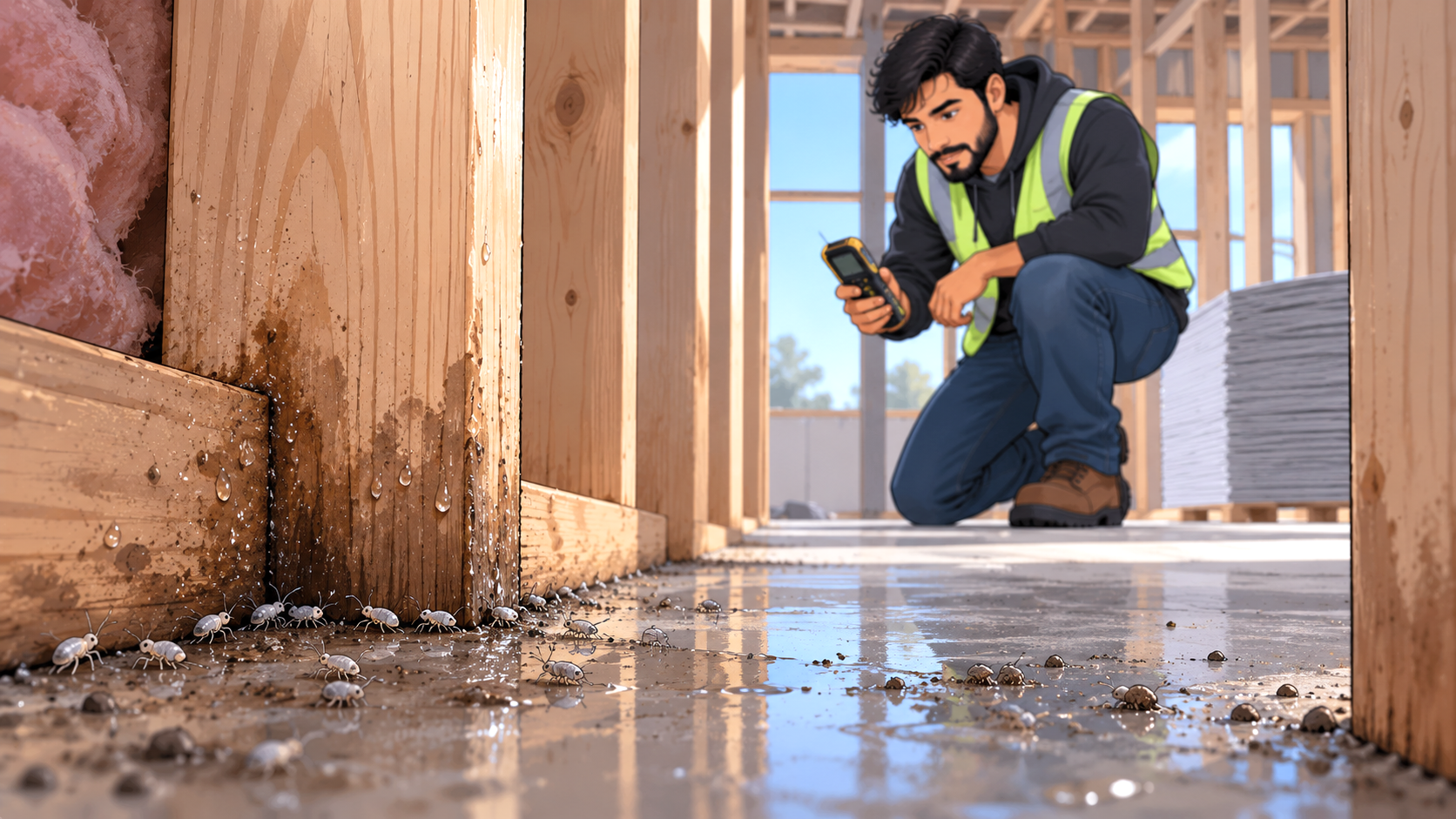
Springtails can show up in a new construction home because newly built structures can retain enough moisture to support them. Rain can wet framing, floors and walls before the building is enclosed, while construction materials themselves introduce moisture. If damp wall spaces support mold growth, springtails can sometimes maintain populations there until the structure dries.
Finding springtails shortly after moving into a brand-new house can feel backwards. There has been little time for household pests to become established, and the home may look completely clean. With springtails, however, cleanliness is not the issue. Moisture is the connection between the insects and new construction.
Why New Construction Can Favor Springtails
A newly finished house is not necessarily a dry house. Concrete, masonry, plaster and other construction processes introduce substantial amounts of water into a building. Framing can also become wet during construction, particularly when rain reaches the structure before the roof and exterior walls are complete.
That moisture does not disappear the moment construction ends. In rapidly completed buildings, construction moisture can remain within the structure for months after occupancy. Enclosing damp materials can also leave humid spaces inside walls where drying happens more slowly than it does on exposed surfaces.
This matters because springtails depend heavily on moisture. They normally inhabit damp outdoor environments, but building infestations are associated with dampness, organic matter and mold. A newly built house can therefore provide suitable conditions even though it has never had the long-term plumbing leaks or maintenance problems associated with an older home. That distinction is the key to understanding this problem. Springtails in a new home do not need years to establish themselves. The moisture conditions that support them may have existed before anyone received the keys.
Rain During Construction Can Create a Hidden Springtail Habitat
One of the clearest explanations for springtails in new construction involves rain before the building is fully enclosed. Floors, walls and framing can become soaked during that stage. Later construction may cover those materials before they have completely dried.
Springtails can sometimes maintain an indoor population within the walls of newly built homes when rain-soaked floors and walls support mold growth. That makes a wall void very different from an ordinary dry cavity. Moisture provides the humid conditions springtails need, while fungal growth can provide food.
You may never see what is happening inside the wall. Instead, tiny springtails can emerge into rooms through small openings and appear along baseboards or around penetrations. Springtails are small enough to exploit very narrow gaps, so their visible location does not necessarily reveal exactly where the damp area is.
For that reason, springtails repeatedly appearing from one part of a new house deserve more attention than a few scattered individuals. The pattern may help narrow down where moisture remains.
The Springtails May Have Been Around the Property Before the House Was Finished
Not every new-home springtail problem originates inside a wall. Construction takes place on land where springtails already occur naturally.
Springtails are abundant inhabitants of soil, leaf litter, compost and other moist environments. They feed on fungi, bacteria and decaying organic material and can reach high densities when conditions suit them. Their normal presence in soil is one reason finding springtails outdoors is not unusual.
Once a house occupies that environment, tiny gaps can provide routes inside. Springtails can enter beneath doors, siding and sill plates and around windows as they move in search of better conditions. They may also crawl through cracks and openings around utility penetrations.
This gives new homeowners two possible sources to investigate. Springtails may be persisting in a damp part of the structure, or large outdoor populations may be entering the new building. Sometimes both conditions can exist at once.
New Landscaping Can Put Large Populations Right Beside the Foundation
The house itself is only half of the new-construction environment. Newly completed properties often receive landscaping at roughly the same stage, and some of those materials can create excellent springtail habitat immediately beside the building.
Moist soil, mulch and decaying organic matter naturally support springtails. When populations become large, the insects can migrate toward structures. Mulch immediately around a foundation can contribute to springtail problems, particularly when it remains wet.
Drainage deserves attention too. Downspouts that release water near the foundation, excessive irrigation, poorly functioning drainage and landscaping that slopes toward a building can all keep the perimeter wetter than it should be. Those conditions do not mean springtails are damaging the foundation. They mean the area immediately outside the house can sustain the population that keeps producing indoor wanderers.
This is where we would separate a landscaping-driven problem from a construction-moisture problem. Heavy activity around exterior walls, doors and windows points toward the surrounding habitat. Springtails repeatedly emerging from a particular interior location give you more reason to investigate the building itself.
A Tight New House Does Not Make Springtails Appear From Nowhere
It is tempting to blame the problem simply on modern construction being tightly sealed. That explanation is incomplete. A house still needs a springtail source and suitable environmental conditions.
Their tiny size makes complete exclusion difficult. Springtails can enter through openings around doors, windows, pipes and other penetrations, and once inside they search for moisture. Indoor springtails commonly collect around water sources, including bathrooms, drains, tubs and kitchen sinks.
The more useful question is therefore not whether the new house is “too tight.” Ask where the moisture is and whether the insects appear to be arriving from outside or persisting somewhere within the building.
That diagnostic split prevents a common mistake. Sealing every visible crack may reduce entry, but it will not dry a damp wall cavity. Conversely, investigating walls for hidden moisture makes little sense when thousands of springtails are visibly concentrated in saturated mulch outside the same door.
How to Tell Whether the Springtails Are Coming From Inside or Outside
You rarely need to identify the exact hiding place of every springtail. Instead, map where and when you see them.
A sudden wave concentrated near exterior doors, windows or foundation edges can fit an outdoor migration. Springtails may move toward buildings when soil and leaf litter dry, while saturated soil can also force them to leave their habitat. Changing outdoor moisture conditions can trigger these migrations.
Persistent activity deep inside the house presents a different picture. Repeated sightings around the same wall, plumbing area or damp room give you a reason to investigate local moisture. Springtails can survive in wall voids, crawl spaces and other interior locations when enough moisture remains available.
This is also where your earlier observations become useful. Instead of treating every sighting as a separate event, look for the pattern described in our guide to the signs of a springtail infestation. Location and recurrence tell you more about the source than the presence of one tiny insect.
Springtails Do Not Mean Your New House Is Being Eaten
Springtails emerging from walls naturally raise a more alarming possibility. A homeowner may wonder whether the insects are feeding on framing or other construction materials.
They are not wood-destroying pests. Springtails mainly feed on fungi, algae, bacteria and decaying organic matter, and they do not cause structural or material damage. Their presence inside a new home matters because of what it can reveal about moisture, not because springtails are consuming the house.
This is an important distinction from termites. A pale or tiny insect appearing around a wall should still be identified correctly rather than assumed to be a springtail. Springtails are wingless, and many species jump when disturbed. Our springtails vs. termites comparison covers the identification differences when the insect itself is uncertain.
Once springtails are confirmed, the building question changes. Instead of searching for insect damage, look for the conditions allowing a moisture-dependent animal to remain there.
Will Springtails in a New Home Eventually Go Away?
They can. A construction-related springtail problem may decline as the building materials dry and the humid conditions that supported the population disappear.
That outcome depends on the source of the moisture. Springtails trapped indoors generally do poorly once conditions become dry. Reducing moisture usually causes indoor springtail problems to subside. A house that is simply drying after construction can therefore behave differently from one with a continuing leak or drainage problem.
Time alone is not a good diagnostic tool, though. Waiting makes sense only when the building is actually drying. If springtails remain concentrated around one location or continue appearing in large numbers, investigate whether something is keeping that area wet.
We would be especially reluctant to dismiss persistent activity simply because the house is new. New construction explains one possible source of moisture. It does not rule out plumbing leaks, drainage problems or other defects that can continue supplying water.
What to Check When Springtails Keep Appearing in a New House
Start with the distribution of the insects rather than immediately spraying them. Check whether activity is concentrated along exterior openings, one wall, a basement area, bathrooms or another recognizable moisture zone. Then look for visible leaks, condensation, persistently damp materials and exterior water collecting near the foundation.
Outside, pay attention to grading, irrigation, downspouts and wet mulch. These are established contributors to excessive moisture around buildings. Inside, unusually persistent activity in one location may justify having the moisture source investigated, particularly when no obvious surface water explains it.
This approach gets closer to the cause than repeatedly killing the springtails you can see. Indoor insecticide sprays are not recommended as the primary answer to springtail problems, because drying the affected area and correcting water problems address the conditions supporting them.
Once you know where the population is coming from, the next step becomes much clearer. An outdoor source calls for attention to perimeter moisture and entry routes. A persistent indoor source calls for finding and correcting the moisture problem. Our broader guide to getting rid of springtails covers the control side in detail.
Other Questions About Springtails in New Construction Homes
How soon can springtails appear after a new house is built?
Springtails can appear shortly after construction because the conditions that support them can develop before occupancy. Rain-soaked materials, humid wall spaces or large populations in the surrounding soil do not require someone to have lived in the house first.
Does finding springtails mean the builder did something wrong?
Not by itself. Springtails establish only that suitable moisture or an entry route exists somewhere around the situation in which they were found. Determining whether there is a construction defect requires identifying the actual moisture source rather than using the insects alone as proof.
Can springtails come through electrical outlets in a new house?
Springtails can inhabit damp wall voids and move through small openings within a building. Seeing them around an outlet can therefore be consistent with activity inside the wall, but the outlet itself does not identify the moisture source.
Can springtails arrive with materials brought onto a new property?
Yes. Springtails naturally live in soil and moist organic material, so landscaping materials can place them close to a newly completed structure. Their presence in those materials is normal outdoor biology rather than evidence that the house itself was already infested.
Should you report springtails to the builder?
Persistent springtail activity associated with one part of a newly built home is worth documenting, particularly when there are also signs of excess moisture. The useful issue to raise is the possible moisture condition, not simply the presence of springtails. Photos, dates and the exact locations of repeated sightings can make that discussion more specific.
One thought on “Why Do Springtails Show Up in a New Constructed Home?”