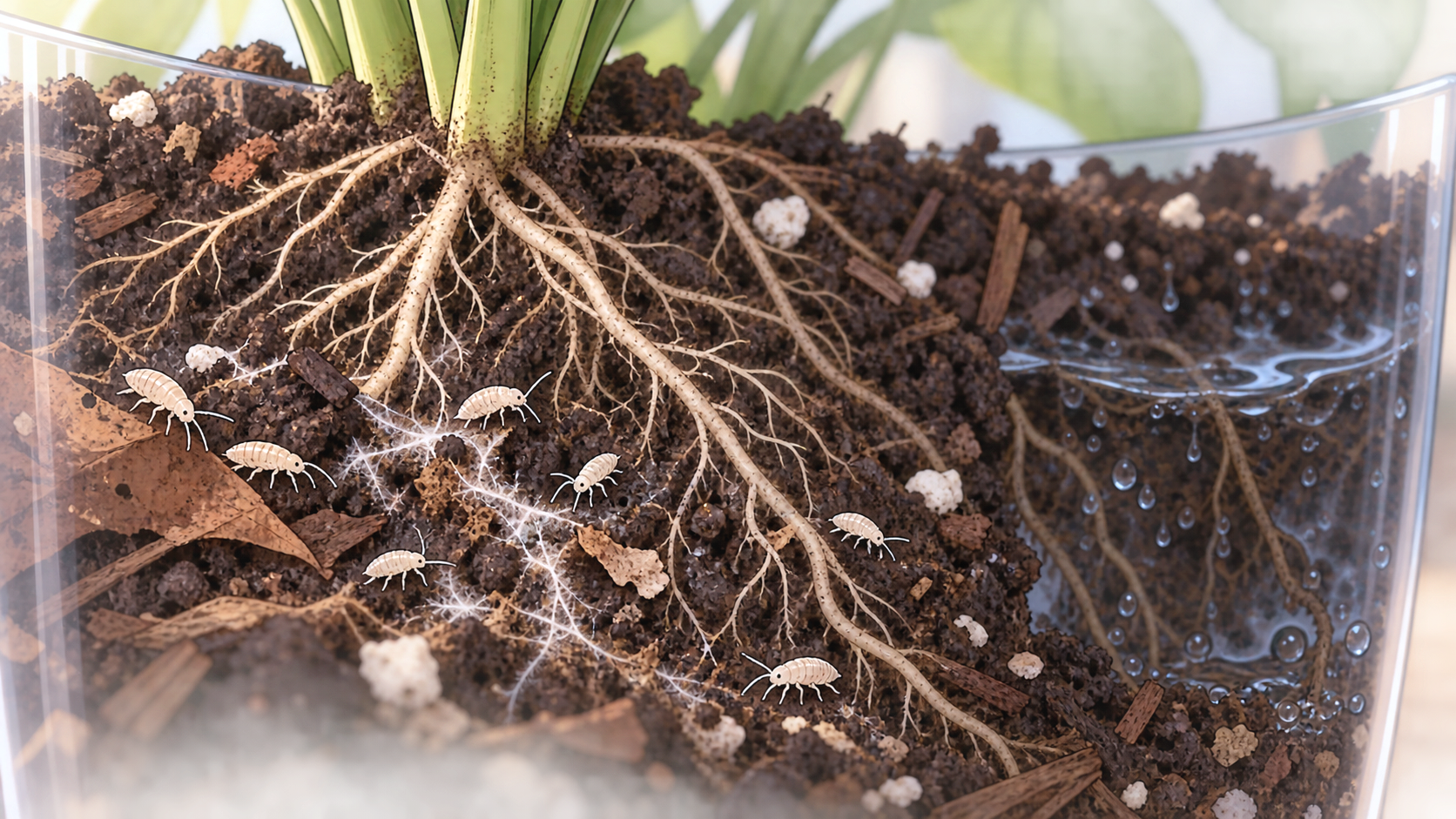
Finding springtails in soil is usually good or harmless, not a reason to treat the soil. Most springtails feed on fungi, algae, bacteria and decaying organic material, making them part of the soil food web and the decomposition process. A few species can feed on living plants, but damaging springtail activity is uncommon.
The better question is what their presence tells you about the soil. Outdoors, springtails are normal soil inhabitants. In a houseplant pot, however, a booming population can point to consistently damp growing media, even when the springtails themselves are doing little or no damage.
Why Springtails Live in Soil
Soil is one of the main habitats for springtails. These tiny arthropods are strongly associated with moisture and organic material, so the upper layers of soil can provide exactly the conditions many species need.
What looks like plain dirt is also a busy biological system. Healthy soil contains springtails alongside mites, nematodes, earthworms, fungi and bacteria, all occupying different positions in the soil food web. Springtails are therefore not unusual intruders that somehow contaminated the soil.
Their diet helps explain why they are there. Most soil-dwelling springtails consume fungi, algae, bacteria and decaying plant material. The great majority develop in soil, although springtail species differ in their exact feeding habits.
Moisture is equally important. Springtails thrive in damp environments, which is why they can become particularly abundant in wet soil, mulch, leaf litter and compost. That relationship also explains what attracts springtails when large populations develop around a property.
Springtails Can Be Useful Members of the Soil Food Web
The strongest case for leaving ordinary soil springtails alone is the work they do around decomposing material.
Small soil arthropods, including springtails, help mediate the decomposition of organic residues. Springtails also consume fungi and other microorganisms associated with decomposition. In turn, other soil animals can feed on these decomposers, connecting springtails to a much larger food web.
As dead organic material breaks down, nutrients cycle through the soil ecosystem. Springtails participate in that process rather than acting like pests that simply take resources from a plant. Their contribution is one reason they are described as an important part of soil ecosystems.
That does not mean adding springtails is necessary for every garden or pot. It means that finding an existing population in suitable outdoor soil is normally not a problem that needs fixing. In a living soil system, their presence makes biological sense.
Springtails in Garden Soil Are Usually Nothing to Worry About
A few jumping specks appearing when you disturb moist garden soil can look alarming simply because springtails move so suddenly. Their numbers can also be surprisingly high. Moist soil rich in organic matter can support very large populations.
For most gardens, however, the presence of springtails alone is not evidence of a plant problem. They commonly feed on decaying organic material, fungi, pollen and algae, while plant damage from springtails is generally minimal.
This is where springtails differ from a pest that should trigger action as soon as you confirm its identity. We would not treat healthy garden soil merely because springtails are present. First look at the plants themselves.
Healthy growth with springtails moving through the soil gives you little reason to blame them for anything. Wilting, damaged leaves or struggling seedlings deserve investigation, but the presence of springtails does not establish that they caused those symptoms. Our separate guide to whether springtails are harmful to plants covers that distinction in more detail.
Springtails in Potting Soil Need a Different Interpretation
A flowerpot changes the situation because the amount of water in that small volume of soil is largely under your control.
Springtails commonly occur in overwatered houseplant soil, particularly in damp growing media containing plenty of organic material. You may notice them immediately after watering because they move onto the surface as the soil becomes saturated.
In this setting, we would pay more attention to the soil moisture than to the springtails. The animals may be feeding on fungi and decomposing plant material without meaningfully harming the living plant. However, a large population can tell you that the pot is maintaining conditions they find favorable.
That makes springtails useful as a clue. Killing every visible individual while continuing to keep the potting mix excessively wet misses the more useful information their presence provides.
Our dedicated guide to springtails in potted plants goes deeper into that specific indoor situation.
A Few Springtail Species Can Damage Plants
Calling every springtail beneficial would go too far.
Some species feed on living plant tissue. Depending on the species and crop, feeding can affect young leaves, seedlings or roots. Documented symptoms can include small pits or holes, while economically significant springtail injury is considered rare.
This exception matters most when the plant itself shows compatible feeding damage. Springtails merely sharing the soil with an unhealthy plant are not enough to establish the cause. Soil can contain many organisms at the same time, and plants can decline for reasons unrelated to the tiny arthropods visible around their roots.
For the average houseplant owner or gardener, that distinction prevents an easy mistake. Presence is not the same thing as damage. A population of springtails in otherwise healthy soil should not automatically be treated as a plant infestation.
Lots of Springtails Do Not Automatically Mean the Soil Is Healthy
There is an opposite mistake worth avoiding too. Springtails participate in healthy soil ecosystems, but their presence is not a standalone soil-health test.
Healthy soil depends on physical, chemical and biological characteristics working together. Organic matter, structure, drainage, plant roots, microorganisms and other soil organisms all contribute. Soil health involves an entire living ecosystem, so one visible arthropod cannot tell you the condition of everything else.
This becomes particularly obvious in a pot. Excessively damp potting soil can support many springtails, yet that does not make excessive watering desirable for the plant. The same springtail population can therefore mean different things depending on context.
We think this is the most useful way to read them. In garden soil, they are usually ordinary members of the ecosystem. In an indoor pot where their numbers keep exploding, treat them as a reason to check how wet the growing medium remains rather than as proof that the soil is either exceptionally healthy or dangerously infested.
Decide Whether Anything Actually Needs to Change
Start with the plant, not the number of springtails. A healthy outdoor plant surrounded by springtails in moist, organic soil usually gives you no reason to remove them. They are doing what soil organisms normally do.
For houseplants, check your watering instead. Indoor springtails are particularly associated with damp potting media, and letting the soil surface dry appropriately between waterings can reduce their numbers without treating the pot as though it contains a destructive pest. How dry the soil can safely become still depends on the plant you are growing.
If springtails have moved beyond the pot and are appearing throughout the room, the question has shifted from soil ecology to household conditions. Our guides to signs of a springtail infestation and how springtails get into a house cover those situations separately.
Other Questions About Springtails in Soil
Do springtails live in compost?
Yes. Compost combines moisture, microorganisms and decomposing organic material, all of which can support springtails. Their feeding fits naturally into the community of organisms involved in decomposition.
Should I throw away soil that contains springtails?
No. Springtails alone are not a reason to discard garden or potting soil. Most are scavengers rather than destructive plant pests, so the condition of the plant and the moisture level of the soil are more useful information than their presence alone.
Can springtails live around plant roots?
Yes. Springtails can occupy soil around roots because that zone contains moisture, microorganisms and organic material. Seeing them there does not by itself mean they are eating healthy roots.
Are springtails the only tiny animals I might find in healthy soil?
No. Soil supports a diverse community that can include mites, nematodes, earthworms and many other small animals alongside springtails. If the organism you found only crawls and does not resemble a typical springtail, our springtails vs. mites comparison can help narrow the identification.
Can springtails survive in completely dry soil?
Springtails depend strongly on moisture, which is why their populations concentrate in damp habitats. Drying conditions can reduce suitable habitat and can also cause outdoor populations to migrate in search of moisture.
5 thoughts on “Are Springtails Good or Bad for the Soil?”