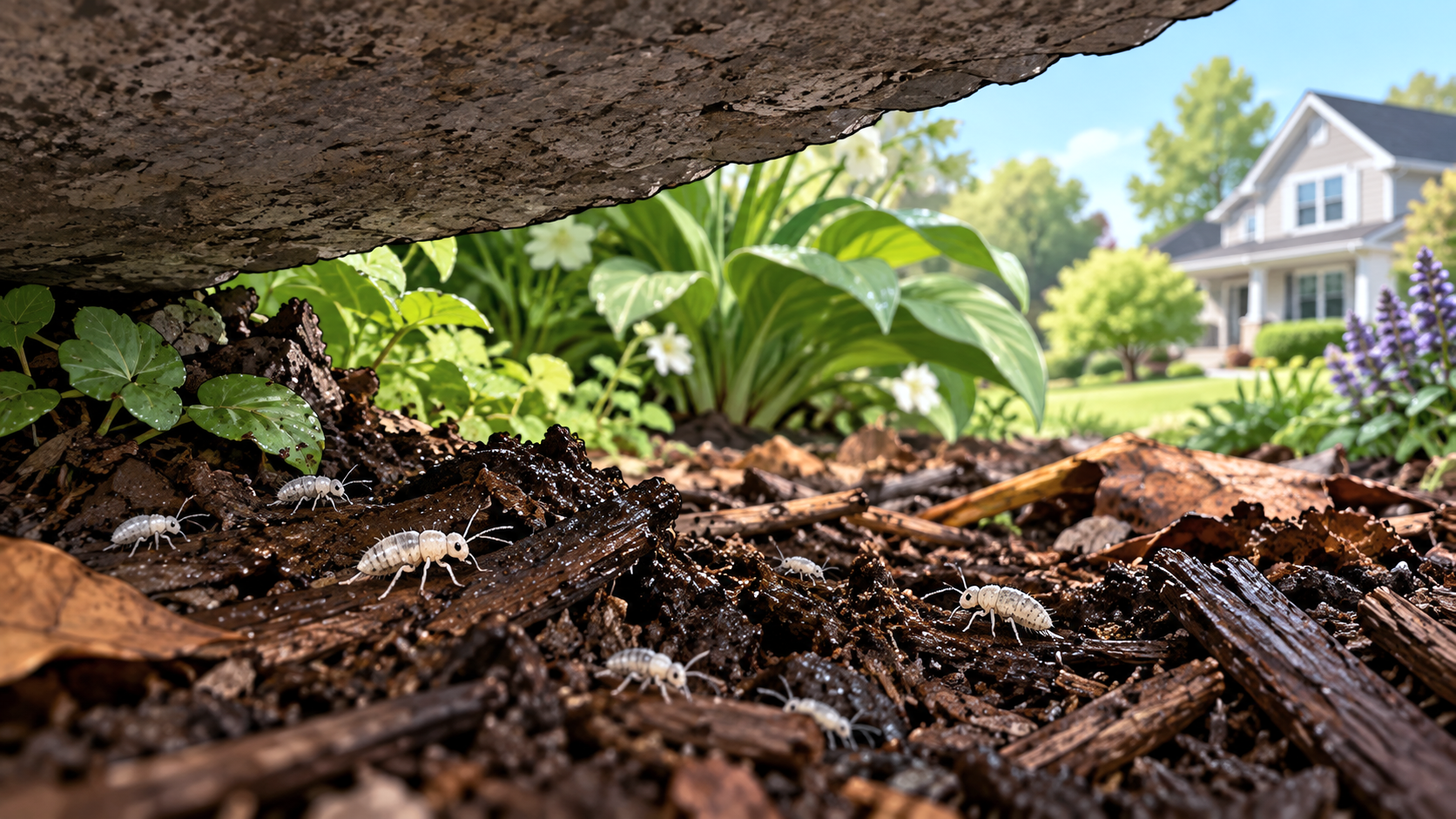
Finding springtails outside the house is completely normal because outdoors is where most springtails live. They thrive in moist soil, leaf litter, mulch, compost and other damp places containing organic material. Even large outdoor populations are not automatically a pest problem, although springtails gathering beside the foundation can sometimes migrate indoors when conditions change. A few springtails hopping across wet soil are easy to overlook. Thousands clustered on a patio, foundation or puddle are another story. That kind of gathering can look like an infestation spilling out of the house, when the population may actually be doing exactly what springtails normally do outdoors.
Springtails Outside the House Are Usually Where They Belong
Springtails are primarily soil-dwelling arthropods. Moist soil, leaf litter and compost are some of their normal habitats, where they feed largely on fungi, algae, bacteria and decaying plant material. Most remain unnoticed because they are tiny and spend much of their time among soil particles and organic debris.
That makes an outdoor springtail sighting fundamentally different from finding the same animals repeatedly inside a bedroom or kitchen. Outside, their presence usually does not indicate that anything has gone wrong. Springtails are part of the community of small organisms living in and around soil.
In fact, springtails contribute to decomposition and nutrient cycling. Small arthropods including springtails help break down organic residues in soil, so eliminating every springtail from a yard would neither be realistic nor desirable.
This is one reason we would not treat the mere presence of outdoor springtails as an infestation. The more useful question is where they are concentrated and whether they are moving toward the house.
Why You May Suddenly Notice Hundreds of Springtails
Normal does not always mean inconspicuous. Springtails can build enormous populations where moisture and food are plentiful. In moist soil rich in organic matter, thousands can occur within a single square foot.
Usually, most of that activity remains hidden. Then something changes.
Soil drying can trigger springtail movement, especially after a period when moist conditions allowed populations to increase. Extended wet conditions can cause problems too. Springtails may become household nuisances during prolonged drought or prolonged saturating rain, so opposite weather extremes can both make an existing outdoor population much more noticeable.
That explains why a yard can appear springtail-free for weeks and suddenly seem covered with them. The population did not necessarily arrive overnight. Environmental conditions may simply have brought large numbers out of their usual hiding places or set them moving.
Our guide to what attracts springtails looks more closely at the conditions that allow those populations to build.
Mulch Is One of the Most Normal Places to Find Them
A layer of damp mulch is almost tailor-made for springtails. It holds moisture near the soil surface while providing decomposing organic material and supporting fungi and microorganisms.
Large numbers of springtails in mulch are therefore unsurprising. Springtails commonly occur in mulch, as well as directly in soil. Organic mulch also slows evaporation and helps the soil beneath it retain moisture more consistently.
That does not make mulch bad for your landscape. Mulch has legitimate gardening benefits, and springtails living in it are not evidence that it needs to be removed from the entire property.
Location matters more. A thick, persistently wet layer pressed directly against the foundation puts springtail habitat beside potential entry points. When indoor invasions become a problem, reducing excessive mulch immediately around the foundation can be more useful than trying to eliminate springtails throughout the yard.
Springtails Around the Foundation Deserve a Closer Look
Seeing a few springtails along a foundation is still normal. Large concentrations there are more useful as a clue.
Springtails need moisture, so a consistently wet strip of ground beside the house can support substantial populations. Poorly directed downspouts, excessive irrigation, drainage problems and landscaping that slopes toward the building can all contribute to excess moisture around a foundation.
The springtails themselves are not damaging the foundation. They are responding to the environment around it.
This distinction matters because killing the visible animals does not correct whatever is keeping that area wet. When springtails repeatedly concentrate in one section of the perimeter, we would inspect the moisture pattern before worrying about the insects. A wet foundation edge is more informative than the number of springtails standing on it.
Springtails on Patios, Driveways and Concrete Usually Came From Nearby Habitat
Hard surfaces are not where most springtails develop. However, patios, sidewalks, driveways, porches and foundation walls make the animals much easier to see than dark soil does.
Nearby mulch, lawn, leaf litter or damp soil may support the actual population. Once springtails begin moving, they can spread across adjoining hard surfaces. Their tiny bodies become particularly noticeable when hundreds collect against an edge or contrast with pale concrete.
Water can make the display even stranger. Springtails can gather on puddles in such large numbers that their floating bodies form visible masses on the surface. Seeing tiny specks moving on water is therefore consistent with springtail behavior rather than evidence that they are breeding in concrete.
If you are unsure whether the tiny moving specks are springtails at all, their jumping behavior can be a useful clue. Our guide to how springtails jump explains the unusual structure they use to launch themselves.
Outdoor Springtails Do Not Usually Mean You Have an Indoor Infestation
This is probably the most important distinction for a homeowner. A large population outside does not prove that springtails have established themselves inside the building.
Springtails are primarily outdoor animals. However, they can migrate from lawns and other outdoor habitats toward buildings when environmental conditions become unfavorable. Hot, drying weather can drive them toward more humid areas, including homes.
Once they reach a building, their small size gives them plenty of opportunities to enter. Springtails can move beneath doors and siding or through openings around windows and other exterior gaps. A separate population may also persist indoors where chronic moisture provides suitable conditions.
That is why the direction of the problem matters. Springtails covering the patio and occasionally turning up beside the door fit an outdoor population producing indoor wanderers. Springtails appearing persistently around a damp basement wall, bathroom or plumbing area deserve a different investigation. Our guide to how springtails get into the house covers those routes in more detail.
Springtails in the Garden Are Usually Not a Reason to Intervene
Gardens contain exactly the kind of habitat most springtails need. Moist soil, decomposing vegetation and fungal growth provide both shelter and food.
Most springtails function as scavengers and decomposers rather than serious plant pests. Some species can feed on living plants, but springtail damage in gardens is typically minimal. Seeing them around plants therefore does not justify assuming they are responsible for holes, discoloration or declining growth.
That becomes particularly important when gardeners start inspecting damp soil closely. Springtails may be abundant simply because the soil supports them. Their presence and plant damage can occur at the same time without the springtails necessarily being the cause.
We cover that distinction separately in whether springtails in soil are good or bad and our guide to whether springtails harm plants.
When Outdoor Springtails Become Worth Addressing
The threshold is not “I found springtails outside.” That would turn an ordinary soil animal into a household pest simply because you noticed it.
Instead, pay attention when large populations repeatedly collect immediately beside the building and begin entering it. At that point, the outdoor habitat becomes relevant because it may be feeding the indoor nuisance.
Start with water. Check whether sprinklers repeatedly soak the foundation, downspouts discharge too close to the house, drainage leaves standing water or mulch remains continuously wet against exterior walls. Correcting those conditions makes the area less suitable for springtails while addressing the reason they are concentrated there.
There is little reason to chase scattered springtails across an entire yard. Outdoor populations are often more of a curiosity than a problem, and large temporary gatherings can disappear as soil conditions change.
When the actual goal is stopping a persistent population beside the building, our dedicated guide to getting rid of springtails outside covers that job without turning ordinary springtail activity elsewhere in the landscape into something that needs treatment.
Other Questions About Springtails Outside the House
Why are springtails sometimes all over a puddle?
Springtails can remain on the water surface rather than immediately sinking, and large populations may gather there during periods of movement. Dense groups can become conspicuous enough to look like a dark floating mass even though each individual springtail is tiny.
Are springtails in compost normal?
Yes. Compost provides moisture, microorganisms and decomposing organic material, all of which fit normal springtail habitat. Springtails are among the small organisms that can occur in compost as decomposition proceeds.
Can springtails live under logs and stones?
Yes. Damp, protected places close to soil provide suitable springtail habitat. The moisture beneath objects also helps explain why moving a board, pot or piece of decaying wood can suddenly expose springtails that were invisible moments earlier.
Why do springtails appear on snow?
Some springtails commonly called snow fleas become active on the surface of snow during winter or around periods of thaw. Their dark bodies can make large groups unusually conspicuous against the white surface even though the animals themselves are very small.
Does seeing springtails outside mean they will eventually come inside?
No. Outdoor springtails can remain outdoors without becoming a household problem. Migration becomes more likely when changing environmental conditions drive large populations from their habitat and the animals encounter suitable entry points around a building.
5 thoughts on “Is It Normal To Find Springtails Outside the House?”