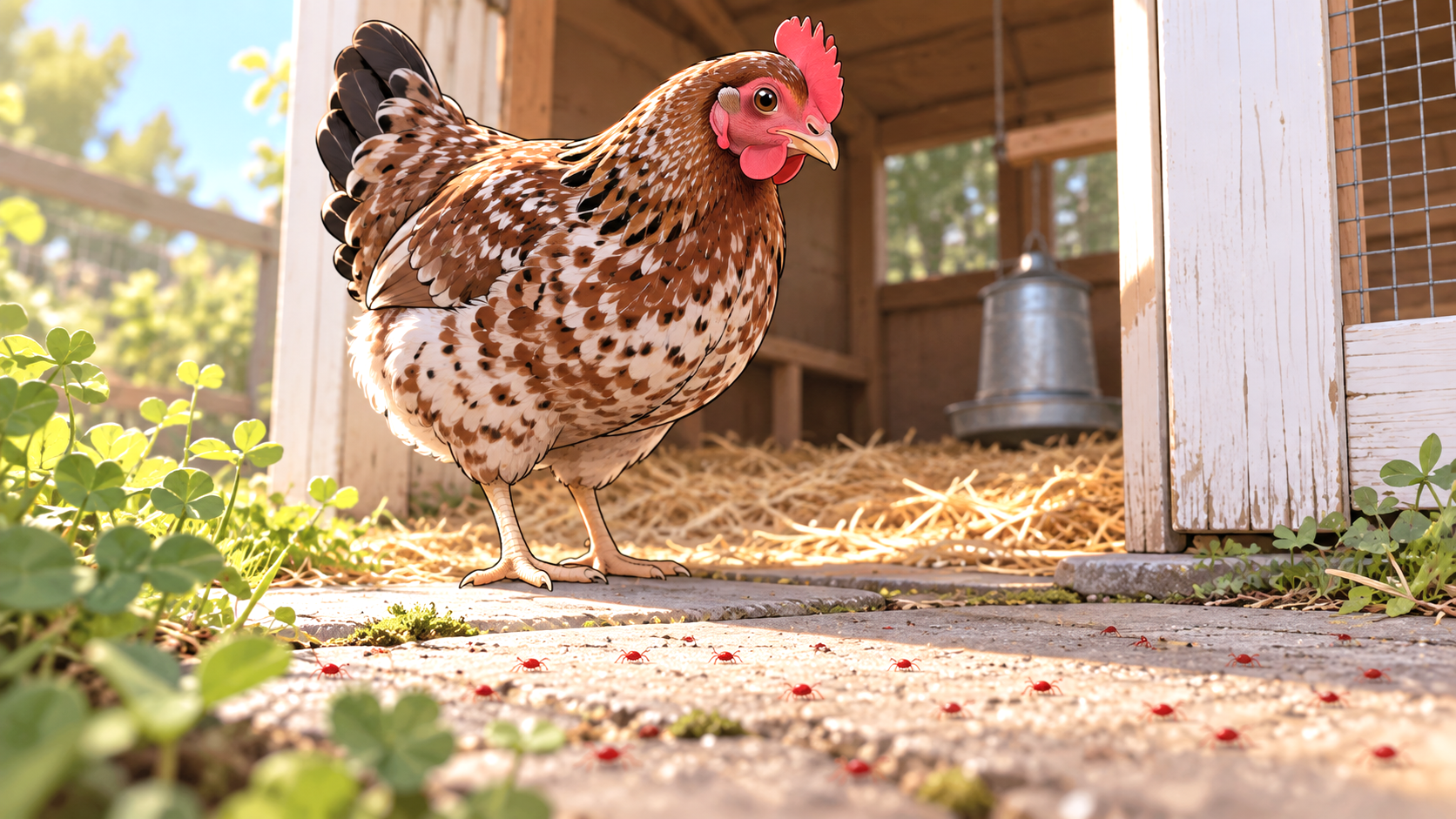
Red mites around a chicken coop deserve attention, but color alone does not tell you whether the birds are in danger. Clover mites are not known poultry parasites and are not considered harmful to chickens. They feed on plants rather than blood, skin, feathers, or other animal tissue. The mites that cause genuine poultry-health problems belong to different groups.
This makes identification especially important in a coop. Clover mites are tiny, reddish to brownish, and have an unusually long first pair of legs. They may wander across structures beside lawns and vegetation, so finding them on a coop wall, run, feeder exterior, or paving does not mean they are infesting the flock. Their plant-based diet gives them no reason to use a chicken as a host.
Red Mites on the Chicken May Be Something Else
A mite repeatedly found beneath feathers deserves more scrutiny than one crawling across the outside of the coop. Northern fowl mites are blood-feeding parasites that live on chickens, commonly concentrating around the vent. Poultry red mites also take blood but behave differently, hiding in cracks, nest boxes, roosts, and other protected parts of the poultry house during the day before feeding on birds at night. Heavy infestations of these poultry mites can reduce egg production and weight gain and can cause anemia or even death.
Those signs do not fit clover mites. A chicken with irritated or crusted skin, dirty vent feathers, feather loss, pallor, reduced production, or large numbers of mites among the feathers needs assessment for a genuine poultry parasite rather than treatment based on the assumption that every reddish mite is a clover mite. Even specialists may need close examination to identify tiny mites accurately, and bird mites can be difficult to distinguish without examining their physical characteristics and where they are living.
Coop Location Can Explain Clover Mites Without Implicating the Birds
A coop beside grass, weeds, or other vegetation can sit directly within clover mite habitat. Large outdoor populations sometimes move from plants onto nearby walls and other structures, producing conspicuous gatherings on wood, concrete, fencing, or equipment. Their presence may therefore follow the same outdoor movement that puts clover mites on concrete or brick and siding.
Look at where the mites actually concentrate. Mites scattered across sunny exterior surfaces beside vegetation fit a very different pattern from parasites embedded among feathers or gathering around the vent. Likewise, mites that disappear into roost joints and emerge to feed on chickens at night should not be dismissed as harmless clover mites simply because they look reddish. Poultry red mites characteristically hide in cracks and around roosting areas during daylight.
Do Not Treat Chickens for Clover Mites Without Confirming the Pest
An unnecessary mite treatment can expose birds, eggs, feed, bedding, and the person applying it to a pesticide without solving the actual source. Products used on poultry must be appropriate for the bird, parasite, application method, and food-production context. Some veterinary parasite treatments also involve withdrawal requirements or restrictions, while other drugs may require veterinary oversight.
Confirmed clover mites around a coop are better approached as an outdoor nuisance. If their numbers warrant control, address the outdoor clover mite population rather than applying a poultry-mite treatment to healthy birds. When the identification is uncertain or chickens show signs of parasitism, confirmation from a veterinarian, poultry specialist, or diagnostic service is more useful than choosing a treatment from mite color alone.
Chicken Related Questions About Clover Mites
Can clover mites live in chicken feathers?
A wandering clover mite could accidentally get onto feathers, but chickens are not its normal habitat or host. Persistent mites among the feathers suggest another identification should be considered.
Can chickens eat clover mites?
A chicken may peck at tiny arthropods while foraging, but clover mites are not recognized as poisonous organisms. Their broader toxicity classification does not identify them as a poisoning hazard.
Can clover mites infest chicken eggs?
They do not parasitize or reproduce on eggs. A wandering mite could crawl across an eggshell if outdoor populations reach the coop, while true northern fowl mite infestations can become heavy enough for mites to be found on eggs.
Are tiny red mites in the nesting box clover mites?
Possibly, but do not identify them by color alone. Poultry red mites can occupy nest boxes and other coop crevices, and northern fowl mites are important chicken parasites. Mites associated closely with the birds or their roosting areas deserve careful identification.