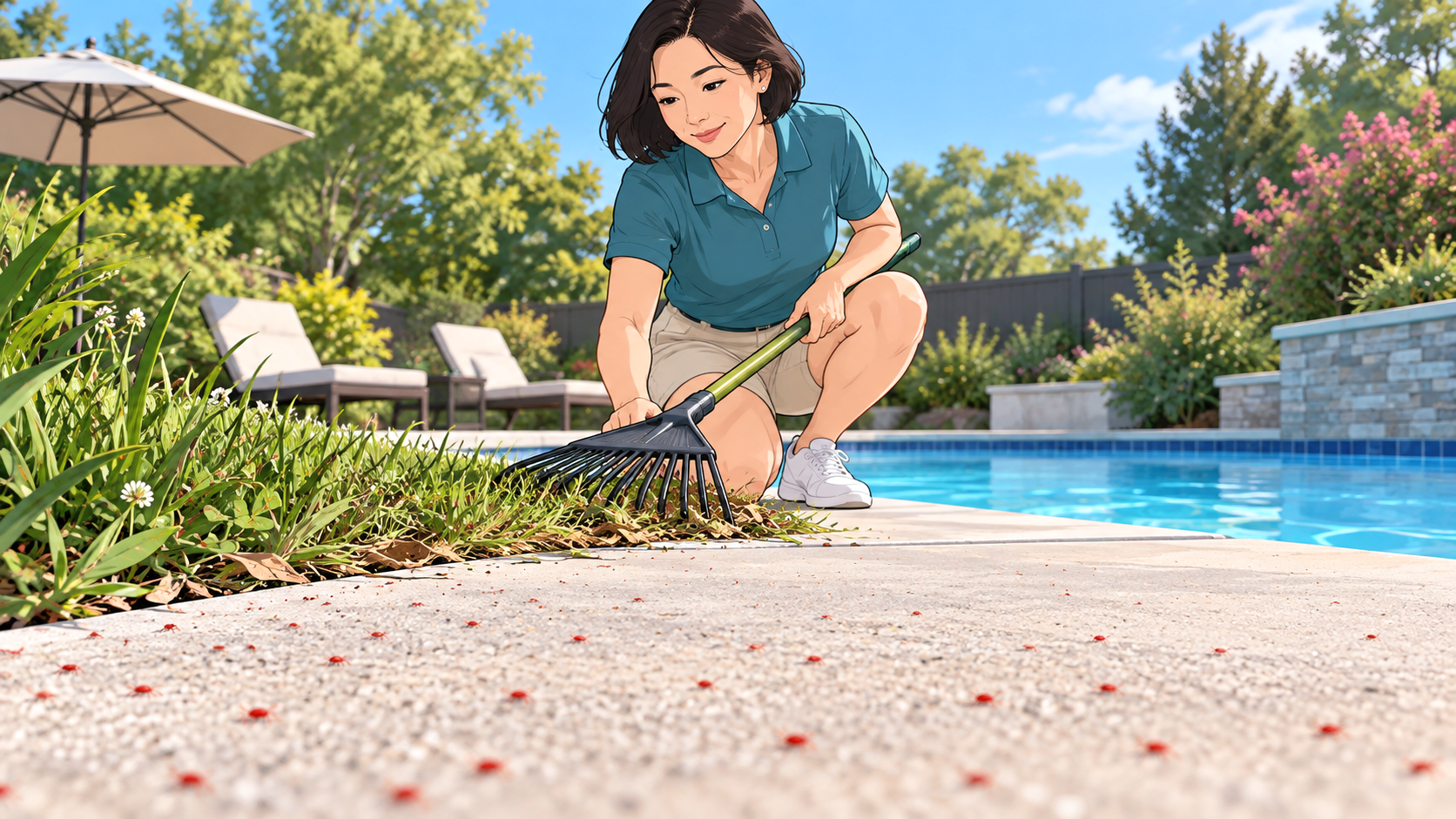
Clover mites around a swimming pool create an awkward cleanup problem because the easiest direction to sweep or rinse them may be straight into the water. A better approach is to remove mites from the deck while they are dry, work outward from the pool edge, and deal with nearby vegetation or cracks that keep supplying new mites. Avoid crushing them against pale coping, concrete, outdoor furniture, or towels because their body pigments can leave reddish stains.
For scattered mites, a handheld or shop vacuum gives you much more control than a hose. Vacuum the deck, coping, expansion joints, fence bases, furniture legs, and other dry surfaces where mites have accumulated. Clover mites are routinely recommended for vacuum removal because crushing can stain surfaces. If the pool surround is wet, wait for accessible areas to dry when practical rather than washing the mites toward the water.
Trace the Busy Side of the Pool
An infestation rarely distributes itself neatly around all four sides. Inspect the boundary where the greatest number of mites appears and look beyond the deck itself. Clover mites live outdoors and feed on grasses and herbaceous plants, with high populations particularly associated with lush or heavily fertilized vegetation. A pool deck bordered by lawn, groundcover, weeds, or planted beds can therefore receive mites directly from the landscaping. This is the same reason they become conspicuous on other hard surfaces, covered more fully in why clover mites appear on concrete.
Move portable planters away from the coping while you inspect beneath them, trim vegetation that sprawls across the deck edge, and remove plant debris lodged against joints. Clover mites also use protected cracks and crevices for molting and egg laying, including spaces around concrete and structures. A cluster repeatedly emerging from one expansion joint deserves attention at that joint rather than another cleaning of the entire pool surround. Where the mites are arriving from a larger lawn or landscape population, switch to the general outdoor clover mite control page rather than trying to solve a yard-wide source from the pool deck.
Keep Pesticides Out of the Pool
A swimming pool is a poor place for casual pesticide spraying. Never apply a product to the deck, coping, vegetation, or nearby cracks unless its current label permits the specific site and application. Pesticide labels carry legally enforceable directions, and current clover mite guidance likewise stresses using a product only where it is labeled for that particular treatment site.
Keep sprays, granules, dusts, and contaminated runoff out of the pool. Pesticide guidance specifically warns against contaminating streams, ponds, and other water, while EPA guidance emphasizes following label restrictions designed to limit pesticide movement beyond the treatment area. Do not assume that a chemical is suitable beside a swimming pool merely because it is labeled for clover mites somewhere else. Products intended for lawns, foundations, ornamental plants, or building perimeters can carry different site restrictions. Our clover mite insecticide guide covers pesticide choices without turning a poolside application into an improvised use.
Physical removal is therefore especially attractive at the water’s edge. It eliminates visible mites without creating pesticide drift, residues on frequently touched pool surfaces, or a route for treatment into the water. If a large infestation makes chemical control necessary, target the actual source area only when the product label permits it, rather than treating the pool surround simply because that is where the mites are easiest to see.
Stop Cleaning the Same Mites Twice
A freshly vacuumed deck that is covered again the next morning points to continued movement from somewhere nearby. Watch the edges before cleaning again. Mites consistently arriving from turf call for attention to the landscape border; activity concentrated along a retaining wall, foundation, or fence may follow that structure instead. Clover mite populations can become especially troublesome during their spring and fall activity periods, so a sudden seasonal appearance does not necessarily mean the pool itself has changed.
If the pool adjoins the house, also check doors and windows facing the deck. Clover mites readily crawl up structures and can enter through very small openings, turning a poolside population into an indoor nuisance. Seal appropriate gaps and repair worn weatherstripping before mites begin appearing inside. The full exclusion strategy belongs in preventing clover mites from entering your home.
Poolside Questions
What should you do with clover mites already floating in the pool?
Remove them with the pool’s skimmer or other normal debris-removal equipment. Do not add an insecticide to swimming-pool water to kill clover mites. Products used to control organisms in pool water are themselves regulated pesticides when they make pesticidal claims and must be used for their labeled purpose.
Can clover mites live in swimming-pool water?
No. Clover mites are terrestrial plant-feeding mites, not aquatic organisms. Individuals that fall into a pool have left the environment in which they normally feed and develop.
Should you spray clover mites hiding underneath pool furniture?
Vacuuming or physically removing them is preferable when practical. If pesticide treatment is considered, the label must specifically permit its use at that site and in that manner.
Why are clover mites only around one end of the pool?
Compare the surroundings at that end with the rest of the pool. Nearby turf, planting beds, cracks, walls, and other sheltered edges can produce a localized route onto the deck even when the remaining pool surround stays nearly mite-free.