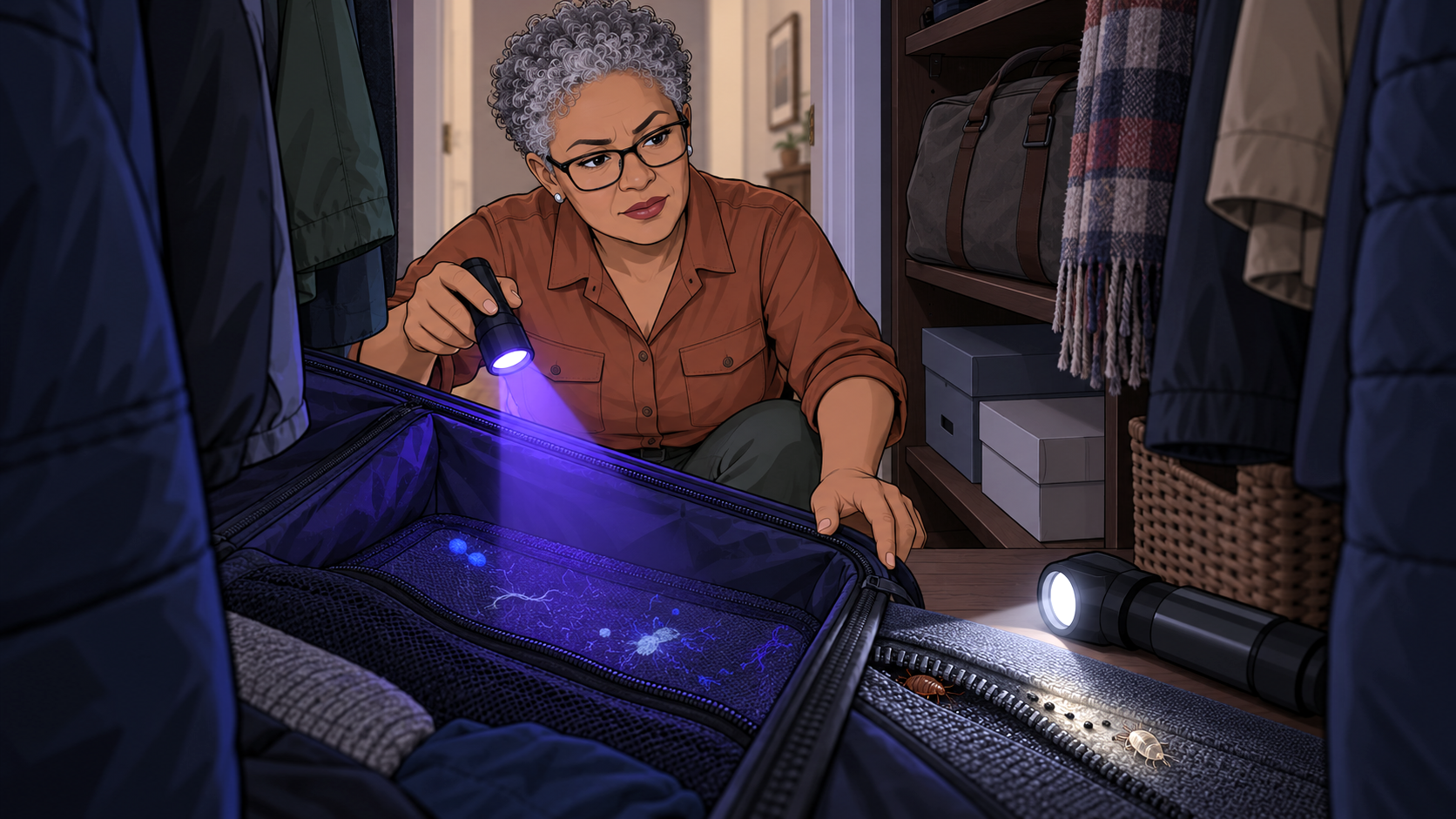
A black light can reveal some material produced by bed bugs that may be difficult or impossible to see under ordinary lighting, but it cannot reliably tell you that a glowing spot came from a bed bug. That makes UV light potentially useful as a supplementary inspection tool, not a dependable bed bug detector by itself.
The strongest evidence comes from peer-reviewed research on bed bug fecal deposits. Researchers discovered clear fecal spots that were invisible under ordinary lighting but became visible under ultraviolet light. What hasn’t been established nearly as well is the broader marketing claim that simply sweeping a UV flashlight across a bedroom will reliably reveal a bed bug infestation.
Some Bed Bug Fecal Spots Are Visible Under UV Light
There is direct research showing that ultraviolet light can reveal otherwise invisible bed bug fecal material.
A 2022 study published in the Journal of Medical Entomology measured the fecal deposits produced by different bed bug life stages after feeding. Researchers recorded dark spots, lighter visible spots and clear spots that could only be seen using ultraviolet light.
Those clear deposits weren’t rare in the experiment. Depending on life stage, they accounted for roughly 38.5% to 55.5% of the spots produced. For example, fifth-instar nymphs appeared to produce an average of 21 visible dark and light spots after a blood meal, but including the UV-visible clear spots increased the average to 44.7.
So it would no longer be accurate to say there is no peer-reviewed evidence connecting UV light with bed bug detection. There is evidence that UV can reveal some bed bug fecal deposits that ordinary visible-light inspection misses.
A Glowing Spot Still Doesn’t Confirm Bed Bugs
The limitation is specificity.
Showing that bed bugs produce material visible under UV light doesn’t establish that everything fluorescing on a mattress, carpet, or piece of furniture came from a bed bug. Household surfaces can contain many biological residues, cleaning products, fibers and other materials that react to ultraviolet light.
The 2022 study demonstrated that researchers could visualize otherwise clear bed bug fecal deposits under controlled conditions. It wasn’t a validation trial showing that consumers or pest professionals could walk into an unknown bedroom with a black light and accurately distinguish bed bug evidence from every other fluorescent material present.
That distinction matters. A UV flashlight may help locate a suspicious spot, but the glow itself shouldn’t be treated as confirmation of an infestation.
Can You See the Bed Bugs Themselves With a Black Light?
There isn’t similarly strong evidence establishing handheld UV illumination as a reliable method for locating live bed bugs themselves.
Bed bugs are visible to the naked eye. Adults are roughly 5 to 7 mm long, while nymphs are smaller and can be pale or translucent. Their habit of squeezing into narrow cracks, seams and other protected harborages is what makes them difficult to find.
The EPA recommends looking for live bugs, eggs and eggshells, shed skins, dark fecal spots and rusty or reddish stains. Around a bed, that means closely examining mattress piping, seams and tags, the box spring, bed frame and headboard before expanding the inspection to nearby furniture and cracks.
UV illumination doesn’t remove the need to physically expose and examine those hiding places.
A Regular Flashlight Is Still More Useful for General Inspection
For most people checking for bed bugs, a bright ordinary flashlight is the more practical primary lighting tool.
The EPA specifically says a flashlight can be useful when inspecting accommodations for bed bugs, while University of Minnesota guidance for pest management professionals includes a quality flashlight among the necessary tools for a detailed bed bug inspection.
A normal flashlight lets you see the things that matter directly: live bugs, pale eggs, shed skins, dark fecal spots and the narrow seams and crevices where these signs accumulate. It also doesn’t depend on interpreting fluorescence that may have another explanation.
A UV flashlight could be used alongside normal lighting if you already have one, particularly when examining surfaces for otherwise difficult-to-see deposits. It shouldn’t replace a regular flashlight during a bed bug inspection.
Where Should You Look for Bed Bugs?
The quality of the inspection matters more than whether the flashlight produces visible or ultraviolet light.
Start close to where people sleep or rest. Examine mattress seams, piping, labels and folds, followed by the box spring, bed frame and headboard. Look into screw holes, joints and narrow cracks rather than simply shining a light across exposed surfaces.
A careful mattress inspection is particularly important because early infestations can be difficult to locate. If evidence isn’t found there but suspicion remains, continue through nearby furniture, baseboards and other potential harborages using a systematic room-by-room bed bug inspection.
Finding an actual insect is especially useful because it can be collected and identified. A glowing mark under UV light can’t provide that level of confirmation.
UV Light Has Also Been Studied for a Different Reason
Some research involving UV and bed bugs has nothing to do with detecting them.
Experimental work has examined what prolonged ultraviolet exposure does to bed bug survival, development or behavior. That research shouldn’t be confused with evidence that a handheld UV flashlight can locate an infestation.
The intensity and duration of controlled experimental UV exposure are fundamentally different from briefly sweeping a consumer black light around a bedroom. Research into UV’s biological effects therefore doesn’t establish UV flashlights as either a reliable detector or a practical treatment.
For inspection, physical evidence remains the priority.
Questions About Black Lights and Bed Bugs
Do bed bug fecal spots show under UV light?
Some do. Peer-reviewed research found clear fecal deposits that were only visible under ultraviolet light. However, seeing fluorescent material doesn’t prove that the material came from bed bugs.
Can a black light confirm that you have bed bugs?
No. A UV light may reveal suspicious material, but confirmation should come from recognizable physical evidence such as an identified bed bug, eggs, shed skins or characteristic fecal evidence considered alongside other signs.
Should you buy a UV flashlight specifically to find bed bugs?
It isn’t necessary for a standard inspection. A good ordinary flashlight, careful inspection technique and appropriate monitoring tools have more established roles. The most useful bed bug inspection tools can help when an infestation is difficult to locate.
Will UV light kill bed bugs?
Don’t rely on a handheld UV flashlight as a bed bug treatment. Experimental UV exposure research shouldn’t be translated into a household treatment recommendation without evidence that the required exposure can be delivered safely and effectively.