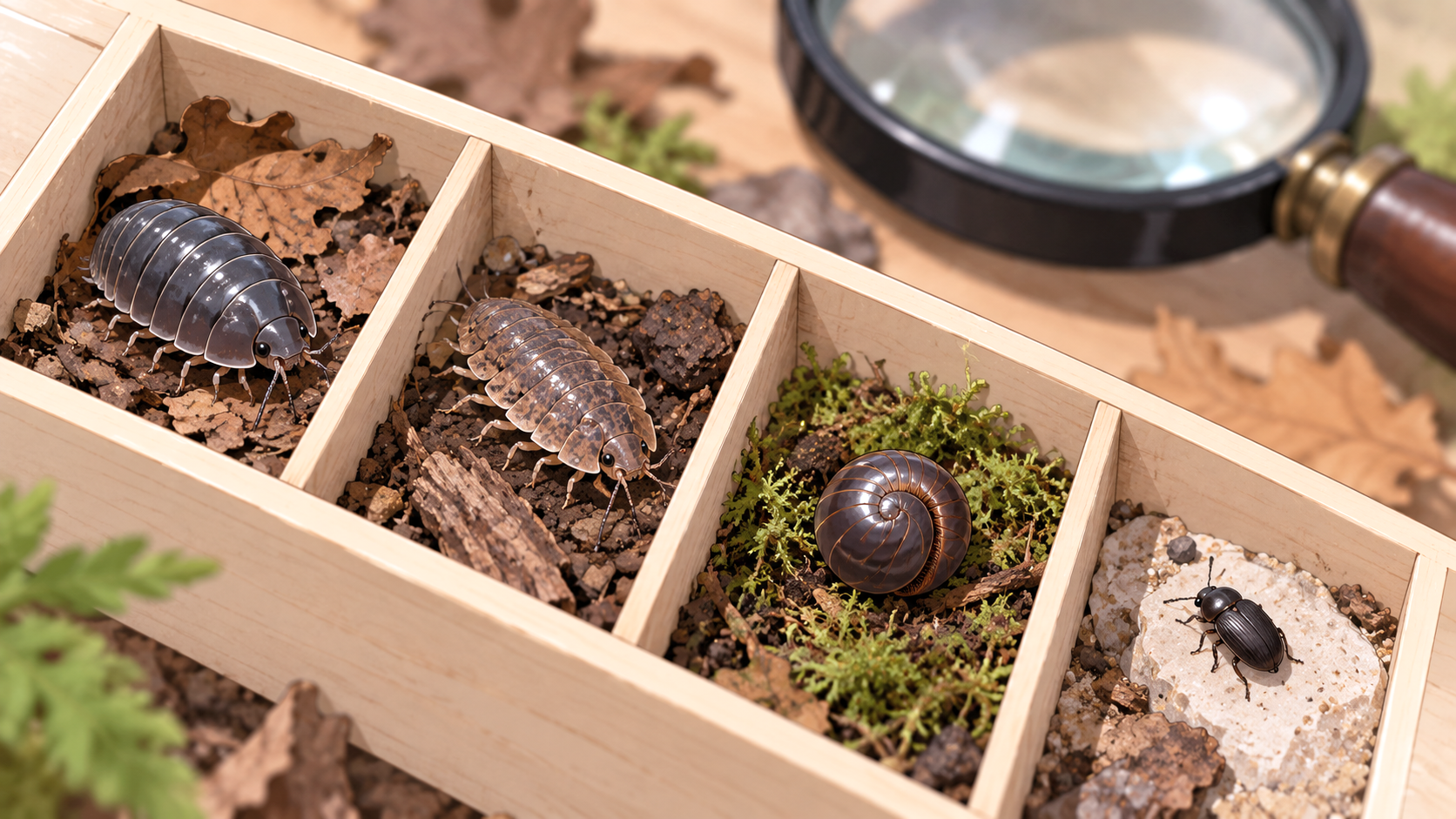
Several small ground-dwelling arthropods can be mistaken for roly-polies, especially sowbugs, pill millipedes and compact beetles. Dark cockroach nymphs can also cause confusion indoors. The fastest checks are leg arrangement, body plates, antennae, rear appendages and whether the animal forms a genuinely enclosed ball rather than simply curling or retracting its legs. Some confusing names create a different problem. “Woodlouse” can include roly-polies themselves, while “potato bug” and “doodlebug” have different meanings depending on region. A name alone may therefore tell you less than the animal’s anatomy.
Sowbugs Are Usually the Closest Match
Sowbugs and roly-polies share the same basic terrestrial-isopod body plan. Both are small crustaceans with seven pairs of walking legs, segmented dorsal armor and a preference for humid shelters. They can even occur together beneath the same logs, stones or mulch. The easiest field marks appear at the rear and in the animal’s defensive response: typical sowbugs have two conspicuous tail-like uropods and cannot close themselves into the tight sphere formed by many pillbugs. Government pest-identification guidance similarly separates the two because sowbugs have projecting rear appendages and cannot roll into a tight ball.
A sowbug also tends to look flatter than the strongly arched pillbug form. Color contributes little because gray and brown occur widely among terrestrial isopods. When the specimen is intact, the combination of a flatter profile, projecting uropods and failure to form a complete ball provides a stronger identification than shade or size. The finer differences between a roly-poly and a sowbug become useful when a specimen has the unmistakable isopod body but its common name remains uncertain.
Pill Millipedes Can Fool the Rolling Test
Pill millipedes create a more surprising resemblance. Unlike the long, cylindrical millipedes most people recognize, members of several millipede groups have compact armored bodies and can roll into a ball. Complete conglobation has evolved independently in pill millipedes and pill woodlice, so seeing an animal curl into a sphere does not automatically establish that it is a roly-poly.
The underside provides better evidence. An adult roly-poly has seven pairs of walking legs, while pill millipedes have many more. Their dorsal armor is organized differently as well, with some species having a conspicuously enlarged shield near the front and a large terminal plate. The leg and plate differences between roly-polies and millipedes become especially valuable when both animals are already rolled and their overall silhouettes look nearly identical.
Pill Beetles Can Resemble Tiny Armored Pebbles
Pill beetles in the family Byrrhidae are compact insects that can pull their appendages into recesses beneath the body. Once retracted, the beetle becomes a rounded capsule resembling a seed, pebble or miniature pillbug. The family name reflects this defensive posture: disturbed pill beetles retract their legs and other appendages to form a compact “pill”.
An uncurled specimen reveals the difference quickly. A beetle has six legs rather than the 14 walking legs of an adult roly-poly, and its hardened forewings meet along a central line down the back. A pillbug instead shows a succession of broad transverse plates. Pill beetles are also genuine insects in the order Coleoptera, whereas roly-polies are terrestrial isopod crustaceans.
Some pill beetles overlap roly-polies in habitat as well as shape. Byrrhidae occur beneath logs and stones, among grass roots and in mossy environments, and many species feed on mosses or related plant material. Habitat alone is consequently weak evidence when the animal is small and rounded.
Dark Cockroach Nymphs Look Less Similar Once They Start Moving
A small wingless cockroach nymph can be mistaken for a roly-poly in a dim basement, bathroom or other ground-level room, particularly when someone sees only a dark oval shape disappearing beneath an object. Cockroach nymphs are flattened rather than strongly domed and have six conspicuous running legs, very long antennae and no series of pillbug-like armored plates. Wood cockroach nymphs, for example, are described as wingless, reddish brown to dark brown juveniles with the characteristic flattened cockroach form.
Movement often exposes the mistake before close examination does. Cockroaches have long, splayed legs suited to rapid running. A roly-poly moves on numerous short legs tucked beneath its body and may respond to disturbance by drawing itself into a defensive ball. Cockroaches cannot perform that enclosed form of conglobation.
Where the animal appears can add context without proving its identity. Roly-polies that wander into houses from moist outdoor habitat commonly appear around foundations, basements and other damp areas. Cockroach species have their own habitat preferences, so an indoor dark-brown specimen still needs to be identified from anatomy rather than location alone.
Bed Bugs Are a Common Indoor Misidentification, but the Body Is Very Different
Bed bugs can enter the conversation whenever an unidentified brown arthropod appears indoors, even though their anatomy differs substantially from a roly-poly. Bed bugs are six-legged, wingless insects with an oval body flattened from top to bottom. Adults are brown to reddish after feeding, while young nymphs can be much paler. Their six-legged flattened body and associated infestation signs provide much stronger evidence than brown coloration alone.
A roly-poly has a convex armored back and seven pairs of walking legs. It also does not produce the bed-associated evidence expected from a blood-feeding infestation. When a specimen comes from a mattress, headboard or sleeping area, physical evidence such as fecal spots, shed bed bug skins and eggs deserves examination alongside the insect itself. The differences between roly-polies and bed bugs are usually obvious once an intact specimen can be viewed closely.
“Potato Bug” Might Mean a Roly-Poly or Something Completely Different
“Potato bug” is not a dependable identification. The name has been applied to pillbugs and sowbugs as well as Jerusalem crickets and Colorado potato beetles. A person using the term may therefore be describing a roly-poly rather than an animal that merely resembles one. Identification guidance for Jerusalem crickets specifically notes that “potato bug” is applied to several unrelated invertebrates.
A Jerusalem cricket is difficult to confuse with a pillbug once clearly seen. It is a large, stout insect with six robust legs, a conspicuous rounded head and a banded abdomen rather than a small oval body covered by overlapping plates. Colorado potato beetles are also six-legged insects with hardened wing covers. Asking what the animal looked like is more useful than trying to resolve the meaning of “potato bug” from the name itself.
“Doodlebug” Has the Same Common-Name Problem
In much of North America, doodlebug refers to an antlion larva. These larvae are six-legged insects with flattened heads and conspicuous sickle-shaped jaws, and many species construct cone-shaped traps in loose sand. Government field references describe larval antlions as plump, flattened predators with six legs and large curved pincers. They bear little resemblance to a roly-poly when examined closely.
Regional speech can use “doodlebug” differently, including for pillbugs. Hearing that someone found a doodlebug therefore does not establish that the specimen is an antlion. A sandy pit and large jaws support antlion identification; an armored body with seven pairs of legs supports a terrestrial isopod.
Use Structure Before Color or Common Names
Start with the legs when an unknown animal is intact. Six legs point toward an insect such as a beetle, cockroach or antlion. Seven pairs fit the adult terrestrial-isopod body plan. Numerous pairs extending beneath multiple trunk rings point toward a millipede. Then examine the dorsal armor, antennae and rear of the body.
Rolling can narrow the possibilities but cannot finish every identification because pill millipedes and a few beetles also use ball-like defensive postures. Color is even less dependable because roly-polies naturally occur in several colors and patterns, while unrelated arthropods overlap those shades. A clear photograph from above and another showing the side or underside will usually preserve more useful identification evidence than a description such as “small gray bug.”
Questions About Roly-Poly Lookalikes
Can a beetle roll into a ball like a roly-poly?
Some beetles can produce a convincing ball-like shape, although they accomplish it differently. Pill beetles retract their appendages, while pill scarab beetles have evolved unusually complete curling mechanisms. They remain six-legged insects rather than isopods.
Is every woodlouse a sowbug?
No. Woodlouse is a broad common name for terrestrial isopods and can include both pillbugs and sowbugs. It should not automatically be treated as the name of a third animal competing with the other two.
Can two different roly-poly species look like separate kinds of bugs?
Yes. Size, surface texture, body proportions and coloration vary among terrestrial isopods, so unfamiliar individuals may appear unrelated at first glance. Several different species occur among animals commonly called roly-polies.
What if a photograph is too blurry to count the legs?
Use several independent clues rather than enlarging pixels until details become artificial. Overall body shape, visible plates, antenna length, rear projections, movement, rolling behavior and the place where the specimen was found can narrow the possibilities. An intact specimen or sharper photograph may still be necessary for species-level identification.