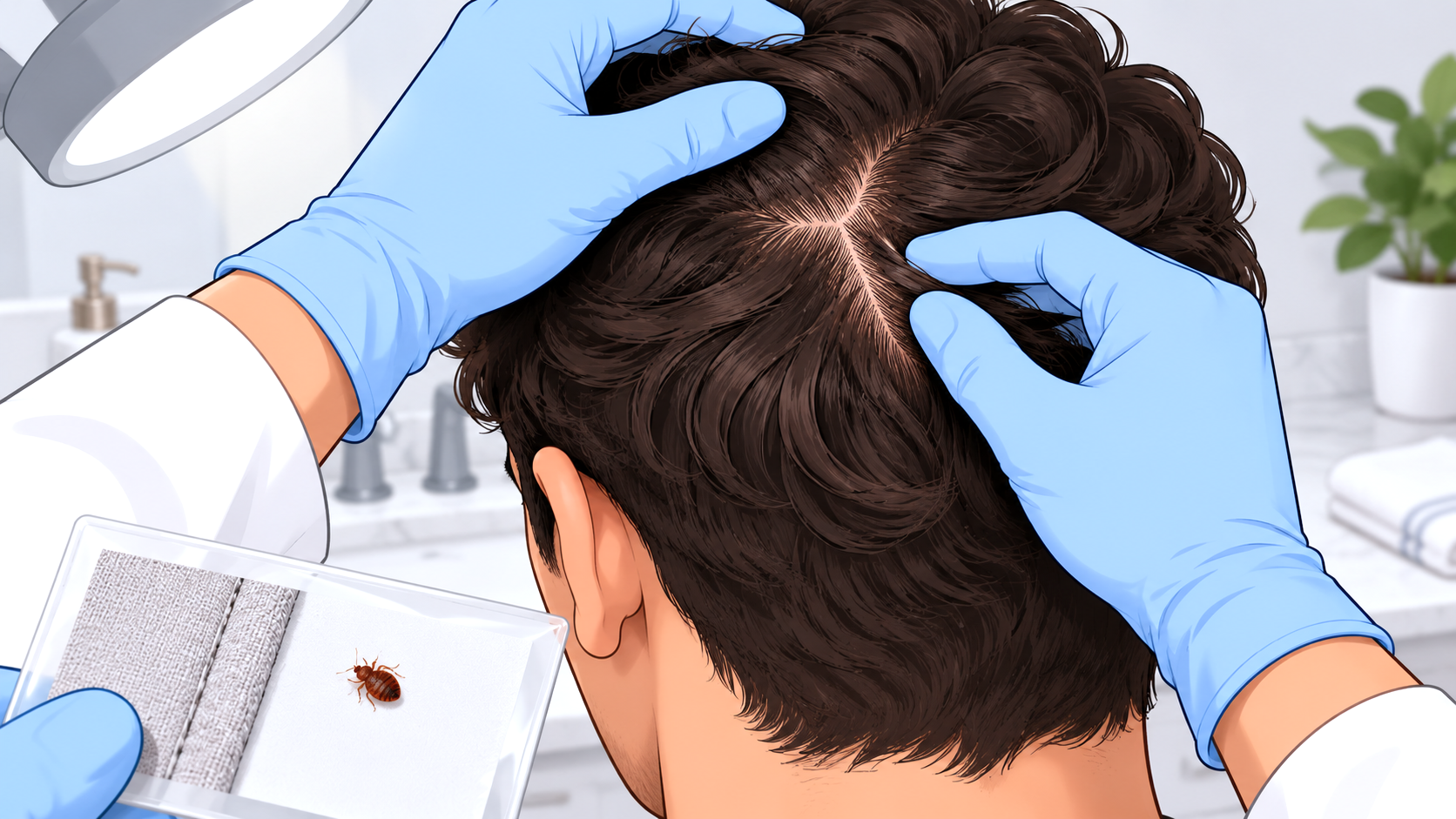
Finding a small insect in your hair after sleeping in a hotel can raise immediate concerns about bed bugs. However, bed bugs do not normally live in human hair or lay their eggs on hair strands. Unlike head lice, they are temporary blood feeders that spend most of their time hidden in the surrounding environment, emerging to feed before returning to shelter. An individual bed bug could accidentally crawl into someone’s hair, particularly during close contact with infested bedding. That brief encounter is different from establishing an infestation on the scalp. Bed bugs lack the specialized claws and attachment behavior that allow head lice to remain among hair strands.
Why Bed Bugs Don’t Stay in Human Hair
The common bed bug, Cimex lectularius, has a broad, flattened body and six legs suited to walking across surfaces and entering narrow hiding places. Its flat, oval body structure allows it to squeeze into mattress seams, bed frames, and furniture joints, where it remains sheltered between blood meals.
Head lice have a different relationship with their hosts. Their legs end in specialized claws that grasp individual hairs, allowing them to remain on the scalp while feeding and moving between strands. Bed bugs lack those adaptations and do not need to maintain continuous contact with a human host to survive.
The differences between lice and bed bugs extend to their feeding and reproduction. Head lice spend their lives closely associated with human hair, whereas bed bugs typically leave their hiding places only when seeking a blood meal or moving between harborages.
An accidental bed bug encounter in hair is possible, especially when someone is lying against infested pillows or furniture. However, the insect is not adapted to remain attached to the hair, and finding one there does not establish that others are living on the person’s head.
Can a Female Bed Bug Lay Eggs on Hair Strands?
Female bed bugs attach their eggs to sheltered surfaces using an adhesive secretion. The eggs are small, whitish, and approximately one millimeter long, making them difficult to notice without careful inspection.
Their usual egg-laying locations include cracks, seams, and other protected surfaces near areas where hosts regularly rest. These locations provide stable shelter for developing eggs and newly hatched nymphs. Hair strands are not a normal egg-laying substrate. Although a female bed bug could theoretically deposit an egg on an unusual surface, there is no evidence that human hair supports the established egg-laying behavior seen in head lice.
Head lice deliberately attach their eggs, called nits, to individual hair shafts close to the scalp. The attachment and positioning of head lice eggs are therefore useful identification features. A tiny pale object firmly attached to a hair strand is more suggestive of a nit than a bed bug egg, although dandruff, hair products, and other debris can also become trapped in hair. The appearance of actual bed bug eggs differs from ordinary scalp debris, and appearance alone may not always establish what a small white object is.
What If You Find a Bug Crawling Through Your Hair?
Finding a live insect among hair strands does not automatically mean it is a head louse. A bed bug, flea, or another small insect might become temporarily caught in someone’s hair.
The insect’s anatomy offers more dependable evidence than its location. Adult bed bugs are generally broader and flatter, with oval, segmented bodies, while adult head lice are smaller and more elongated, with conspicuous legs adapted for grasping hair.
Head lice are usually around 2–3 millimeters long as adults, whereas adult bed bugs commonly measure approximately 5–7 millimeters before feeding. Juvenile bed bugs are smaller, so size alone cannot identify every specimen.
The visible differences in bed bug development and body shape may help distinguish an immature bed bug from an adult louse. A clear photograph or an intact specimen is more useful than trying to identify a moving insect from memory.
If head lice are suspected, a fine-toothed lice comb can help locate live insects. Finding an adult louse or nymph is stronger evidence of an infestation than scalp itching alone. A healthcare professional can assist when identification remains uncertain.
Can Bed Bugs Bite Your Scalp or Hairline?
Bed bugs can bite exposed skin around the forehead, temples, ears, hairline, and neck. Their mouthparts pierce skin to obtain blood, so the presence of nearby hair does not prevent feeding when accessible skin is available. The scalp beneath dense hair is less accessible than exposed skin, but a bite there is possible. Bed bugs do not need to establish residence in the hair to feed near it.
However, an itchy scalp or a cluster of bumps near the hairline cannot reliably distinguish head lice from bed bug bites. Individual reactions to bed bug feeding vary, and some people develop no visible bite marks at all.
Head lice frequently cause scalp itching, particularly around the ears and back of the neck, but similar discomfort can arise from skin irritation and other conditions. The appearance of bed bug bites is not sufficiently distinctive to confirm an infestation without additional evidence. Persistent scalp irritation warrants attention to the scalp itself rather than assuming that an insect found elsewhere in the bedroom caused it.
What About Wigs, Hair Extensions, and Hair Accessories?
A wig, hair extension, scarf, or hair accessory left near an active bed bug infestation could occasionally provide temporary shelter for a wandering insect. Fabric seams, attachment points, and folds offer more plausible hiding spaces than individual hair strands.
The same possibility exists with other personal belongings. Bed bugs can be transported inadvertently in luggage, clothing, and folded fabrics, particularly when those items remain near occupied sleeping areas.
A wig containing a stray bed bug is not evidence that bed bugs reproduce in artificial hair. An insect discovered in an accessory should be identified before deciding whether the item requires any action.
Hair extensions attached to the scalp also do not turn someone’s hair into a normal bed bug habitat. However, removable hairpieces stored on infested furniture should be considered among the belongings that may have been exposed.
Should You Use Bed Bug Spray or Lice Shampoo on Your Hair?
Neither product should be used simply because bed bugs are suspected near the head. Household bed bug insecticides are not scalp treatments. Applying them directly to hair or skin can create unnecessary chemical exposure and may violate the product’s labeling instructions.
Head lice medications are formulated for treating lice infestations, not for eliminating bed bugs from a sleeping environment. Using them without confirming head lice offers no reliable solution to a suspected bed bug problem.
If an insect is found in your hair, remove it without crushing it if possible, preserve it in a sealed container, and seek identification when necessary. Ordinary hair washing may remove incidental debris or a stray insect, but it will not eliminate bed bugs hiding elsewhere in a room.
Where Should You Look if You Suspect Bed Bugs After Sleeping?
The most useful evidence will generally be in the places where bed bugs conceal themselves between meals. Examine the sleeping area for live insects, shed skins, pale eggs, and dark fecal spotting rather than focusing exclusively on your hair.
The seams and folds of a mattress are important inspection points, along with the bed frame, headboard, box spring, and furniture immediately surrounding the bed.
Physical signs are more dependable than unexplained skin irritation. The combination of dark spots, cast skins, and live insects can help establish whether an infestation is present, whereas bites alone may resemble numerous other skin reactions.
If the concern began during travel, examine belongings that were placed near the bed or on upholstered furniture before unpacking them at home. If evidence of bed bugs is found, address the exposed belongings and sleeping environment rather than treating the scalp.