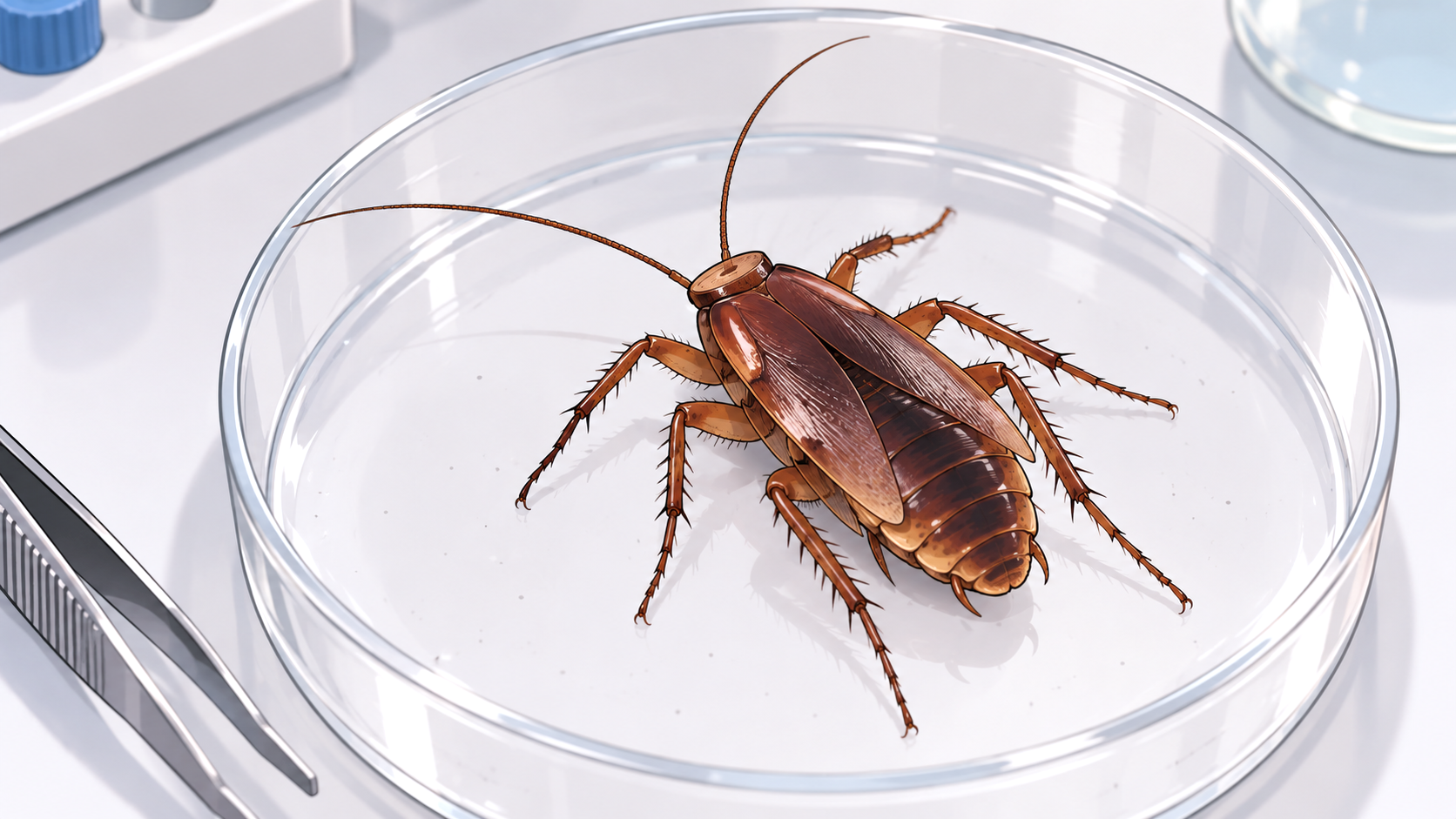
A cockroach can remain alive without its head for days and, under favorable laboratory conditions, some have survived for several weeks. Decapitation is not immediately fatal because cockroaches breathe through body openings rather than the mouth, have low-pressure open circulation, and retain nerve centers outside the brain. Eventually, the headless insect dies.
The familiar claim sounds more supernatural than the physiology actually is. Losing the head removes major sensory organs, the mouthparts, the brain, and important hormonal control. What remains is not a normally functioning cockroach. It is a severely impaired body whose respiratory, circulatory, and some nervous functions can continue independently for a surprising length of time.
Losing the Head Does Not Cause Catastrophic Blood Loss
Decapitation is rapidly fatal to a mammal partly because severed blood vessels produce massive blood loss and a collapse in blood pressure. Cockroach circulation works differently. Their internal fluid, called hemolymph, circulates through an open system rather than remaining inside the extensive closed network of arteries, veins, and capillaries found in humans.
Pressure within this system is much lower. After decapitation, the opening at the neck can clot and seal instead of producing the uncontrolled bleeding expected from a major mammalian injury. Experiments on American cockroaches have consequently been able to maintain decapitated individuals for physiological research rather than having the insects die immediately from fluid loss.
The broader anatomy of a cockroach differs from vertebrate anatomy in several ways that make this possible. Removing the head is still catastrophic damage, but it does not simultaneously destroy every system required to keep the remaining tissues alive.
A Headless Cockroach Can Still Breathe
The cockroach’s respiratory system provides another major part of the explanation. Air does not have to enter through its head. Insects exchange gases through spiracles, external openings connected to a branching network of tracheal tubes that carries gases through the body.
Cockroach respiratory research has directly observed spiracles opening and closing during ventilation. The head is therefore not equivalent to the nose, mouth, lungs, and respiratory control center of a human combined.
Decapitation does alter respiratory regulation without stopping gas exchange altogether. Experiments with Nauphoeta cinerea found that decapitated cockroaches continued discontinuous cycles of gas exchange. Neural pattern generators in the thoracic and abdominal ganglia could maintain the cycle without the cephalic ganglion, although regulation became less precise.
The result is counterintuitive but straightforward: removing a cockroach’s head does not remove the openings through which most of its body obtains oxygen.
Much of the Nervous System Remains in the Body
A cockroach does have a brain, but nervous control is distributed more widely than the popular headless-cockroach story sometimes suggests. Its central nervous system includes paired nerve cords and a series of ganglia extending through the thorax and abdomen. These local concentrations of neurons can participate in sensory processing and motor control without every signal first being routed through the brain.
Experimental decapitation demonstrates how much remains operational. Headless cockroaches exposed to stimuli have produced directionally appropriate escape turns, although movement of the front and middle legs was impaired compared with normal animals. Other experiments found that decapitated cockroaches could produce rhythmic motor-neuron activity but walked slowly and with poor coordination.
Movement after decapitation therefore does not mean the body is behaving normally or that the brain was unnecessary. The brain’s removal eliminates descending neural input while leaving some circuitry farther down the body intact. Reflexes and limited coordinated movements can persist because the entire nervous system was never located inside the head in the first place.
Several Weeks Is Possible, but It Is Not a Fixed Survival Time
The often-repeated statement that a headless cockroach “lives for weeks” needs a qualification. It describes what can happen under suitable conditions, not a timer that starts at decapitation. In laboratory observations of American cockroaches, specimens whose wounds were sealed to reduce drying survived for several weeks.
Conditions surrounding the injury strongly affect survival. Species, hydration before decapitation, humidity, wound condition, infection, temperature, and access to stored energy can all influence how long the body continues functioning. A severely dehydrated cockroach on a dry floor and a carefully prepared laboratory specimen are not equivalent cases.
Even an intact cockroach’s longevity changes with environmental conditions, so a precise universal number for a decapitated insect would be misleading. The normal lifespan of a cockroach belongs to a functioning animal capable of feeding, drinking, sensing its surroundings, and regulating its behavior. Headless survival is an abnormal physiological endurance period, not an extension of ordinary life.
Water Loss Becomes a Major Limitation
Decapitation interferes with the cockroach’s ability to regulate water balance. Experiments on American cockroaches found that fully hydrated individuals initially lost water considerably faster after decapitation. Earlier work also measured accelerated water loss following removal of the head and found evidence that hormonal factors originating in the brain and associated structures help regulate water loss through the body surface.
A headless cockroach also loses the ordinary means of seeking and consuming water. Cockroaches normally depend on environmental moisture, and access to water strongly affects cockroach survival. Stored body water can sustain tissues temporarily, but it cannot be replenished through normal drinking after the mouth and associated sensory structures are gone.
This combination helps explain why dehydration is frequently associated with the eventual death of a decapitated cockroach. Starvation can contribute as stored resources are exhausted, but loss of water can become limiting sooner under dry conditions.
The Body Can Function, but It Cannot Live Normally
Survival after decapitation is sometimes described as though a headless cockroach simply continues its usual routine. Its actual capabilities are much narrower. It has lost its eyes, antennae, brain, mouthparts, and substantial sensory and neuroendocrine control. Normal feeding is no longer possible even though digestive tissues remain in the body.
The remaining nervous system can still produce some reflexive and motor responses. Researchers have even used decapitated American cockroaches in assays where stimulation of the body produced a scratch reflex. Such responses demonstrate functioning neural circuits, not normal awareness or normal behavior.
Energy demand also differs from that of a warm-blooded animal. Cockroaches are ectotherms, so they do not continually burn large quantities of energy to maintain a constant high body temperature. Their ability to withstand extended food deprivation further delays the point at which lack of feeding becomes fatal. Research on American cockroaches has examined animals subjected to four weeks of starvation, illustrating how prolonged food deprivation can be tolerated under experimental conditions. What cockroaches normally eat becomes irrelevant to a decapitated individual because it no longer has a functional head with which to find and consume that food.
The Severed Head Does Not Immediately Become Biologically Inert Either
Decapitation creates two pieces containing living tissues rather than an instantly dead head attached to a living body. Antennae and other structures on an isolated head can continue responding for a period while remaining cells have sufficient energy and physiological conditions permit activity.
The head, however, has lost the large body that normally supplies it with circulating hemolymph, nutrients, sensory input, and physiological support. Its persistence is consequently much more limited unless researchers artificially maintain the tissue. The unusual survival of both portions reflects how insect organs and neural circuits can retain function temporarily after their normal connections have been severed.
This experimental phenomenon is one reason cockroaches have been useful models in neuroscience. Researchers can study parts of the nervous system separately, including the abdominal nerve cord and associated neural circuits, while keeping those tissues physiologically active.
Questions About Headless Cockroaches
Can a cockroach grow its head back?
No. A decapitated adult cockroach cannot regenerate an entire replacement head. Cockroaches can repair some injuries and immature individuals have regenerative abilities associated with later molts, but complete adult head regeneration is not part of their biology.
Can a headless cockroach reproduce?
Decapitation disrupts important neural and hormonal regulation, so surviving without a head should not be confused with retaining normal reproductive function. Experiments have found substantial hormonal changes in decapitated female cockroaches, including altered circulating ecdysteroid levels.
Does a headless cockroach know where it is going?
Its movement is greatly impaired. Neural circuits outside the head can still generate reflexes and portions of locomotor behavior, but the animal has lost major sensory organs and brain input needed for normal navigation and coordinated behavior.
Will crushing a cockroach’s head always stop movement immediately?
Not necessarily. Residual activity and locally controlled reflexes can continue after catastrophic injury because neural circuits remain elsewhere in the body. Movement alone is therefore not reliable evidence that an injured cockroach remains capable of normal behavior.