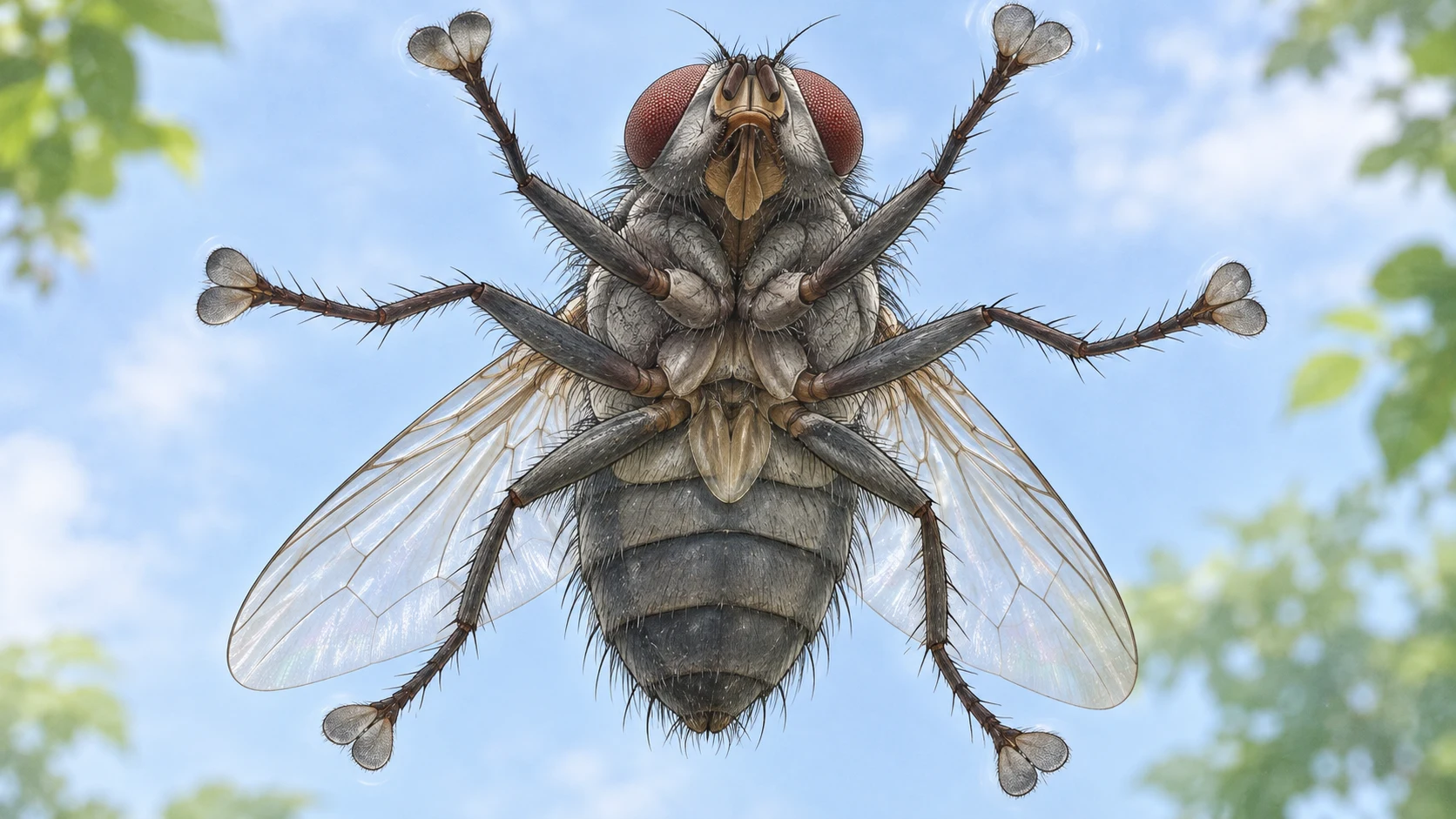
House flies (Musca domestica) can walk upside down on ceilings and across smooth glass because their feet have specialized adhesive pads and tiny gripping claws. The pads, called pulvilli, contain dense coverings of microscopic hairs that help them cling to smooth surfaces. A thin secretion released by these hairs strengthens the attachment, while the claws provide additional grip on surfaces with small irregularities.
How Do House Flies Stick to Smooth Glass?
The secret to a house fly’s ability to walk across glass lies in the paired adhesive pads at the ends of its feet. These soft structures are called pulvilli, and each is covered with numerous microscopic hairs known as setae.
The hairs are flexible and have tiny flattened tips that make close contact with the surface underneath them. Their arrangement allows the pads to follow small variations in the surface, even when the glass appears perfectly smooth to the human eye.
The setae also produce a small amount of liquid secretion. This fluid helps the hair tips adhere to the surface through capillary forces, alongside other intermolecular attractions. Together, these forces create enough grip to support the fly while it moves.
Microscopic examination of fly footprints on glass has provided direct evidence of this adhesive action. Measurements of individual hair tips also show that the secretion contributes substantially to the strength of attachment. The research examining adhesion forces in the microscopic hairs of fly feet demonstrates how these tiny contact points hold an insect against a smooth surface.
The same basic attachment system explains how the common house fly can remain attached to a vertical pane of glass without sliding down. Its specialized foot structures provide the contact needed to maintain its grip as it moves.
What Do the Tiny Claws on a House Fly’s Feet Do?
House flies also have small, curved claws that help them maintain contact with surfaces. These structures provide a different type of grip from the adhesive pulvilli.
On rough materials, the claws can catch against microscopic bumps, cracks and irregularities. The insect can use these points of contact to prevent slipping as it moves across the surface.
Smooth glass presents a different challenge because it offers fewer large irregularities for the claws to engage. The adhesive pads therefore contribute more to maintaining contact.
The two structures work together, allowing the fly to move across surfaces with different textures. The claws provide mechanical gripping points where irregularities are available, while the pulvilli generate adhesion through their microscopic hairs and surface secretion.
A detailed explanation of how common houseflies cling to glass and other smooth surfaces describes both mechanisms and why the apparent smoothness of a surface does not prevent insects from attaching to it.
How Can a House Fly Walk Upside Down on a Ceiling?
Walking on a ceiling requires the fly to maintain enough attachment force to support its body against gravity. Its adhesive pads provide that grip, allowing it to move without falling as it changes which feet support its weight.
Landing upside down is an especially interesting maneuver. A house fly does not simply fly straight toward a ceiling and abruptly turn its body over. High-speed recordings of Musca domestica show a coordinated sequence of movements that brings the insect into contact with the inverted surface.
The landing process involves an initial upward movement, rapid body rotation and extension of the legs toward the ceiling. Once the front feet establish contact, the fly uses them as a pivot while swinging the rest of its body into position. The remaining feet then make contact with the ceiling, completing the landing.
The experimental study of house fly landings on vertical and inverted surfaces documents this sequence using high-speed cameras. It also shows that the fly adjusts its approach according to its movement toward the landing surface.
The adhesive pads help stabilize the fly when its feet first touch the ceiling. The ability to establish a firm grip during this brief landing maneuver allows the insect to finish its rotation without falling.
Visual information also contributes to the maneuver. The fly uses its surroundings to coordinate its approach and prepare its legs for contact. Its visual system helps explain how it responds to the ceiling’s position while approaching it.
How Do House Flies Keep Their Grip While Walking?
Once attached to a ceiling, a house fly must repeatedly attach and release its feet as it walks. Each movement requires the insect to transfer its weight without losing its overall hold on the surface.
The pulvilli press against the ceiling during contact. Their microscopic hairs spread across the surface, allowing the secretion to establish adhesive contact. When the fly moves a foot forward, it adjusts the position of the attachment structures so they can separate from the surface.
High-speed observations of fly walking have revealed that the claws spread apart as the adhesive pads are pressed against a smooth surface. The pads also change position during detachment, allowing the fly to release its grip without remaining stuck.
This is a controlled attachment process rather than a permanent bond. The insect repeatedly forms and releases contact as it progresses across the ceiling.
The research on tarsal movements during fly attachment and detachment examines these movements on smooth surfaces and explains how flies manage both parts of the process. The coordination between sensory information and movement also involves the house fly nervous system.
Why Don’t House Flies Fall When They Move Between Surfaces?
The adhesive system maintains contact while the fly changes its position, but the insect must also coordinate its movements with the surface it is approaching.
For example, moving from a wall onto a ceiling changes the direction of gravity relative to the surface. The fly must adjust its attachment and posture while maintaining enough contact to support itself.
The pads provide adhesion during these changes, while the claws help secure contact where the surface has suitable irregularities. The fly’s ability to respond to changing visual information and coordinate its movements is also relevant to its rapid escape and reflex responses.
A 2019 investigation of inverted landings showed that successful ceiling contact involves several coordinated movements rather than one simple attachment action. The fly’s body swing and final foot placement help distribute its weight across the available contact points.
Can House Flies Walk on All Types of Glass?
House flies can walk across ordinary glass because their adhesive pads can establish close contact with the surface. The glass does not need to be visibly rough for the microscopic hairs to maintain adhesion.
However, the effectiveness of attachment depends on the condition of the contact surface. The microscopic hairs need sufficient contact with the underlying material, and their secretion contributes to the forces holding the fly in place.
Glass is particularly suitable for demonstrating the adhesive system because its surface is relatively smooth. On rougher materials, the claws can provide additional mechanical grip.
These different attachment methods explain how house flies can move between walls, ceilings and glass without relying on one identical gripping action for every surface.
The Science Behind a Fly Walking on Your Ceiling
A house fly’s ability to walk upside down comes from the combination of microscopic adhesive hairs, surface secretion and small gripping claws. Its ceiling landings also involve coordinated movements that establish contact before the insect settles into its upside-down position.
The familiar sight of a fly walking across a ceiling is therefore the result of several specialized adaptations working together. The same system allows it to cling to glass and move across surfaces that would otherwise offer little obvious grip.