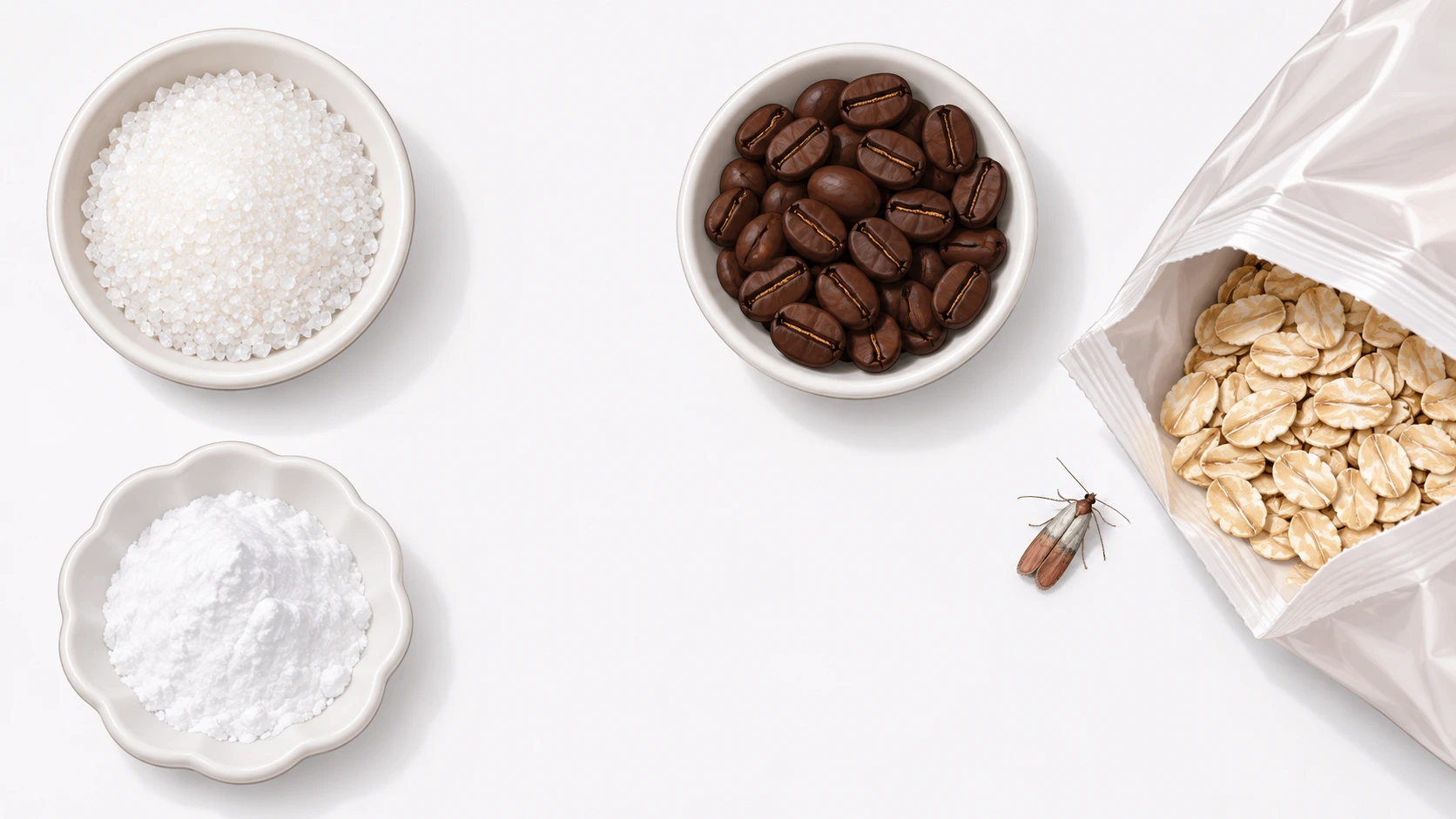
Indian meal moths can respond to sugar, but plain sugar is not a typical breeding food. Coffee is not a well-established food source for their larvae, and baking soda is neither a suitable food nor a proven way to kill them. Finding a moth in any of these three products does not automatically mean it has been feeding there.
The difference matters because Indian meal moths (Plodia interpunctella) are often discovered while someone is opening kitchen containers. A small moth inside a sugar jar, webbing around a coffee-can lid, or a caterpillar crawling through spilled baking soda can make the product itself look responsible. The insect may simply have entered the container or passed through it.
There is also a biological difference between being attracted to a substance and being able to complete development on it. Indian meal moth larvae respond to certain sugars during feeding, yet they need more than sugar to grow into healthy adults.
We would not treat sugar, coffee, and baking soda as equally attractive or equally vulnerable. Each product presents a different question.
Sugar, Coffee, and Baking Soda: What Is the Difference?
The three products have very different relationships with Indian meal moths.
| Product | Do Indian meal moth larvae feed on it? | Can moths be found in it? | Does it work as bait or a remedy? |
|---|---|---|---|
| Plain white sugar | Sugar stimulates larval feeding, but pure sugar is not an established complete food source | Yes, especially through accidental entry or contamination | Sugar-based baits may interest some adults, but are not a dependable infestation solution |
| Coffee beans or ground coffee | Coffee is not a routinely documented breeding food for this species | Yes, but presence alone does not prove feeding | Coffee grounds are not an established Indian meal moth repellent or killer |
| Baking soda | No established role as a suitable larval food | Yes, through incidental entry or movement | No reliable evidence supports it as an effective treatment |
The strongest evidence concerns sugar and larval feeding behavior. Coffee requires more caution because it is easy to confuse it with cocoa, which is a documented food associated with Indian meal moth infestations. Baking soda is the clearest case: it should not be relied upon either as food-based bait or as a control method.
Do Indian Meal Moths Eat Sugar?
Indian meal moth larvae respond positively to several sugars, including sucrose, which is the main ingredient in ordinary table sugar. That makes it inaccurate to say sugar has no appeal to them.
Experiments examining the feeding behavior of Indian meal moth larvae found that sucrose, glucose, fructose, and several other carbohydrates acted as strong feeding stimulants. These substances encouraged feeding responses when presented under controlled experimental conditions.
But a feeding stimulant is not necessarily a complete diet.
Indian meal moth larvae need suitable nutrition to develop through their caterpillar stages and eventually become adults. Their normal stored-food hosts supply a mixture of nutrients rather than carbohydrates alone. A jar containing nothing but refined white sugar should therefore not be treated as equivalent to a package of grain-based food.
This explains an apparent contradiction. The insect can respond to sugar during feeding without plain sugar being a typical material in which a household infestation develops.
Can Indian Meal Moths Infest a Bag of White Sugar?
A moth or larva can end up inside a bag of white sugar, but that does not prove the insect developed by eating the sugar.
A bag with a loose fold, damaged seam, or open top can admit wandering insects. A mature Indian meal moth larva may also move away from its original feeding material before forming a cocoon. These movements can place insects in locations that do not provide suitable food.
The packaging itself deserves attention. If there is webbing around the folded paper at the top of a sugar bag, check whether it is attached to the outside packaging rather than running through the sugar crystals.
The silk webbing produced by Indian meal moth larvae is useful evidence, but its location matters. Silk on a bag seam can be associated with an insect resting or pupating there. Silk and feeding damage throughout a food product provide a different kind of evidence.
If larvae or webbing are actually inside the sugar, discard the affected product rather than attempting to sift it clean. Food contamination is a separate issue from whether sugar supported the insect’s growth.
What About Brown Sugar and Powdered Sugar?
Brown sugar contains sucrose along with molasses, while powdered sugar generally contains finely ground sugar and a small amount of an anti-caking ingredient, commonly cornstarch.
Those differences should not be stretched into claims that either product is a preferred Indian meal moth food.
Brown sugar has a different moisture content and composition from white granulated sugar, but that alone does not establish that Indian meal moth larvae develop successfully on it. Powdered sugar may contain starch, yet the small amount ordinarily present does not make it equivalent to a nutritious grain-based product.
A finding of insects or silk in either type of sugar deserves the same practical response: treat visible contamination seriously, but do not assume the sugar was the original breeding material.
Are Indian Meal Moths Attracted to Sugar Water or Sugar Baits?
Sugar-based liquids may interest some adult Indian meal moths, but they are not a reliable substitute for identifying an infestation.
The distinction between adults and larvae becomes particularly important here. Adult Indian meal moths generally do not feed as a regular part of their short adult lives. Nevertheless, observations have recorded adults showing interest in fruit juice and sugar baits. The species’ documented adult behavior includes this exception without establishing sugar water as an effective household control system.
An adult approaching a sugary liquid does not prove that it is feeding normally, and a few adults appearing around a homemade bait would not establish that the bait attracts the entire population.
Sugar water also has obvious limitations. It cannot draw larvae out of sealed food packages, destroy eggs, or identify which material originally supported an infestation.
For these reasons, we would not leave bowls of sugar water around a pantry expecting them to solve an Indian meal moth problem. They create sticky food residues while leaving the damaging life stage unaddressed.
Do Indian Meal Moths Eat Coffee Beans or Ground Coffee?
Coffee beans and ground coffee are not among the routinely documented food sources for Indian meal moth larvae. Finding an insect in a coffee container therefore requires more evidence before concluding that it has been feeding or breeding there.
Coffee is a plant-derived product, so it is understandable to wonder whether a pantry moth would eat it. But the fact that an insect feeds on certain dry plant materials does not establish that it can develop on every dried plant product.
The distinction is especially relevant because coffee and cocoa are different commodities. Indian meal moths are associated with cocoa, chocolate, and confectionery products. The Canadian Grain Commission’s description of affected commodities specifically includes cocoa and chocolate.
That evidence cannot be transferred to roasted coffee beans or ground coffee. Cocoa being susceptible does not prove coffee is susceptible in the same way.
A moth sitting on a coffee bag, a caterpillar beneath a coffee-can lid, or silk caught in the packaging fold is insufficient evidence that the insect completed its development on the coffee itself.
Can Indian Meal Moths Live in a Container of Coffee?
An adult may enter an open coffee container, and a wandering larva may shelter in a lid or packaging seam. Either situation can happen without the coffee serving as food.
Consider a tightly closed jar of ground coffee. A moth found on the outside of its lid has not shown that it can penetrate the seal or live on the coffee grounds. Even an insect discovered inside after the jar has been opened does not establish how long it was present or what it was eating.
You need stronger evidence to connect the coffee itself to development, such as multiple feeding larvae actively established within the product, feeding-related silk distributed through it, and signs that the insects are progressing through their life stages.
Those observations would justify investigating the product carefully rather than dismissing it because coffee is not a common host.
Still, an isolated insect in a coffee container is not proof of a coffee-fed infestation.
Can Indian Meal Moths Infest Instant Coffee?
Instant coffee is not an established preferred larval food for Indian meal moths.
Plain instant coffee consists largely of soluble coffee solids. It should not be treated the same as a sweetened instant coffee mix, flavored powder, or coffee drink mix containing other ingredients.
When a packaged product combines several ingredients, the commercial name on the front is less informative than its contents. Finding a larva in a sweetened drink powder does not tell you which component, if any, supported its feeding.
A container holding only plain instant coffee presents a different question from a packet containing sugar, milk powder, and flavorings.
The practical point is to avoid assuming that every coffee-labeled product has the same pest susceptibility.
Do Coffee Grounds Repel Indian Meal Moths?
Coffee grounds are sometimes suggested as a natural pest deterrent, but there is no established basis for relying on them to repel or eliminate Indian meal moths.
The suggestion often rests on the idea that coffee’s strong smell will drive insects away. An odor being noticeable to humans does not establish that it repels this particular moth, much less that it stops egg laying or larval development.
Fresh grounds, used grounds, and brewed coffee also differ in composition and moisture. Results or claims involving one preparation cannot automatically be applied to another.
Scattering used coffee grounds in a pantry creates an additional problem. Damp organic material can retain moisture, produce odors, and encourage mold growth if left in enclosed storage spaces.
There is no good reason to add that material to food-storage shelves when the objective is to keep those spaces clean and dry.
Will Putting Coffee Beans in a Cupboard Keep Moths Away?
A bowl of coffee beans is not a dependable Indian meal moth deterrent.
Even if moths show little interest in the coffee itself, that does not mean its presence prevents them from reaching another item. A product can be unattractive as food without functioning as a repellent.
Those are separate properties, and the second cannot be inferred from the first.
Do Indian Meal Moths Eat Baking Soda?
Baking soda is not a suitable food for Indian meal moth larvae. It is sodium bicarbonate, a mineral compound used in baking and cleaning rather than a nutrient-rich stored food.
Unlike sugar, it does not supply carbohydrates that would stimulate and support normal larval feeding. It also lacks the mixture of nutrients larvae require to develop.
A moth or caterpillar found in a baking soda box is therefore more plausibly explained by incidental entry, movement, or sheltering than by sustained feeding on the powder.
The packaging can contribute to the confusion. Baking soda is commonly sold in cardboard boxes, sometimes with a tear-open spout. Once opened, such packaging may provide folds and sheltered edges where a small insect can rest.
Finding a cocoon in the corner of the box would not demonstrate that the larva ate baking soda. Mature larvae are capable of leaving the material where they fed and crawling elsewhere to pupate.
The movement of Indian meal moth larvae before pupation helps explain why they can appear in unexpected locations.
Does Baking Soda Kill Indian Meal Moths?
Baking soda is not a proven treatment for Indian meal moth eggs, larvae, pupae, or adults.
Household advice sometimes claims that baking soda kills insects by drying them out, damaging their digestive systems, or causing gas to build up after ingestion. Those explanations should not be treated as established Indian meal moth biology.
There is no reliable, species-specific basis for recommending ordinary baking soda as an effective insecticide for this pest.
Dusting pantry shelves with baking soda also misses the main target. Indian meal moth larvae generally develop in infested stored products, not as exposed insects waiting on a clean shelf. A powder spread across the cupboard will not reliably reach eggs and larvae protected inside packages.
More importantly, the presence of baking soda does not replace the steps that are known to address infestations. Removing contaminated material, cleaning up residues, and using secure storage are supported approaches to managing pantry pests.
We would not recommend coating pantry shelves, food packages, or container openings with baking soda to control Indian meal moths.
Does Baking Soda and Sugar Work as an Indian Meal Moth Bait?
Mixing sugar and baking soda does not turn either ingredient into a verified Indian meal moth control product.
The claim assumes that sugar will cause the insect to ingest baking soda and that ingestion will kill it. For Indian meal moths, neither the killing mechanism nor the practical effectiveness of such a mixture has been established.
Sugar can stimulate larval feeding in controlled experiments, but this finding does not prove that larvae would consume a household sugar-and-baking-soda mixture in lethal quantities.
The mixture also cannot reach developing insects inside an inaccessible food package simply by sitting nearby.
A bait recipe should not be considered effective merely because one ingredient is palatable and the other is widely claimed to kill household pests.
What Does Finding a Moth in One of These Products Actually Mean?
An insect’s location and its food source are not always the same. This is particularly true for Indian meal moths because adults can fly away from the material in which they developed, and mature larvae can crawl away before pupating.
That mobility creates three different situations that can look similar during a quick inspection.
A moth may be resting on the outside of a sugar jar. A caterpillar may have entered a loose coffee-bag fold while looking for somewhere to pupate. Or a product may contain feeding larvae and silk distributed throughout its contents.
Only the last situation provides strong evidence that the product itself is involved in an infestation, and even then the insect’s identity and the material’s composition matter.
Use the following distinctions when assessing what you have found.
| Observation | Most useful interpretation | Appropriate response |
|---|---|---|
| One adult on the outside of a sugar jar | Adult presence, not proof of sugar feeding | Identify the moth and check for actual product contamination |
| A larva beneath a coffee-can lid | Possible incidental entry or sheltering | Examine the lid, seal, and coffee for further evidence |
| A cocoon in a baking soda box flap | Possible pupation site rather than feeding site | Remove the insect and inspect the condition of the opened package |
| Several larvae and silk distributed through a product | Stronger evidence of infestation or contamination | Discard the affected product and identify the insect |
| Loose webbing on a package’s outer seam | May reflect movement or sheltering outside the contents | Inspect the seam and verify whether the contents are affected |
The assessment should be based on the evidence present, not on whether the product sounds appealing to a moth.
For details on confirming that the insect is the correct species, adult Indian meal moth identification is more useful than the product in which the insect happened to appear.
Should You Throw Away Sugar, Coffee, or Baking Soda After Finding a Moth?
Whether a product should be discarded depends on what the insect has contacted and whether there is evidence of contamination.
If an adult moth is resting on the outside of a sealed sugar jar, the contents are not automatically compromised. Clean the outside of the container and check that the lid closes properly.
If larvae, webbing, droppings, or dead insects are inside an open bag of sugar or coffee, discarding that product is the safer choice. The same applies to baking soda intended for cooking when insects or their residues have contaminated the contents.
We would not try to make contaminated sugar or coffee usable again by sifting it. Removing visible insects does not necessarily remove silk, shed skins, droppings, or other residues.
A baking soda box contaminated by moths should not be reused for food preparation. Replacing an ordinary opened box is simpler than attempting to separate insect debris from the powder.
These decisions concern food cleanliness, not whether the insects were capable of obtaining nutrition from the product. A food product can be contaminated even when it was never a suitable breeding material.
How Should You Store These Products to Keep Indian Meal Moths Out?
Use containers with well-fitting lids for sugar and coffee, especially after their original packaging has been opened. Glass, metal, and sturdy food-grade plastic containers help limit incidental entry and protect the contents from contamination.
Baking soda intended for cooking can also be kept in a clean, sealed container. This prevents insects and pantry debris from entering an open cardboard box.
Check package folds and lids before transferring products. An insect tucked into a seam can otherwise be moved along with the package, creating the impression that it was living in the contents.
Good storage protects food even when a particular product is not a preferred Indian meal moth host. It also makes later inspection easier because a clean, transparent container shows contamination more readily than a folded paper bag.
If an active infestation has already been established, changing containers alone will not resolve it. The complete Indian meal moth removal process must address the infested material itself.
Frequently Asked Questions
Do Indian Meal Moths Prefer Sugar Over Flour?
Sugar can stimulate larval feeding, but that does not establish that Indian meal moths prefer a jar of pure sugar over flour. The two materials differ considerably in nutritional composition. Flour is a recognized larval food, while refined sugar alone is not a typical documented breeding medium.
Are Indian Meal Moths Attracted to the Smell of Coffee?
There is no established evidence that coffee odor is a dependable attractant for Indian meal moths. Finding an adult near a coffee maker or a coffee bag does not show that the aroma drew it there.
Can Indian Meal Moths Lay Eggs in Coffee Grounds?
An adult female might deposit eggs on a surface that ultimately proves unsuitable, but egg presence would not establish successful larval development. Coffee grounds are not a routinely documented breeding medium for this species, so finding eggs or suspected eggs would call for careful identification rather than an assumption about the diet.
Is Baking Soda Poisonous to Indian Meal Moths?
Baking soda should not be described as a proven poison for Indian meal moths. Its ordinary household use and chemical properties do not establish that it kills this species under realistic pantry conditions.
Will Sugar Attract Indian Meal Moths Into a Trap?
Sugar-containing baits may interest some adults, but sugar does not reliably attract and capture an Indian meal moth population. A positive feeding response by larvae also cannot be treated as proof that adults will respond in the same way.
Are Coffee Grounds Better Than Baking Soda for Keeping Pantry Moths Away?
Neither is an established Indian meal moth repellent. Coffee grounds add unnecessary organic material to pantry shelves, while baking soda does not provide proven protection. Clean storage surfaces and tightly closed containers are more dependable preventive measures.
The Bottom Line
Indian meal moths have a more complicated relationship with sugar than with coffee or baking soda. Sugar stimulates larval feeding, but pure refined sugar is not a typical complete breeding food. Coffee is not a routinely documented larval food, and its relationship with the insect should not be confused with the well-established susceptibility of cocoa and chocolate. Baking soda is not a suitable food or a proven moth killer.
An insect appearing in any of these containers may be passing through, resting, or pupating rather than feeding on the contents.
What matters most is the evidence inside the product. An adult on a jar lid is different from larvae and silk distributed through the material. Use that evidence to decide whether a product is contaminated, and do not rely on sugar bait, coffee grounds, or baking soda to solve an Indian meal moth infestation.