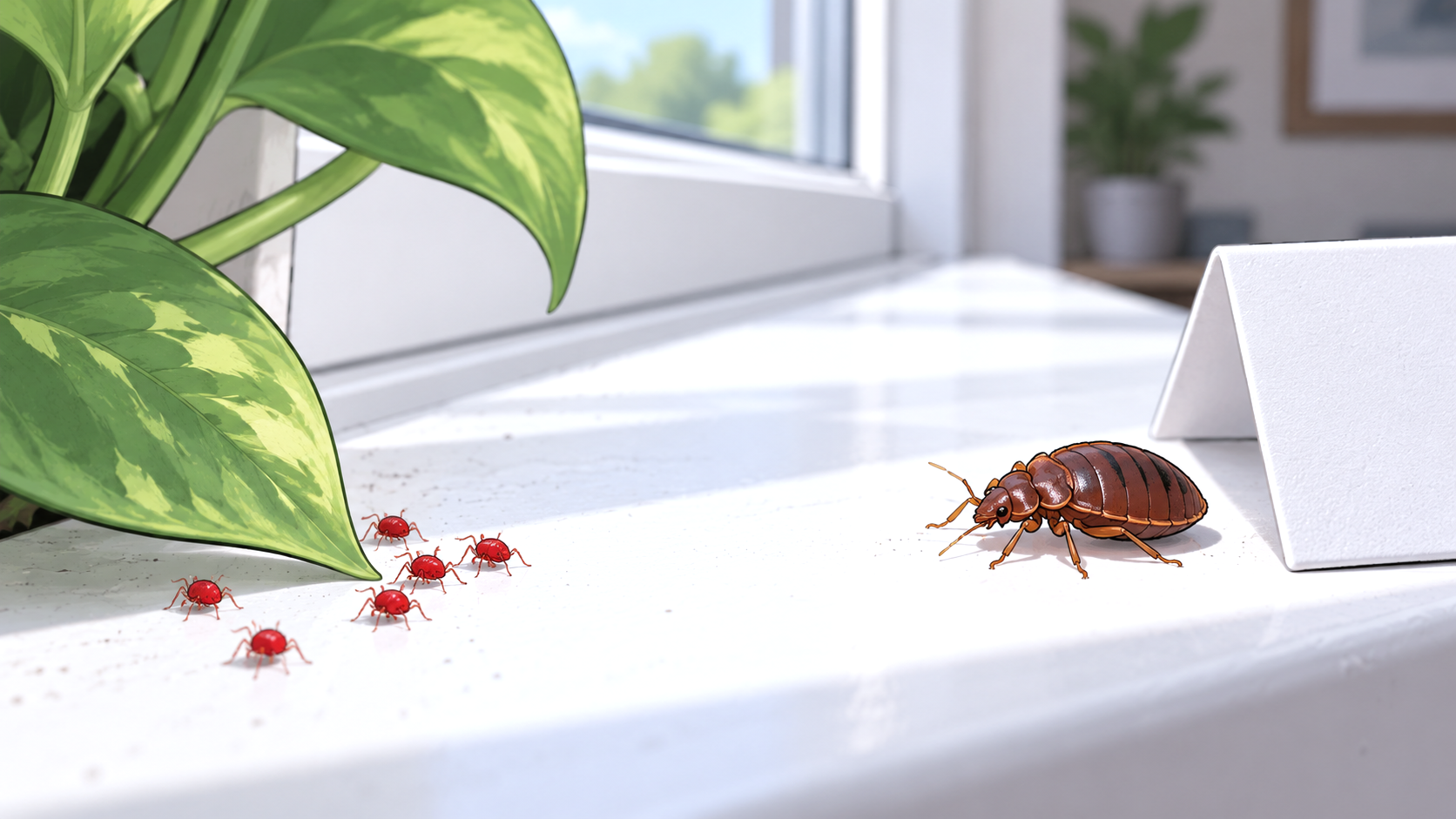
Crush a clover mite on a light-colored wall and the reddish stain can look suspiciously like blood. It isn’t. That color comes from the mite itself, and this tiny arachnid has never needed a blood meal.
Clover mites and bed bugs are completely different pests. Clover mites are tiny plant-feeding arachnids that do not bite people or pets, while bed bugs are insects that feed on blood. Clover mites are also much smaller, have unusually long front legs, and cannot establish a reproducing population inside a home. The reddish smear is one reason the two can cause confusion, but their appearance and behavior quickly separate them once you know what to check.
Clover Mite vs Bed Bug Identification
An adult clover mite is only about 0.75 mm long. At that size, it can look more like a moving reddish dot than an animal with recognizable body parts unless you use magnification.
Bed bugs are considerably larger. Adults are visible to the naked eye and have broad, flattened, oval bodies when unfed. Even young bed bugs have the recognizable body structure of an insect rather than the tiny, mite-like appearance of a clover mite.
One of the easiest clover mite features to recognize under magnification is its front pair of legs. They are approximately as long as the body and nearly twice as long as the other legs. Because they project forward, people sometimes mistake them for antennae.
They are still legs. Clover mites are arachnids related to spiders and ticks and have no antennae.
Bed bugs are insects and have six legs plus a genuine pair of antennae.
The Red Clover Mite Stain Isn’t Blood
The stain is probably the most misleading similarity between these pests.
Crushing a clover mite can leave a conspicuous red-brown mark on walls, curtains, carpets, paper and other light surfaces. However, the red material is the mite’s body pigment rather than blood. Clover mites do not blood-feed.
They obtain their food from plants, particularly grasses and clover, although they can feed on other vegetation as well. Large populations are frequently associated with vigorous lawns, especially heavily fertilized grass growing close to a building.
A recently fed bed bug is different. Bed bugs consume blood, and crushing an engorged one can release material from its recent blood meal.
So a red smear alone does not tell you that you crushed a bed bug.
Clover Mites Don’t Bite People or Pets
There is no bite comparison to make between these two pests.
Clover mites do not bite people or pets. They also do not feed on skin, blood, stored food, clothing or household furnishings.
Bed bugs depend on blood meals and readily feed on people.
That gives you a useful diagnostic distinction. Finding tiny reddish mites around windows at the same time someone has unexplained skin irritation does not make the mites the cause. The skin problem needs to be considered separately rather than automatically attributed to whatever small arthropod happens to be visible nearby.
Likewise, bite-like marks alone are not enough to diagnose bed bugs. Confirming whether you actually have bed bugs requires looking for the insects or other convincing evidence of an infestation.
Clover Mites Come Indoors but Don’t Establish Indoor Infestations
Seeing hundreds of clover mites inside can make the problem look more serious than it is. Clover mites are accidental invaders. They commonly enter through tiny openings around windows, doors and other exterior gaps, particularly during spring and fall.
They can appear in enormous numbers. That does not mean they are reproducing throughout the house.
Once indoors, clover mites do not reproduce and perish within a short period. They need the outdoor plant resources their normal life cycle depends on. Bed bugs have no comparable limitation. A bedroom provides them with sheltered harborages and access to a blood source, allowing an infestation to remain entirely indoors and continue reproducing.
Where you find the pest can therefore provide another clue. Numerous tiny red mites concentrated around windows and exterior entry points fit clover mite behavior far better than bed bug behavior.
Clover Mites Reproduce Without Males
Clover mite reproduction is unusual enough to explain how outdoor populations can become enormous.
Females reproduce through parthenogenesis, producing viable eggs without mating. No males are known in the species, and the resulting offspring are genetically identical to their mothers.
Females deposit bright red eggs in protected, relatively dry locations such as cracks and crevices. The mites pass through larval, protonymph and deutonymph stages before becoming adults.
Their activity also follows a seasonal pattern. Populations are generally most active during the moderate temperatures of spring and fall and become inactive during temperature extremes.
Bed bugs reproduce sexually and follow a completely different life cycle, so this is another area where the resemblance ends with both pests simply being small household arthropods.
Clover Mite Control Usually Starts Outside
An indoor clover mite problem is largely an entry problem.
Vacuuming is one of the simplest ways to remove mites that have already entered. It also avoids the reddish stains that can result from crushing them against walls or fabric.
Longer-term control focuses on the exterior. Sealing cracks around windows, doors and foundations reduces entry points, while changing the vegetation immediately against the building can reduce the number reaching it.
A grass- and weed-free strip about 18 to 24 inches wide around the foundation can help where clover mite invasions repeatedly occur. Avoiding excessive lawn fertilization can also reduce the lush plant growth associated with large populations.
Routine indoor pesticide treatment usually is not necessary. Penn State recommends vacuuming because the mites die indoors within a few days from dehydration.
That approach is nothing like bed bug control because the underlying problems are different. With clover mites, you are primarily stopping an outdoor plant feeder from wandering inside. With bed bugs, you are dealing with an indoor blood-feeding population that can reproduce in the home.
Questions About Clover Mites and Bed Bugs
Can clover mites damage a lawn?
Large populations can injure turf by feeding on plant juices, sometimes producing silvery or discolored areas. Their presence indoors, however, does not mean they are feeding on anything inside the house.
Why are clover mites often found around windows?
They commonly crawl onto exterior walls and enter through small gaps around windows and doors. Once indoors, windowsills are consequently one of the places where large numbers may become noticeable.
Can clover mites reproduce inside walls?
They may shelter or overwinter in protected structural spaces, but they do not establish the kind of self-sustaining indoor population associated with bed bugs. Their feeding biology remains tied to plants outdoors.
Should you crush a clover mite to identify it?
There is no need. Crushing one can leave a difficult red-brown stain. A magnifying glass is more useful because the extremely long front pair of legs provides a distinctive identification feature.