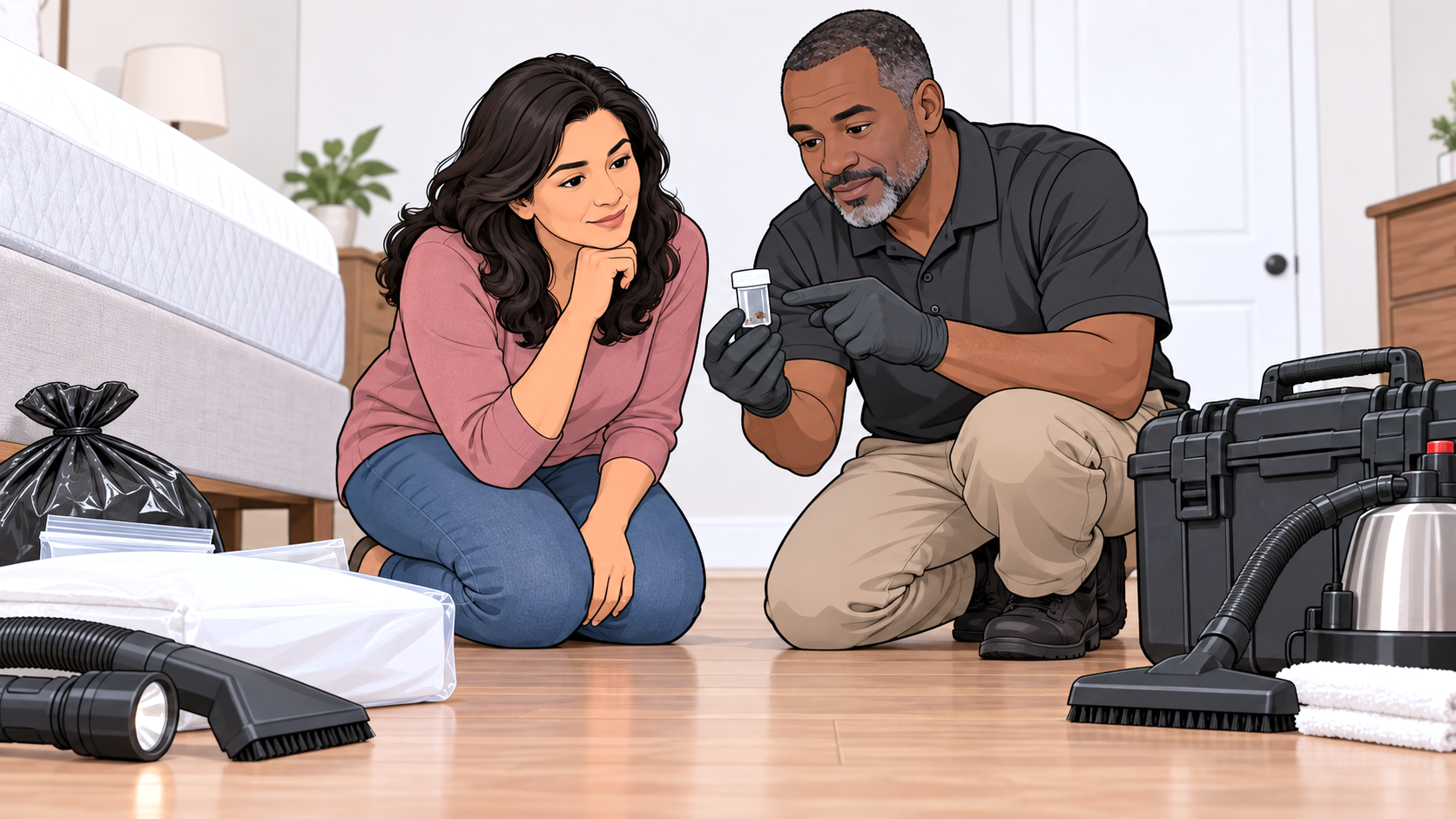
Yes, it is possible to get rid of bed bugs without hiring an exterminator, particularly when an infestation is detected early and the people involved can carry out a thorough treatment plan. However, DIY control becomes much harder as the infestation grows, clutter increases, neighboring units become involved, or treatment isn’t followed consistently.
The EPA doesn’t present DIY bed bug control as a simple matter of choosing the right spray. It emphasizes inspection, preparation, treatment, monitoring, and repeated follow-through.
What Determines Whether DIY Bed Bug Treatment Can Work?
The EPA identifies several factors that affect the likelihood of successfully eliminating bed bugs yourself. These include the extent of the infestation, how much clutter provides hiding places, whether neighbors also have bed bugs, and whether everyone in the household or building participates.
Those factors help explain why the same DIY methods can produce very different results in different homes.
A small infestation concentrated around one sleeping area is generally easier to locate and treat than bed bugs established throughout several rooms. Likewise, reducing unnecessary clutter makes inspection and treatment easier because fewer protected hiding places remain.
Consistency matters just as much. Bed bug control usually requires more than one action, so stopping after the first apparent improvement can leave surviving insects or eggs behind.
Can Nonchemical Bed Bug Treatment Work?
Research shows that nonchemical methods can sometimes eliminate low-level infestations, but the evidence needs to be interpreted carefully.
A field study involving a 223-unit apartment building compared several approaches to bed bug management. Researchers used methods including vacuuming, steaming, mattress encasements, laundering, installing interceptors, and removing heavily infested furniture when necessary.
Some lightly infested apartments were successfully cleared using nonchemical measures.
However, this wasn’t the equivalent of residents simply treating their apartments themselves. Trained researchers and pest management personnel inspected apartments and carried out or supervised repeated interventions. The study therefore demonstrates that carefully implemented nonchemical control can work against some low-level infestations, not that every light infestation can easily be eliminated without professional assistance.
The study also documented resident noncooperation as one factor contributing to unsuccessful treatment in some apartments.
Apartments Are More Complicated Than Single-Family Homes
Bed bugs can move between apartments through structural openings and shared walls, making multi-unit housing particularly challenging.
Treating one apartment while an adjoining unit remains infested can allow bed bugs to be reintroduced. Management may therefore need to inspect neighboring units and coordinate treatment across several apartments.
This is one reason bed bugs spreading between apartments require a different approach from an isolated infestation in a detached house. If multiple apartments are affected, building management and a pest management professional may be better positioned to coordinate inspection, treatment, and follow-up than individual residents acting independently.
Household Cooperation Can Affect Treatment
Bed bug treatment often involves changes throughout the affected living space. Depending on the treatment plan, residents may need to provide access for inspection, reduce clutter, process clothing and bedding correctly, avoid moving infested belongings, and maintain monitoring devices.
If those steps are carried out in one bedroom but ignored in another affected area, hidden bugs can survive.
Cooperation becomes especially important in shared homes and apartments because one person’s actions can affect other rooms or units. Moving untreated belongings, for example, can transport bed bugs into previously unaffected areas.
However, living alone doesn’t automatically make DIY treatment easy. It removes the need to coordinate with other household members, but infestation size, clutter, treatment technique, adjoining apartments, and the ability to find harborages still matter.
When Is DIY Bed Bug Treatment Most Realistic?
DIY treatment is more realistic when the infestation appears limited, you can thoroughly inspect the affected areas, clutter is manageable, and you’re able to carry out multiple control measures consistently.
An integrated approach may include vacuuming, laundering and heat-treating suitable items, mattress and box-spring encasements, interceptor traps, steam where appropriate, and correctly labeled pesticides when needed.
Don’t judge the infestation solely by the number of bugs you’ve personally seen. Bed bugs spend much of their time hidden, so several sightings don’t provide a reliable population count.
Continued monitoring is particularly important. If activity persists despite correctly performed treatment, appears in additional rooms, or repeatedly returns after initially declining, the infestation may be beyond what your current DIY approach is accomplishing.
When Should You Call a Professional?
Professional help becomes increasingly useful when bed bugs are widespread, several rooms are involved, the infestation has persisted despite treatment, neighboring apartments may also be infested, or you’re unable to inspect and treat all relevant areas safely.
A professional also has access to inspection experience, commercial equipment, and treatment options that may not be practical for homeowners.
Hiring an exterminator still doesn’t eliminate the resident’s role. Preparation and cooperation may remain necessary, and follow-up may be required depending on the treatment.
If you’re deciding whether the infestation has reached that point, when to call an exterminator for bed bugs covers the situations where professional treatment becomes particularly useful.
Questions About DIY Bed Bug Treatment
Can a small bed bug infestation be treated yourself?
Potentially. Low-level infestations are generally more manageable than widespread ones, and research has shown that intensive nonchemical methods can eliminate some lightly infested apartments. Success still depends on finding the affected areas, applying the methods correctly, and continuing to monitor afterward.
Does living alone make DIY treatment easier?
It can make coordination easier because only one person’s cooperation is required. It doesn’t change the difficulty created by a large infestation, excessive clutter, hidden harborages, or neighboring infestations in multi-unit housing.
Can you start with DIY treatment and hire an exterminator later?
Yes. However, don’t continue repeating an ineffective DIY treatment indefinitely. Persistent sightings, expansion into additional rooms, or continued activity despite correctly performed treatment are reasons to reconsider the approach.
How do you know whether an infestation is light?
There isn’t a universal household threshold based simply on how many bed bugs you’ve seen. Professional and research settings can use monitoring results and systematic inspections to estimate infestation level, but casual sightings alone aren’t reliable enough to classify an infestation confidently.