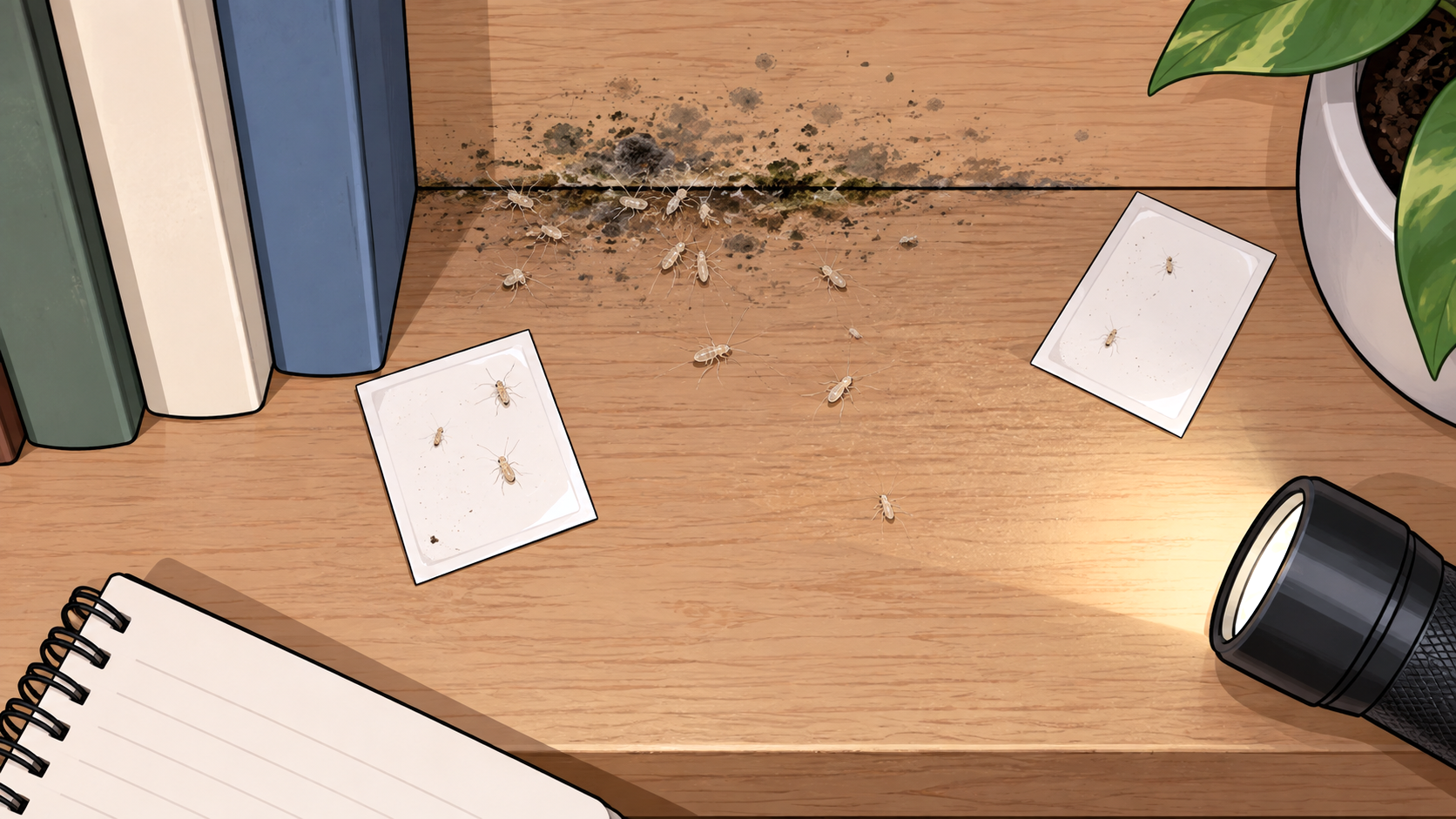
Booklice traps sound like an easy solution. Put down a sticky trap, wait for the tiny insects to wander onto it, and eventually the infestation should disappear. The problem is that trapping a few booklice and controlling the population are not the same thing. Booklice traps can catch individual insects and may help with monitoring, but ordinary traps are not a reliable way to eliminate a household infestation. Research on stored-product psocids shows that trapping and attractants have potential for monitoring, but effective booklice management in homes still centers on reducing moisture and removing favorable conditions.
Sticky Traps Can Catch Booklice
A booklouse that walks across a sufficiently sticky surface can become trapped. That makes glue traps potentially useful when you are trying to determine whether booklice are still active in a particular area.
Placement matters because booklice are strongly associated with damp, undisturbed locations. A trap placed randomly in the middle of a dry room may tell you very little about insects living around a damp windowsill, cabinet, wall junction, or storage area.
Their tiny size creates another problem. Adult indoor booklice are commonly only around 1 to 2 millimeters long, so anything caught on a glue trap needs careful identification. A tiny pale speck is not automatically a booklouse. Springtails, mites, and other small arthropods can occur in some of the same environments.
For that reason, we see ordinary sticky traps primarily as monitoring tools, not treatment.
Traps Do Not Reach the Source of a Booklice Problem
Catching adults does not change the conditions allowing the rest of the population to survive.
Indoor booklice commonly occupy humid places where molds and fungi provide food. They may be concealed among cardboard, paper, stored products, cracks, damp building materials, or other protected locations. Reducing indoor moisture is the most effective household control method, and insecticides are normally unnecessary.
A trap cannot lower humidity, dry damp materials, stop condensation, repair a leak, or remove fungal growth. It also cannot capture insects that never encounter its adhesive surface.
This explains why a trap can accumulate booklice while the infestation continues nearby. The trap is removing a small sample from an environment that remains suitable for reproduction.
If catches continue, investigate where the booklice are coming from rather than simply adding more traps.
There Is Research on Attracting Booklice to Traps
Trapping becomes more interesting when an attractant is added.
Researchers studying stored-product psocids have tested substances including grains, wheat germ, grain oils, commercial lures, and brewer’s yeast. In one study involving six psocid species, brewer’s yeast produced the strongest or among the strongest responses, although responses differed considerably among species.
That research supports the possibility of better psocid monitoring systems. It does not establish a household brewer’s-yeast trap as a proven way to eradicate booklice.
The distinction is important because these experiments primarily concern psocids associated with stored commodities. Booklice is a broad common name rather than a single species, and many indoor booklice belong to the genus Liposcelis. Attraction observed in one species, environment, or experimental setup should not automatically be applied to every household population.
Research has also examined light. A USDA-supported study investigated light attraction in Liposcelis bostrychophila, a major stored-product psocid. Again, species-specific attraction does not mean a generic household light trap is an established booklice treatment.
Pheromone Traps Are Not the Booklice Equivalent of Pantry-Moth Traps
Some household pests have highly developed commercial monitoring systems. Pantry moths are a familiar example, with species-specific pheromone lures used to attract particular insects.
Booklice are different.
Research into stored-product psocids has repeatedly described limitations in available trapping and monitoring tools. USDA research evaluating possible attractants found promising responses to brewer’s yeast, wheat germ, and wheat germ oil, while noting the need for improved psocid monitoring tools.
That evidence does not support treating a generic insect pheromone trap as a booklice trap. A lure designed for moths, beetles, cockroaches, or another pest should not be expected to attract booklice simply because all of them are insects.
Homemade Booklice Traps Have an Evidence Problem
Online trap ideas can involve vinegar, sugar, yeast, wet paper, tape, or combinations of household ingredients. Some may physically capture insects that happen to encounter them, but that is different from demonstrating reliable population control.
We would not deliberately create a damp food-based trap in an area with booklice. These insects already benefit from moisture, and mold and fungi are important booklice food sources. Adding damp organic material to attract them works against the environmental changes normally recommended for control.
Brewer’s yeast deserves a little more nuance because experimental research has demonstrated attraction in several stored-product psocid species. However, turning that observation into an improvised household recipe requires assumptions about trap design, quantity, placement, species response, and effectiveness that the research does not establish.
A plain monitoring trap avoids those complications.
Where a Sticky Trap Can Actually Be Useful
Traps make the most sense when you use them to answer a question.
Suppose you have been finding booklice around one side of a basement. After correcting a condensation problem and running a dehumidifier, strategically placed sticky traps could provide another way to watch for continued activity. Falling catches would be useful information alongside direct inspection, while continued catches would justify another search for moisture or infested material.
This can be particularly useful because booklice can be difficult to notice at their normal size. A trap creates a fixed surface that can be inspected carefully rather than relying entirely on seeing tiny insects moving across a wall.
For simple household monitoring, place traps only where they will not create a hazard for children or pets and where the adhesive will not damage surfaces. Check them regularly and replace them when dust, debris, or loss of adhesion makes them ineffective.
A Dehumidifier Does More Than a Trap
If you are deciding where to spend money, we would put a dehumidifier ahead of a collection of booklice traps when excessive humidity is present.
Booklice depend heavily on moisture. Household guidance consistently recommends reducing humidity, with levels below roughly 45 to 50% becoming unfavorable for psocids. Clemson similarly recommends reducing relative humidity below 50% while correcting leaks and other moisture problems.
A dehumidifier tackles the conditions supporting booklice throughout the affected space. A trap affects only insects that physically encounter it.
Vacuuming visible insects, discarding badly affected disposable materials, increasing airflow where appropriate, and correcting the moisture source complete the basic approach. Even pesticide treatment is often unnecessary. University of Georgia guidance lists no pesticide product for indoor booklice and identifies humidity reduction as the ultimate remedy for infestation.
Use Booklice Traps to Monitor, Not to Solve the Infestation
A sticky trap has a legitimate place in booklice management, but it is a small one.
Use traps when you want to confirm continued activity, compare activity between locations, or monitor an area after moisture correction. Do not expect them to intercept enough insects to overcome a damp environment that continues supporting the population.
If booklice keep appearing, check humidity and look for condensation, leaks, damp cardboard, stored food problems, mold, or moisture trapped in building materials. The broader approach to getting rid of booklice is built around removing those conditions rather than trying to catch every insect individually.
More Questions About Trapping Booklice
Can double-sided tape catch booklice?
It can physically trap a booklouse that walks onto a sufficiently adhesive surface, but that does not make double-sided tape a validated booklice control method. Adhesive can also damage paint, finishes, paper, and other surfaces, so a purpose-made monitoring trap is more practical.
Should I put sticky traps near my books?
They can be placed nearby for monitoring if the location is safe for the books and surrounding surfaces. Avoid attaching adhesive directly to books. Finding repeated activity around a collection should prompt an investigation into preventing booklice in books, particularly humidity and damp storage conditions.
Will yellow sticky traps attract booklice?
Do not assume they will. Yellow sticky cards are designed around the visual behavior of particular plant pests, while attraction in psocids varies by species. Research into booklice trapping has investigated specific food odors and light responses rather than establishing ordinary yellow cards as a universal booklice attractant.
Can traps tell me whether all the booklice are gone?
Not conclusively. An empty trap means no booklice were captured during that period, not that none remain elsewhere. Combine trap results with direct inspection and continued moisture control before deciding the problem has ended.
Are traps better than spraying booklice?
They serve different purposes, but neither addresses excessive humidity. For most household infestations, environmental control should come first. If chemical treatment is being considered after the moisture problem has been corrected, the spray or insecticide must be appropriate for booklice and the intended treatment site.