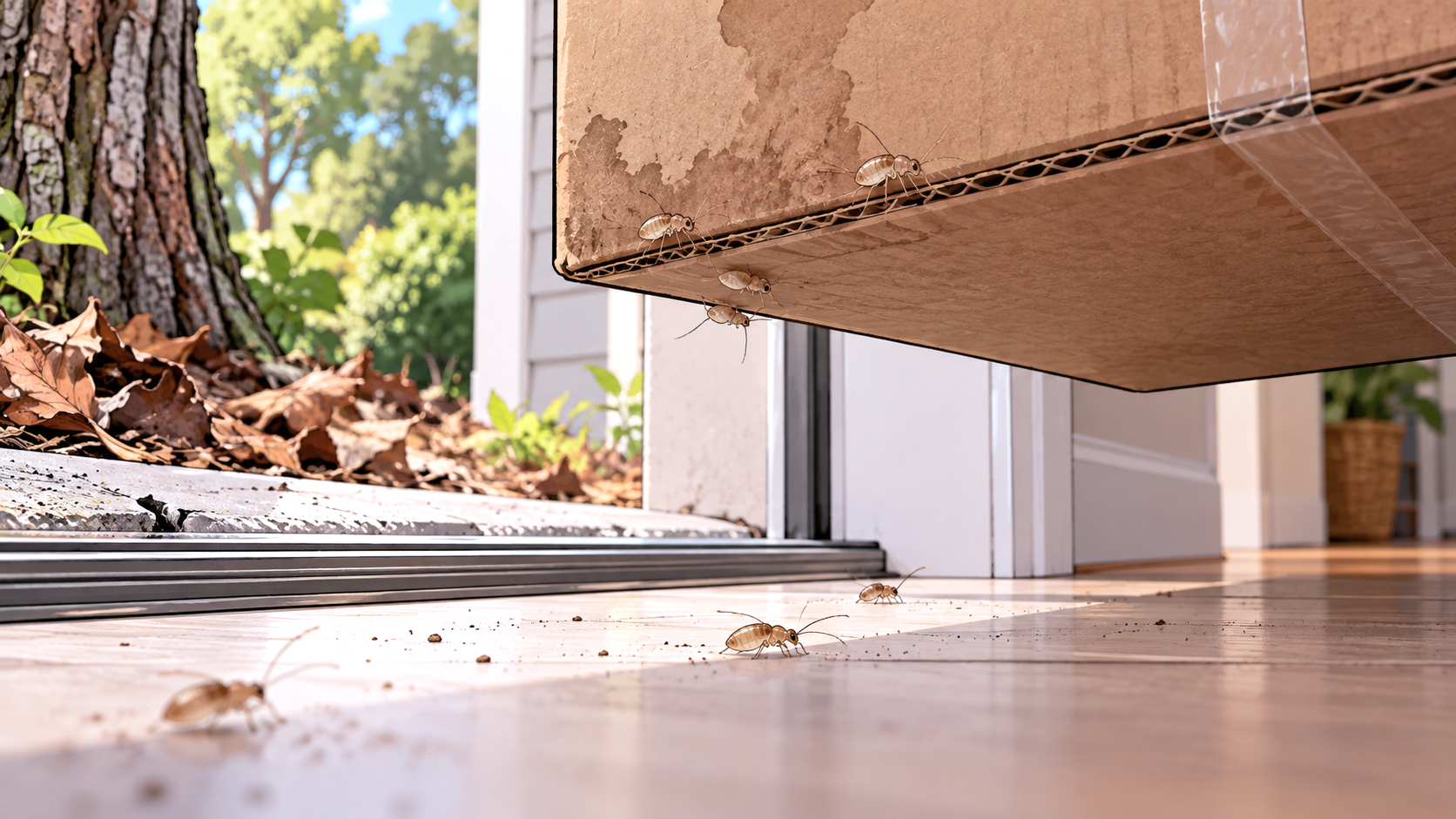
Booklice can seem to appear from nowhere. One week you see nothing, and the next there are tiny insects crawling around a bookshelf, pantry, bathroom, windowsill, or newly finished wall. They did not develop from mold or suddenly appear because a room became humid. Booklice come from existing populations and can enter buildings from outdoors or arrive unnoticed with things brought inside.
Booklice can come from outdoors or be carried inside with cardboard boxes, books, stored foods, packaging, building materials, and other belongings. Once inside, a few unnoticed insects can multiply if they find enough humidity and fungal food. That is why an infestation may appear suddenly even though the original booklice arrived much earlier.
In many cases, you will never determine exactly how the first booklouse entered your home. Finding out why the insects were able to stay and reproduce is usually much more useful.
Booklice Exist Naturally Outside Your Home
Booklice belong to a larger group of insects called psocids. Although we tend to associate the name with books and houses, most psocids live outdoors. They can occur on tree bark, leaves, shrubs, stones, decaying vegetation, nests, and other places where microscopic fungi and organic material are available.
The insects commonly called booklice indoors are only part of this much larger group. Many household species belong to Liposcelis, although booklice do not have one single scientific name. Outdoor relatives are often called barklice, and some have wings, unlike the wingless Liposcelis species commonly encountered inside buildings.
This outdoor population provides one possible route into a house. Tiny psocids can enter buildings accidentally, particularly when suitable habitats exist immediately outside. However, outdoor movement is not the only explanation because booklice can also travel surprisingly well with objects people move from place to place.
Booklice Can Hitchhike Into Your House
Common household booklice are often only about 1 to 2 millimeters long. At that size, an insect can hide in a fold, seam, crack, package, or pile of material without anyone noticing it.
Cardboard boxes, books, paper products, stored foods, packaging, furniture, and building materials can potentially transport booklice. Some Liposcelis species are particularly well known as stored-product pests and occur in food-storage and processing environments around the world.
This helps explain how booklice can turn up in places where you have never noticed them before. They do not necessarily have to crawl all the way into the building from the yard. People can unknowingly transport them.
Arrival alone, however, does not create a lasting infestation. A booklouse brought into a dry, unsuitable room may never establish a population. The bigger change occurs when it lands somewhere that provides the moisture and food it needs.
Humidity Does Not Create Booklice
The connection between booklice and humidity is strong enough to create a common misunderstanding. People sometimes discover tiny insects after a room becomes damp and conclude that the moisture somehow produced them.
It did not. Every booklouse ultimately comes from another booklouse. Adults reproduce, eggs hatch, nymphs develop, and another generation follows through the normal booklice life cycle.
Humidity determines whether those insects have a good chance of surviving. Booklice depend heavily on atmospheric moisture, and damp conditions also encourage the microscopic fungi that provide much of their food. Household populations are consequently associated with warm, damp, protected places where fungal growth can develop.
A few booklice may have been present without attracting any attention. Once humidity becomes favorable, that small population can begin reproducing successfully and become much easier to notice.
Booklice Do Not Come From Mold
Mold does not transform into booklice either. The two are separate organisms with an ecological relationship.
Booklice feed heavily on microscopic molds and fungi. Damp cardboard, paper, building materials, stored foods, and other surfaces can develop fungal growth that is barely visible or completely invisible to us. Booklice can exploit that food even when you cannot see a fuzzy patch of mold.
This is why the insects are strongly associated with moisture-damaged environments. High moisture can help booklice survive while simultaneously increasing the amount of fungal food available to them. Stored-product infestations are also more common in high-moisture commodities contaminated with mold.
So when booklice appear alongside mold, the mold did not produce the insects. It helped create an environment where existing booklice could thrive. Their tendency to eat mold helps explain why the two are so often found together.
Some Booklice Can Arrive With Stored Food
A pantry infestation can genuinely begin with a product brought into the house.
Several Liposcelis species infest stored grain and processed foods. Because booklice and their eggs are so small, they can be difficult to detect before a product reaches your kitchen. They may be present within the food itself, around packaging, or elsewhere in the storage environment.
Finding numerous booklice directly inside flour, cereal, grain, or another stored product makes that item particularly suspicious. The insects may have arrived with it, although it is also possible for an existing household population to move into suitable food after the product has been stored.
Moisture again influences what happens next. Stored-product psocids are especially successful when conditions provide enough humidity for survival and fungal growth. A contaminated product kept under favorable conditions can therefore support continued reproduction instead of remaining an isolated introduction.
Cardboard Boxes Can Be Part of the Problem
Cardboard is another plausible way for booklice to move between places. Boxes pass through factories, warehouses, delivery vehicles, storage rooms, garages, basements, and homes, giving tiny insects plenty of opportunities to travel unnoticed.
The cardboard becomes even more relevant after it gets damp. Wet cardboard can support fungal growth and provides numerous folds, seams, and protected spaces where tiny booklice can hide. Household psocids are known to become troublesome around wet stored cardboard and other damp materials.
A stack of boxes sitting on a humid basement floor can therefore play two roles. It may help transport booklice into the building, and it can later provide a suitable place for them to survive.
That does not mean every delivery box should be treated as contaminated. Dry cardboard is not automatically a booklice source. Persistent dampness is what makes stored cardboard much more concerning.
Secondhand Books Can Carry Booklice, but Books Are Not Their Original Source
Booklice existed long before printed books, so their name should not be taken literally.
Books can nevertheless transport them. A box of secondhand books stored for months in a humid basement, warehouse, or garage could contain booklice or their eggs. Moving those books can move the insects as well.
Once the books reach another humid environment, the population may continue. Bookbindings, glue, paper, dust, and microscopic fungal growth can provide food and protected spaces, particularly when books remain damp.
This is different from saying that every old book contains booklice or that booklice are primarily paper eaters. Their association with books is strongly connected with moisture, fungi, and suitable starchy materials. Understanding what booklice actually eat makes their unusual name much less mysterious.
Booklice Can Arrive With Building Materials
New homes provide another route that is easy to overlook. Lumber, drywall, cardboard packaging, and other construction materials move through outdoor storage areas, warehouses, trucks, and building sites before becoming part of a finished house. Tiny insects can potentially travel with those materials.
More importantly, new construction can provide excellent conditions for any booklice that are present. Concrete, plaster, drywall compounds, lumber, and other materials can retain substantial moisture while a building dries. If wet materials are enclosed too quickly, protected wall voids may remain humid after the rooms themselves look completely finished.
Booklice are specifically associated with trapped moisture in newly constructed buildings. That does not mean construction materials generate the insects. It means booklice that arrive during or after construction can find an unusually favorable environment in which to reproduce.
This is why booklice in newly built homes are often better understood as a moisture problem than a cleanliness problem.
Booklice Can Spread From One Part of the House to Another
The first place you notice booklice may not be where the population began.
These insects are extremely small and can move through cracks and other protected spaces. A population developing around a damp wall void might eventually produce insects that appear along a baseboard or nearby windowsill. Booklice living around a leaking pipe can wander onto a bathroom counter. Others developing around damp cardboard may begin appearing on the surrounding walls.
This can make the source confusing. Removing every visible booklouse from one surface may accomplish very little if eggs, nymphs, and adults remain in a humid space nearby.
Pay attention to where sightings repeatedly occur. If booklice continually appear around the same cabinet, window, wall, plumbing fixture, or pile of stored material, that pattern may lead you toward the actual habitat.
Why Do Booklice Suddenly Appear in Huge Numbers?
What looks like a sudden invasion can actually be the result of weeks of unnoticed reproduction.
Adult booklice are already difficult to see, and their eggs are even smaller. Young booklice resemble miniature adults and can be particularly pale or nearly transparent. A small population hidden in a wall void, cupboard, cardboard box, or stored product can therefore escape attention.
When temperature, humidity, and food are favorable, development can happen quickly. Some common building species can complete development from egg to adult in less than a month under warm conditions. New adults can then reproduce while earlier adults are still present, allowing generations to overlap.
Eventually the population becomes large enough that insects begin wandering across visible surfaces. To the person living in the house, it looks as though hundreds of booklice arrived at once. In reality, the population may have been building quietly nearby.
Booklice Do Not Come From People
Booklice are not human parasites. They do not live on people, feed on blood, or depend on a human host for reproduction.
A booklouse can accidentally crawl onto your skin, clothing, or hair, especially if you are handling infested material. That does not mean you are carrying a scalp or body infestation. Booklice are environmental insects, and their normal habitat is around suitable damp materials and fungal food.
This is an important distinction from head lice. Human head lice are specialized parasites that live in hair, feed on blood, and attach their eggs to hair shafts. Booklice do none of those things.
If you find a genuine booklouse in your hair, look at the surrounding environment for the source rather than assuming the insects are reproducing on your body.
Pets Are Not the Source Either
Cats and dogs do not maintain booklice infestations in the way animals can carry fleas.
A booklouse might accidentally crawl onto an animal after contact with an infested area, but pets are not the normal habitat or food source for household booklice. These insects are associated with moisture, fungi, stored products, paper materials, and similar environmental resources.
If booklice repeatedly appear around a pet’s bedding, inspect the bedding and the room itself. Damp fabric, moisture beneath a bed, a nearby wall problem, or humid storage could explain the insects without the animal being the source.
Booklice are considered harmless to people and pets and do not bite or transmit disease. Their presence should redirect attention toward the building environment rather than toward treating an animal.
You May Never Know Exactly How the First Booklouse Arrived
Once an infestation has become established, tracing the original insect is often impossible. It might have come through an opening, arrived in a cardboard box, traveled with a stored product, been carried with books, or entered alongside construction materials. Weeks or months later, the insects you see may be several generations removed from the original introduction.
Fortunately, identifying that exact route is rarely necessary for control. What matters is why the population survived.
Booklice need suitable moisture, and indoor populations are strongly associated with damp areas where fungal food is available. If you keep finding them, check relative humidity and inspect for condensation, leaks, damp cardboard, wet building materials, mold, stored-food moisture, and other protected humid spaces. Booklice can be one of the signs of a booklice infestation even when the original entry route remains unknown.
Focus on Why the Booklice Stayed
Booklice ultimately come from other booklice. They already exist outdoors and can be transported indoors with ordinary materials such as stored foods, boxes, books, packaging, and construction materials. Because they are so small, the first few insects can arrive without anyone noticing.
The real infestation begins when those insects find an environment that lets them survive and reproduce. Persistent humidity, damp materials, and microscopic fungal growth can turn a few hidden booklice into a population large enough to suddenly appear on walls, shelves, cupboards, or other visible surfaces.
Instead of spending too much time trying to reconstruct how the first insect entered, investigate what is supporting the population now. Fix leaks, dry wet materials, reduce excessive humidity, inspect contaminated stored products, and address mold-supporting conditions. Removing those resources is central to getting rid of booklice and prevents the next generation from simply replacing the insects you remove.
Other Questions About Where Booklice Come From
Can booklice come through windows?
Booklice and related psocids occur naturally outdoors, so individual insects can enter buildings. Repeated indoor sightings, however, are more important because they can indicate that conditions inside are allowing the insects to survive and reproduce.
Can booklice come from cardboard boxes?
They can potentially be transported with boxes, especially materials that have spent time in humid storage. Damp cardboard can also become a suitable habitat by supporting fungal growth and providing protected spaces.
Can booklice come from food?
Yes. Some Liposcelis species are established stored-product pests and can infest grain and processed foods. Finding numerous booklice directly inside one product makes that product an important place to investigate.
Can booklice come from mold?
No. Mold does not create booklice. Existing booklice reproduce to produce new insects. Mold matters because fungi provide food, while the moisture supporting fungal growth also creates favorable conditions for booklice.
Why do booklice keep coming back after I clean them up?
The insects you can see may be only a small part of the population. If a humid hiding place remains nearby, eggs, nymphs, and adults can continue developing after visible insects have been removed.
4 thoughts on “Where Do Booklice Actually Come From?”