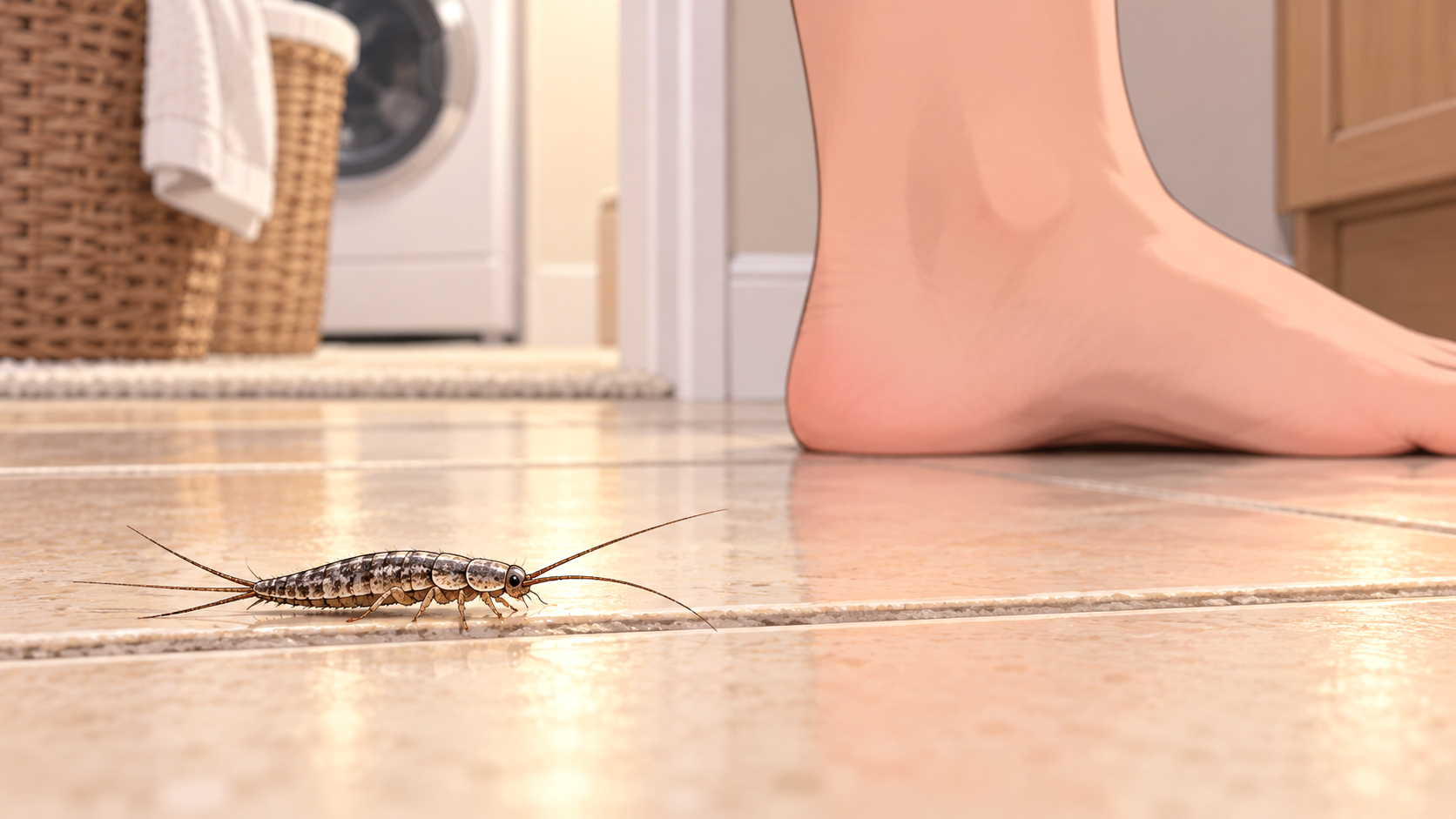
Firebrats do not normally bite people. They have chewing mouthparts, but their jaws are weak and adapted to scraping or removing tiny particles from the materials they eat rather than biting human skin. Their normal feeding behavior is directed at food and other suitable materials, not people.
That distinction is important because saying an insect technically possesses jaws does not mean those jaws function like the biting mouthparts of mosquitoes, fleas, bed bugs, or other insects that deliberately feed on humans. Firebrats are scavenging household insects. When they use their mouthparts, they are typically scraping food from surfaces.
Firebrats Have Jaws, but They Are Very Weak
Firebrats belong to a group of insects with chewing mouthparts. Their mandibles can remove small pieces of material, which is why damaged paper, wallpaper, fabrics, and similar items may show evidence of feeding.
However, those mandibles are weak. Detailed guidance on silverfish and firebrats explains that their mouthparts are used to bite off small particles or scrape surfaces. UC IPM similarly describes both insects as having very weak jaws that scrape rather than bite the surface of paper.
That gives a much clearer picture of what a firebrat’s mouth is designed to do. It can mechanically process the foods the insect encounters, but it is not specialized for piercing skin, drawing blood, or attacking a vertebrate host.
Firebrats Are Not Blood Feeders
Nothing in the normal feeding biology of a firebrat requires a human or animal host. Firebrats forage for foods containing carbohydrates or protein and consume materials such as cereals, flour, paper-associated adhesives, book bindings, household debris, dead insects, fungi, and other suitable foods.
Some of those foods can be surprisingly protein-rich. Firebrats and related bristletails may consume dead insects and other animal-derived material, but that scavenging behavior should not be confused with feeding on a living person. Penn State’s overview of bristletail feeding behavior notes their preference for foods including dried beef, beef extract, and dead insects.
The important distinction is food versus host. A firebrat may eat material derived from an animal, but humans are not hosts that the insect seeks out for a blood meal. Its broader feeding habits are covered separately in what firebrats eat.
Will a Firebrat Bite If You Touch or Pick It Up?
There is no good evidence that firebrats respond to handling by deliberately biting people. Their characteristic response to disturbance is escape.
Firebrats are fast-moving insects that spend much of their time hidden in narrow cracks and crevices. When their shelter is disturbed, they typically dart toward another protected location. Their flattened bodies and rapid movement make fleeing particularly effective.
That behavior also fits their place in the food chain. Firebrats themselves are prey for other arthropods, so avoiding a large approaching animal is considerably more useful than trying to bite it. Their relationships with those predators are covered in what eats firebrats.
Why Does Firebrat Damage Sometimes Get Described as “Bites”?
The word bite can create confusion because pest-control material sometimes uses it to describe how an insect removes pieces from an object. A firebrat can use its chewing mouthparts to bite off tiny food particles, but that is different from saying it bites people.
Paper provides a good example. Firebrats can damage it, yet their jaws are so weak that feeding occurs largely by scraping the surface. With continued feeding, paper and fabrics can eventually develop disconnected, irregular holes.
So both statements can technically appear in descriptions of the insect: firebrats have chewing mouthparts capable of removing material, while firebrats do not normally bite humans. The apparent contradiction disappears once the feeding mechanics are separated from the everyday meaning of an insect bite.
What If You Find a Skin Mark Near a Firebrat?
Finding a firebrat near an unexplained skin mark is not enough to establish that the insect caused it. Firebrats are not recognized as human-feeding insects, so proximity alone is weak evidence of cause.
A more useful approach is to consider other explanations independently rather than starting with the assumption that the firebrat must be responsible. Several household arthropods can interact with people in very different ways, and some skin conditions can also resemble insect-related irritation. For example, bed bug bites and flea bites can be difficult to distinguish from appearance alone, making identification of the actual pest and other surrounding evidence important.
The appearance of alleged firebrat bite marks is a separate identification question and is covered in what firebrat bite marks look like. The broader question of whether firebrats present other risks also belongs separately in are firebrats dangerous.
What Should You Do If You Keep Finding Firebrats?
You do not need to treat repeated firebrat sightings as evidence that something in the house is trying to bite you. Instead, repeated sightings are a reason to determine whether the insects have become established.
Firebrats are nocturnal and usually stay hidden during the day, so recurring sightings can be more useful as evidence of pest activity than as a bite concern. Look for the broader signs of a firebrat infestation and pay attention to where the insects repeatedly appear.
If you are finding them around heating equipment, pipes, ovens, or other consistently warm locations, those conditions may help explain why they are remaining there. Addressing the population itself is more useful than worrying about direct biting behavior.
Questions About Firebrat Bites
Do firebrats suck blood?
No. Firebrats do not have the piercing and sucking mouthparts used by blood-feeding insects. Their mouthparts are adapted for chewing and scraping food materials.
Do firebrats bite pets?
Firebrats are not blood-feeding parasites and are not known for seeking pets as hosts. Their normal feeding behavior is directed toward suitable food materials rather than living animals.
Can a firebrat bite in self-defense?
Reliable entomological sources describe firebrats as fast-moving insects that escape when disturbed rather than as insects that defensively bite people. We could not find evidence supporting defensive biting as a normal firebrat behavior.
Do baby firebrats bite?
Firebrat nymphs are not blood feeders either. Their feeding develops around the same types of suitable food materials used by adults rather than human skin.
Are firebrats the same as fire ants?
No. Firebrats (Thermobia domestica) and fire ants are completely different insects. The similar common names do not indicate similar biting or stinging behavior. Fire ants can bite and then sting, whereas firebrats are small bristletails with weak chewing mouthparts.